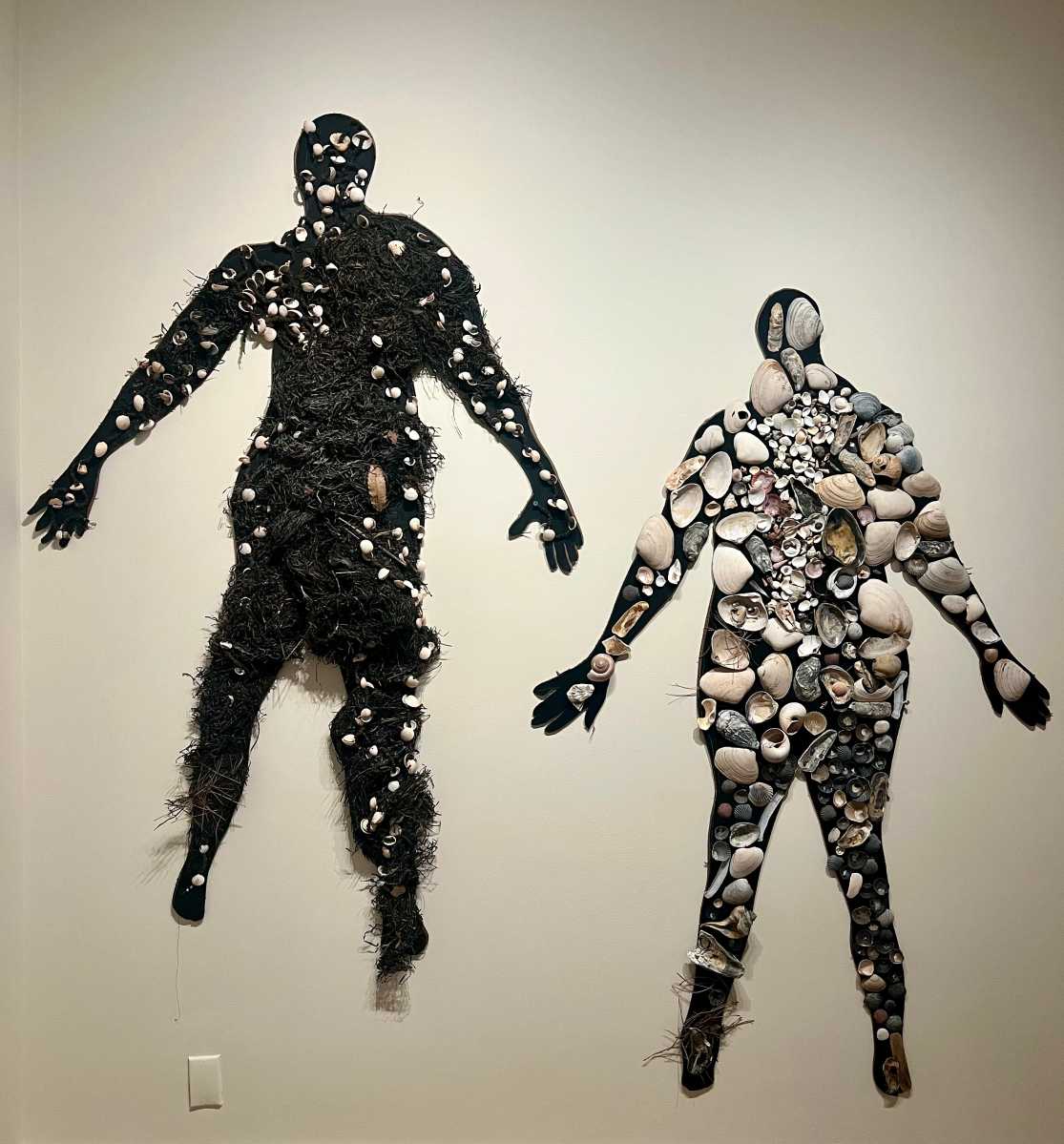
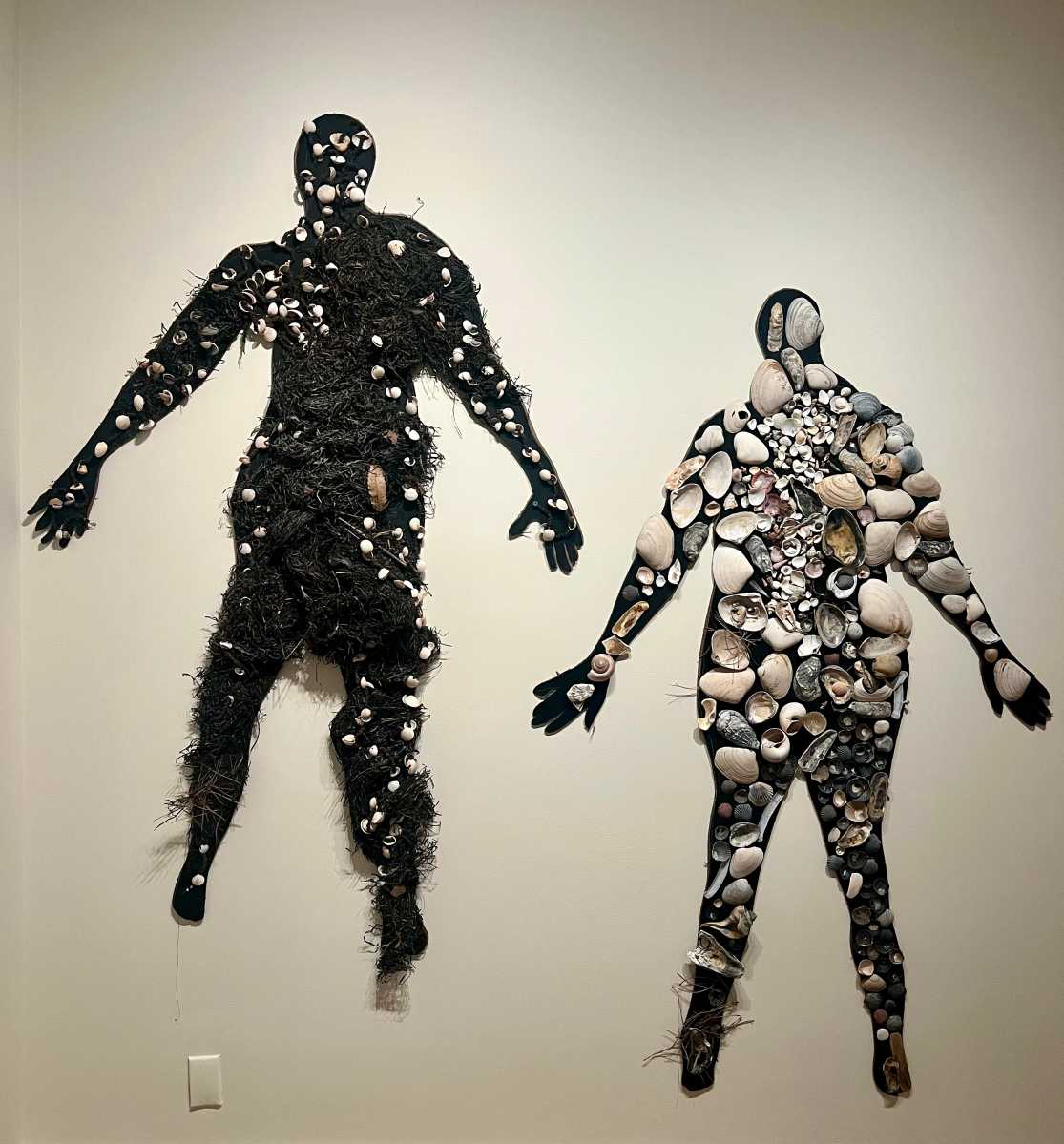
HOMAGE 1 (HOMENAJE 1), 2026.
Pamela Sneed
Pamela Sneed and Carlos Martiel’s joint offering at Leslie-Lohman Museum of Art, “Sacred and Profane,” is a mixed-media exhibition that utilizes beautiful objects to display ugly truths. The exhibition asserts “that to uncover what has been buried is to recover the body as a witness to what was taken and what still remains.”
“Sacred and Profane” is not an easy show to digest for all of us who love Fire Island in the here and now, not excluding the artists themselves. Both have held the innovative BOFFO Residency on Fire Island for LGBTQ+ creatives. Their show presents a conversation between new works from Sneed that excavate the unseen remnants of slave-holding in and near Fire Island, and productions by Martiel exploring his hypervisibility on the island, a queer refuge that can turn uncomfortable for people of color.
Beginning with Sneed, she juxtaposes Fire Island’s serene topography with the historical presence of enslaved persons. In “Homage 1” and “Homage 2,” cardboard silhouettes of Sneed’s own body filled in with pretty seashells and seaweed she plucked off the beach represent unnamed captives of the past.
“The seaweed is symbolic of the debris that may have covered the bodies while in captivity,” she writes.
Similarly, “Invasive Species,” a wall-sized watercolor of Fire Island’s characteristic reedy landscape, is tranquil to behold until you read the message written in barely-visible script on the wall beside it: “Starting around 1799 when New York began phasing out slavery, ‘Blackbirders’ used the Fire Island inlet for a two-way trade, bringing people from the West Indies and kidnapping free northern Blacks to sell south. Physical evidence of this activity includes stockades built on Fire Island near the inlet for temporary holding.”
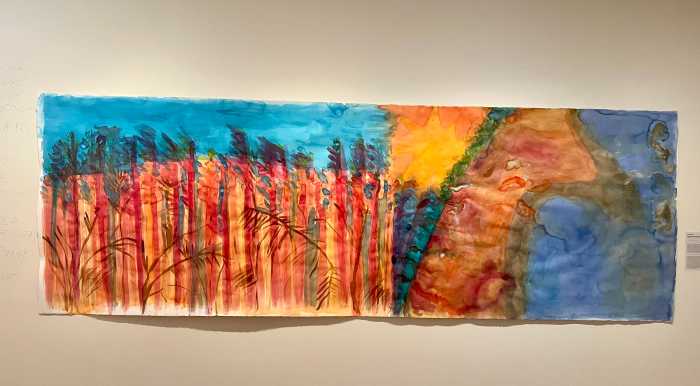 Invasive Species (Especie invasora), 2026.Pamela Sneed
On another wall, Sneed presents a collection of framed works-on-paper drawn on her “research into histories of the slave trade on Long Island.” Given the limited amount of material documentation, the works pose the question: “What constitutes evidence?” Over reproductions of runaway-slave notices published in the “Long Island Star” newspaper in 1814, Sneed has drawn illustrations of George Floyd and Breonna Taylor, the victims of police violence whose 2020 deaths shook the nation. Sneed drew Floyd’s face over a Long Island runaway ad that offered a $20 reward because his killing came about over a $20 counterfeit bill.
“It is ironic that our lives could be seen to have had more value in slavery when slave owners served to protect their investments,” Sneed writes.
This point is further driven home with a selection of disquieting antebellum documents (not all of which are sourced from the Fire Island region), arranged in a vitrine. One is a slave inventory from 1852 among whose human commodities are listed two 80 year-old women, Molly and Lucky, up for sale at 50 cents each. Elderly and far beyond their profit-making reproductive capacity, Molly and Lucky’s commercial value amounts to a single dollar, together.
If this weren’t troubling enough to comprehend, beneath the document itself Sneed posts a note that accompanied it from the manuscript dealer: “Document is nice, clean and on blue legal size paper. Easy to read. Cost is $325. Would you like this?”
Shifting to today, Cuban-born Carlos Martiel critiques the image of Fire Island as an idyll for queer people because for him it has sometimes felt “cannibalistic.”
In “Jungle,” a durational performance piece, Martiel lies naked across two tables in a house on the island, his form covered by a smorgasbord of tropical fruits endemic to Africa, the Caribbean, and Latin America. “The spectators, mostly white homosexual men, are invited to eat,” Martiel explains, “until, through their consumption, my body is revealed.”
In another performance, “Sedimento,” the theme is burial rather than hypervisibility with Martiel’s body being covered rather than exposed. The artist lies on a gallery floor beside a mound of fertile soil. Handful by handful, his mother heaps the soil on top of her son until he is completely covered. She then exits the gallery.
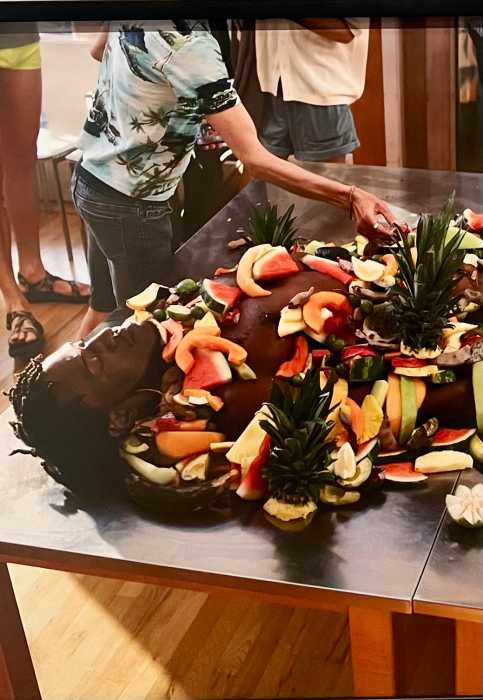 Jungle (Selva), 2024.Carlos Martiel
Martiel’s piece, “Cuerpo,” is a riveting performance in which he remains suspended nude with a noose around his neck while a group of non-Black volunteers work together to keep his body aloft. A clear reference to the history of lynching, its power rests not in the spectacle of Martiel’s stripped and restrained body, but the teamwork required to prevent him from being hanged. As the performance progresses, urgency intensifies and the volunteers struggle to shoulder the responsibility.
Sacred and Profane | Leslie-Lohman Museum of Art | Until April 12
Nicholas Boston, Ph.D., is a professor of media sociology at Lehman College of the City University of New York (CUNY). Follow him on Twitter @DrNickBoston and Instagram @Nick_Boston_in_New York