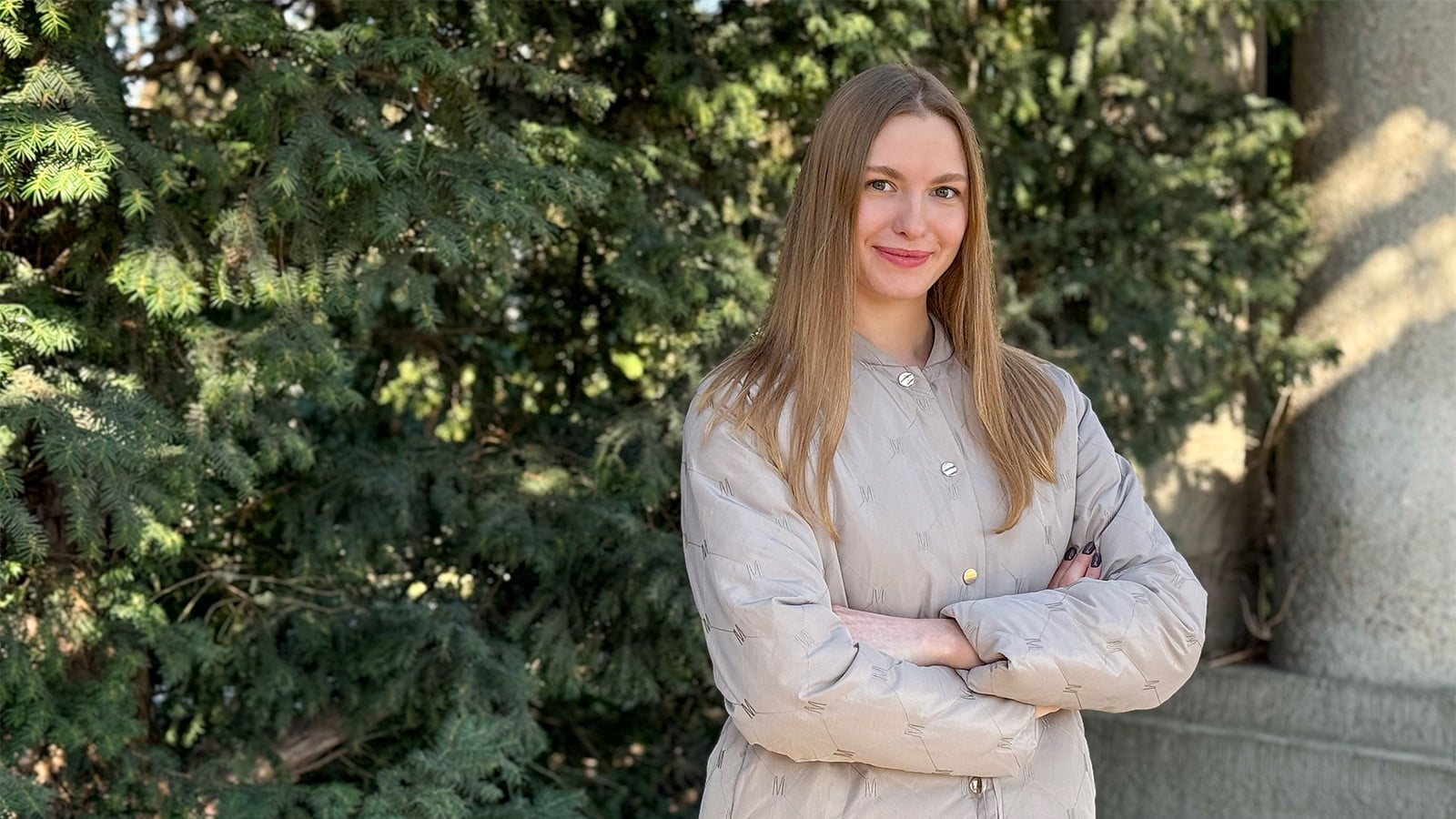
Liza (Yelyzaveta) Mamula was set to fly to Italy for a study term abroad in February 2022 when Russian bombs began to rain down on her home in Kyiv, Ukraine.
It was a rude awakening at 4 a.m. Instead of heading to the airport, she and her parents crammed into their car with the family dog and not much more, fleeing to the border with Poland.
“Half the country was on that road,” she recalls. “It was really scary to drive in the queue because if a bomb fell, there was no way to escape.”
A year and a half later, Mamula sent an email to Carla Prado, University of Alberta Distinguished Professor, Canada Research Chair in Integrative Nutrition, Body Composition, and Energy Metabolism and director of the U of A’s Human Nutrition Research Unit. She hoped to come to Canada to carry on her studies in safety.
From that very first interaction, Prado could sense something rare in Mamula: a clarity of purpose.
“She did not simply express interest in a degree; she expressed a life mission,” remembers Prado. “Despite the unimaginable disruption caused by the war in Ukraine, her message was focused not on loss, but on contribution. She wanted to promote human health through nutritional science.
“More than anything, I saw resilience and courage,” says Prado. “Those qualities matter enormously in research.”
Mamula, now 25, graduates today with her master’s degree in human nutrition. Her role in Prado’s lab had her gathering data and interacting with patients in a major clinical trial on life after endometrial cancer. She leaves the U of A with skills she can take anywhere in the world to carry out that purpose.
More than anything, I saw resilience and courage (in Yelyzaveta). Those qualities matter enormously in research.
Resilience and courage
Mamula’s father was forced to turn back once they got to the Polish border. The border crossing took Mamula and her mother 15 hours of walking, letting women with children go to the front of the line, the dog shaking with fear and the winter cold.
They eventually made it through and headed to her sister’s home in Germany. Mamula was able to take up her studies in Italy, but her mind was constantly on her homeland.
“Inside I was still back in my country, reading all the news and understanding that my father was still there,” she recalls. “You feel guilty that you are not in Ukraine, not supporting people who are there, but this is how it was.”
She returned to Kyiv a year later to collect her degree from Taras Shevchenko National University of Kyiv. She already had an undergraduate degree in dietetics and earned master’s degrees in both laboratory diagnostics and language education while she was in Europe. She had always pictured her life unfolding in Kyiv, but it was not to be, at least for now.
“I came back to Ukraine to defend my thesis and I always wanted to stay in my city, but I understood that my parents still didn’t want me to be in Ukraine,” she says. “There are missiles and bombs coming from the sky. It’s never safe. You could die any time.”
She had heard about the University of Alberta from a fellow classmate. She learned about Carla Prado’s work from an introductory video on the U of A website, then sent her that fateful email. At first the answer was no, because there were no positions for graduate students. But then Prado reached out again.
“I was super happy, shocked, a little bit scared,” Mamula remembers. “She told me the program would be challenging and she might ask a lot from me as a student, but I knew I wanted to work in nutrition and research.”
Mamula’s interest in nutrition started young. She made her first how-to cooking video at the age of seven. Her father was a chef-level home cook who always packed her the healthiest lunches — salads, fish, lots of veggies and nuts. The other students always wanted a taste. Mamula decided her specialty would be desserts — macarons with home-ground almond flour, and paska, a traditional Easter sweet.
She credits a professor at Magna Graecia University of Catanzaro, Italy, for sparking her interest in research. She was there on an Erasmus+ scholarship, sponsored by the European Union. She was given a two-week rotation in many of the science labs there.
“This helped me to understand what people are doing, what research means, what people actually do, how they get to choose the field they like,” she recalls.
Prado helped Mamula secure funding to come to Canada to continue her studies. She received the Babich/Babichuk Memorial Scholarship for Agriculture, which was established in memory of Hnat and Maria Babich and George and Elena Babichuk for students from Ukraine, as well as the Hazel Mclntyre Summer Research Award. She also received a stipend from Carla Prado’s research budget, funded by Alberta Innovates.
“There is no way I could have studied in Canada if I hadn’t received this financial support,” Mamula says.
Discipline, hard work and dedication
After arriving at the U of A in August 2023, Mamula quickly took up her role evaluating dietary intake, body composition and metabolic parameters for participants enrolled in the RESILIENCE Trial.
It was hard but rewarding work, just as she had expected. Along with the scientific evaluations, she was connecting with patients, building empathy for their needs.
“I was really engaged and dedicated to this project,” she explains.
“Liza brought discipline, hard work and dedication,” says Prado. “She approaches science with seriousness, compassion and respect, with genuine care for the individuals behind the data.”
Mamula found a welcoming and supportive community in Edmonton. She joined the U of A Ukrainian Students’ Society and the Edmonton branch of the Ukrainian National Youth Federation. Her project crew of five became “like a family.”
“Our lab environment is intentionally collaborative and close-knit, so she quickly became part of a community rather than feeling isolated,” Prado says. “Sometimes what matters most is knowing that someone believes in you. I made it clear from the beginning that she belonged here.”
Ironically, Mamula faced some health issues of her own, eventually receiving a diagnosis of endometriosis.
“I had chronic pain, and it took a long time to figure out why. I couldn’t find answers, so I could understand what the women in our study go through,” she says.
Despite all that, she felt supported at every stage.
“I had some struggles, but if I had a question I would always get an answer,” Mamula recalls. “I felt safe at the University of Alberta.”
Since finishing her studies in Edmonton, Mamula has moved to Kraków in Poland, as the war continues in Ukraine. Her fiancé, Vlad, also Ukrainian, did his undergraduate and master’s studies in that country. They hope to marry this summer.
Her parents, reunited in Kyiv, are a 12-hour train ride away, and it is tempting to return.
“Life is going on in Kyiv. Theatres are working, cinemas are working, cafes are working, even though there is no light because most of the power stations were targeted,” she explains.
Mamula plans to learn Polish as soon as she can. She is teaching English and is about to begin a naturopathy course. She is also looking for work as a researcher, possibly for a pharmaceutical company or in a clinical setting.
Prado predicts a bright future for her graduating student, who developed not only technical skills but also confidence during her time at the U of A.
“She arrived as a talented student displaced by war,” Prado says. “She graduates as a scientist with international experience, resilience and a great contribution to be proud of.”