Lobstein T, Jackson-Leach R, Moodie ML, Hall KD, gortmaker SL, Swinburn BA, et al. Child and adolescent obesity: part of a bigger picture. Lancet. 2015;385:2510–20. https://doi.org/10.1016/S0140-6736(14)61746-3.
Kumar S, Kelly AS. Review of childhood obesity: from epidemiology, etiology, and comorbidities to clinical assessment and treatment. Mayo Clin Proc. 2017;92:251–65. https://doi.org/10.1016/j.mayocp.2016.09.017.
Smego A, Woo JG, Klein J, Suh C, Bansal D, Bliss D, et al. High body mass index in infancy may predict severe obesity in early childhood. J Pediatr. 2017;183:87–93.e1. https://doi.org/10.1016/j.jpeds.2016.11.020.
Adise S, Rhee KE, Laurent J, Holzhausen EA, Hayati Rezvan P, Alderete TL, et al. Limitations of BMI z scores for assessing weight change: a clinical tool versus individual risk. Obesity. 2024;32:445–49. https://doi.org/10.1002/oby.23957.
Freedman DS, Zemel BS, Dietz WH, Daymont C. Screening accuracy of BMI for adiposity among 8- to 19-year-olds. Pediatrics. 2024;154:e2024065960. https://doi.org/10.1542/peds.2024-065960.
Chung S. Body mass index and body composition scaling to height in children and adolescent. Ann Pediatr Endocrinol Metab. 2015;20:125–29. https://doi.org/10.6065/apem.2015.20.3.125.
Alves Junior CA, Mocellin MC, Gonçalves ECA, Silva DA, Trindade EB. Anthropometric indicators as body fat discriminators in children and adolescents: a systematic review and meta-analysis. Adv Nutr. 2017;8:718–27. https://doi.org/10.3945/an.117.015446.
Bibiloni Mdel M, Pons A, Tur JA. Defining body fatness in adolescents: a proposal of the AFAD-A classification. PLoS ONE. 2013;8:e55849. https://doi.org/10.1371/journal.pone.0055849.
Martin-Calvo N, Moreno-Galarraga L, Martinez-Gonzalez MA. Association between body mass index, waist-to-height ratio and adiposity in children: a systematic review and meta-analysis. Nutrients. 2016;8:512. https://doi.org/10.3390/nu8080512.
Maynard LM, Wisemandle W, Roche AF, Chumlea WC, Guo SS, Siervogel RM. Childhood body composition in relation to body mass index. Pediatrics. 2001;107:344–50. https://doi.org/10.1542/peds.107.2.344.
Demerath EW, Schubert CM, Maynard LM, Sun SS, Chumlea WC, Pickoff A, et al. Do changes in body mass index percentile reflect changes in body composition in children? Data from the Fels Longitudinal Study. Pediatrics. 2006;117:e487–95. https://doi.org/10.1542/peds.2005-0572.
Shypailo RJ, Wong WW. Fat and fat-free mass index references in children and young adults: assessments along racial and ethnic lines. Am J Clin Nutr. 2020;112:566–75. https://doi.org/10.1093/ajcn/nqaa128.
Alvero-Cruz JR, Alvarez Carnero E, Fernández-García JC, Barrera Expósito J, Carrillo de Albornoz Gil M, Sardinha LB. Validez de los índices de masa corporal y de masa grasa como indicadores de sobrepeso en adolescentes españoles: estudio Esccola [Validity of body mass index and fat mass index as indicators of overweight status in Spanish adolescents: Esccola Study]. Med Clin. 2010;135:8–14. https://doi.org/10.1016/j.medcli.2010.01.017.
Wells JC, Williams JE, Chomtho S, Darch T, Grijalva-Eternod C, Kennedy K, et al. Body-composition reference data for simple and reference techniques and a 4- Validity of body mass index and fat mass index as indicators of overweight status in Spanish adolescents component model: a new UK reference child. Am J Clin Nutr. 2012;96:1316–26. https://doi.org/10.3945/ajcn.112.036970.
Weber DR, Moore RH, Leonard MB, Zemel BS. Fat and lean BMI reference curves in children and adolescents and their utility in identifying excess adiposity compared with BMI and percentage body fat. Am J Clin Nutr. 2013;98:49–56. https://doi.org/10.3945/ajcn.112.053611.
Hofsteenge GH, Chinapaw MJ, Weijs PJ. Fat-free mass prediction equations for bioelectric impedance analysis compared to dual energy X-ray absorptiometry in obese adolescents: a validation study. BMC Pediatr. 2015;15:158. https://doi.org/10.1186/s12887-015-0476-7.
De Silva MHAD, Hewawasam RP, Lekamwasam S. Concordance between body composition indices measured with dual-energy X-ray absorptiometry and bioelectrical impedance analysis in obese children in Sri Lanka. Int J Pediatr. 2021;2021:6638057. https://doi.org/10.1155/2021/6638057.
Radley D, Cooke CB, Fuller NJ, Oldroyd B, Truscott JG, Coward WA, et al. Validity of foot-to-foot bio-electrical impedance analysis body composition estimates in overweight and obese children. Int J Body Compos Res. 2009;7:15–20.
Lopez-Gonzalez D, Wells JCK, Clark P. Body composition assessment in Mexican children and adolescents. Part 2: cross-validation of three bio-electrical impedance methods against dual X-ray absorptiometry for total-body and regional body composition. Nutrients. 2022;14:965. https://doi.org/10.3390/nu14050965.
González-Ruíz K, Medrano M, Correa-Bautista JE, García-Hermoso A, Prieto-Benavides DH, Tordecilla-Sanders A, et al. Comparison of bioelectrical impedance analysis, slaughter skinfold-thickness equations, and dual-energy x-ray absorptiometry for estimating body fat percentage in Colombian children and adolescents with excess of adiposity. Nutrients. 2018;10:1086. https://doi.org/10.3390/nu10081086.
Bammann K, Huybrechts I, Vicente-Rodriguez G, Easton C, De Vriendt T, Marild S, et al. Validation of anthropometry and foot-to-foot bioelectrical resistance against a three-component model to assess total body fat in children: the IDEFICS study. Int J Obes (Lond). 2013;37:520–26. https://doi.org/10.1038/ijo.2013.13.
Slaughter MH, Lohman TG, Bolieau RA, Horswill CA, Stillman RJ, Van Loan MD, et al. Skinfold equations for estimation of body fatness in children and youth. Hum Biol. 1988;60:709–23.
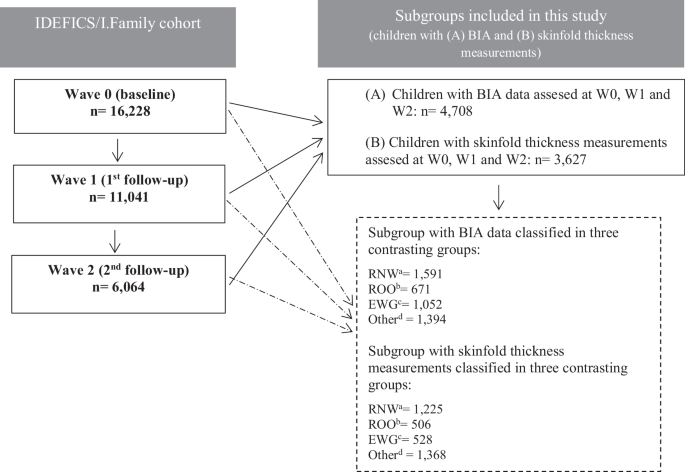
Ahrens W, Bammann K, Siani A, Buchecker K, De Henauw S, Iacoviello L, et al. The IDEFICS cohort: design, characteristics and participation in the baseline survey. Int J Obes. 2011;35:S3–15. https://doi.org/10.1038/ijo.2011.30.
Ahrens W, Siani A, Adan R, De Henauw S, Eiben G, Gwozdz W, et al. Cohort profile: the transition from childhood to adolescence in European children-how I. Family extends the IDEFICS cohort. Int J Epidemiol. 2017;46:1394–5. https://doi.org/10.1093/ije/dyw317.
Cole TJ, Lobstein T. Extended international (IOTF) body mass index cut-offs for thinness, overweight and obesity. Pediatr Obes. 2012;7:284–94. https://doi.org/10.1111/j.2047-6310.2012.00064.x.
Marfell-Jones M, Olds T, Stewart A, Carter L. International Standards for Anthropometric Assessment. Potchefstroom, South Africa: International Society for the Advancement of Kinanthropometry; 2006.
Pigeot I, Baranowski T, De Henauw S. The IDEFICS intervention trial to prevent childhood obesity: design and study methods. Obes Rev. 2015;16:4–15. https://doi.org/10.1111/obr.12345.
United Nations Educational, Scientific, and Cultural Organization (UNESCO) International Standard Classification of Education (ISCED). Montreal: UNESCO Institute for Statistics; 2011.
Marra M, Sammarco R, De Lorenzo A, Iellamo F, Siervo M, Pietrobelli A, et al. Assessment of body composition in health and disease using bioelectrical impedance analysis (BIA) and dual energy X-ray absorptiometry (DXA): a critical overview. Contrast Media Mol Imaging. 2019;2019:3548284. https://doi.org/10.1155/2019/3548284.
Moeng-Mahlangu L, Monyeki MA, Reilly JJ, Kruger HS. Comparison of several prediction equations using skinfold thickness for estimating percentage body fat vs. body fat percentage determined by BIA in 6-8-year-old South African children: the BC-IT study. Int J Environ Res Public Health. 2022;19:14531. https://doi.org/10.3390/ijerph192114531.
Zanini Rde V, Santos IS, Chrestani MA, Gigante DP. Body fat in children measured by DXA, air-displacement plethysmography, TBW and multicomponent models: a systematic review. Matern Child Health J. 2015;19:1567–73. https://doi.org/10.1007/s10995-015-1666-5.
Freedman DS, Wang J, Maynard LM, Thornton JC, Mei Z, Pierson RN, et al. Relation of BMI to fat and fat-free mass among children and adolescents. Int J Obes (Lond). 2005;29:1–8. https://doi.org/10.1038/sj.ijo.0802735.
Vicente-Rodríguez G, Rey-López JP, Mesana M, Poortvliet E, Ortega FB, Polito A, et al. Reliability and intermethod agreement for body fat assessment among two field and two laboratory methods in adolescents. Obesity. 2012;20:221–8. https://doi.org/10.1038/oby.2011.272.
Bammann K, Huybrechts I, Vicente-Rodriguez G, Easton C, De Vriendt T, Marild S, et al. Validation of anthropometry and foot-to-foot bioelectrical resistance against a three-component model to assess total body fat in children: the IDEFICS study. Int J Obes. 2013;37:520–6. https://doi.org/10.1038/ijo.2013.13.
Orta Duarte M, Flores Ruelas Y, Lopez-Alcaraz F, del Toro-Equihua M, Sanchez-Ramirez CA. Correlation between percentage of body fat measured by the Slaughter equation and bio impedance analysis technique in Mexican schoolchildren. Nutr Hosp. 2014;29:88–93. https://doi.org/10.3305/nh.2014.29.1.6992.
Golec J, Kmiotek EK, Czechowska D, Szczygiel E, Maslon A, Tomaszewski KA, et al. Analysis of body composition among children and adolescents – a cross-sectional study of the Polish population and comparison of body fat measurement methods. J Pediatr Endocrinol Metab. 2014;27:603–9. https://doi.org/10.1515/jpem-2013-0427.
Rodriguez G, Moreno LA, Blay MG, Blay VA, Fleta J, Sarria A, et al. Body fat measurement in adolescents: comparison of skinfold thickness equations with dual-energy X-ray absorptiometry. Eur J Clin Nutr. 2005;59:1158–66. https://doi.org/10.1038/sj.ejcn.1602226.
Seo YG, Kim JH, Kim Y, Lim H, Ju YS, Kang MJ, et al. Validation of body composition using bioelectrical impedance analysis in children according to the degree of obesity. Scand J Med Sci Sports. 2018;28:2207–15. https://doi.org/10.1111/sms.13248.
Lopez-Gonzalez D, Wells JCK, Parra-Carriedo A, Bilbao G, Mendez M, Clark P. Body composition assessment in Mexican children and adolescents. Part 1: comparisons between skinfold-thickness, dual X-ray absorptiometry, air-displacement plethysmography, deuterium oxide dilution, and magnetic resonance imaging with the 4-C model. Nutrients. 2022;14:1073. https://doi.org/10.3390/nu14051073.
González-Ruíz K, Medrano M, Correa-Bautista JE, García-Hermoso A, Prieto-Benavides DH, Tordecilla-Sanders A, et al. Comparison of bioelectrical impedance analysis, slaughter skinfold-thickness equations, and dual-energy X-ray absorptiometry for estimating body fat percentage in Colombian children and adolescents with excess of adiposity. Nutrients. 2018;10:1086. https://doi.org/10.3390/nu10081086.
Luque V, Closa-Monasterolo R, Rubio-Torrents C, Zaragoza-Jordana M, Ferré N, Gispert-Llauradó M, et al. Bioimpedance in 7-year-old children: validation by dual X-ray absorptiometry – Part 1: assessment of whole body composition. Ann Nutr Metab. 2014;64:113–21. https://doi.org/10.1159/000356450.
Prins M, Hawkesworth S, Wright A, Fulford AJ, Jarjou LM, Prentice AM, et al. Use of bioelectrical impedance analysis to assess body composition in rural Gambian children. Eur J Clin Nutr. 2008;62:1065–74. https://doi.org/10.1038/sj.ejcn.1602830.
De Henauw S, Huybrechts I, De Bourdeaudhuij I, Bammann K, Barba G, Lissner L, et al. Effects of a community-oriented obesity prevention programme on indicators of body fatness in preschool and primary school children. Main results from the IDEFICS study. Obes Rev. 2015;2:16–29. https://doi.org/10.1111/obr.12346.