Released in 1978 in what was then Czechoslovakia, Beauty and the Beast by director Juraj Herz follows a young woman who, to save her father, agrees to live in the castle of a feared creature, isolated by the local community. In a ruined space that seems suspended between the world of the living and the dead, she encounters a grotesque presence whose initial violence gradually gives way to a disturbing form of coexistence. The plot preserves the basic outlines of the tale, but the script rejects any redemptive sentimentality; there is no return to normalcy, only a slow negotiation between fear, recognition, and closeness.
Made a decade after the Prague Spring and during the period of “political normalization” imposed by cultural conformity, through daily surveillance that transformed difference into a potential deviation from conduct, the film emerges from a context marked by social control and constant distrust toward change. And in this scenario, difference is only tolerated, even with difficulty, and then managed, classified, and, when necessary, removed from the visible field. Herz transposes this contextual atmosphere to the fable and transforms the tale into a somber meditation on the body standard that doesn’t fit, on the community defined by exclusion, and on the symbolic violence that sustains the entire idea of belonging.
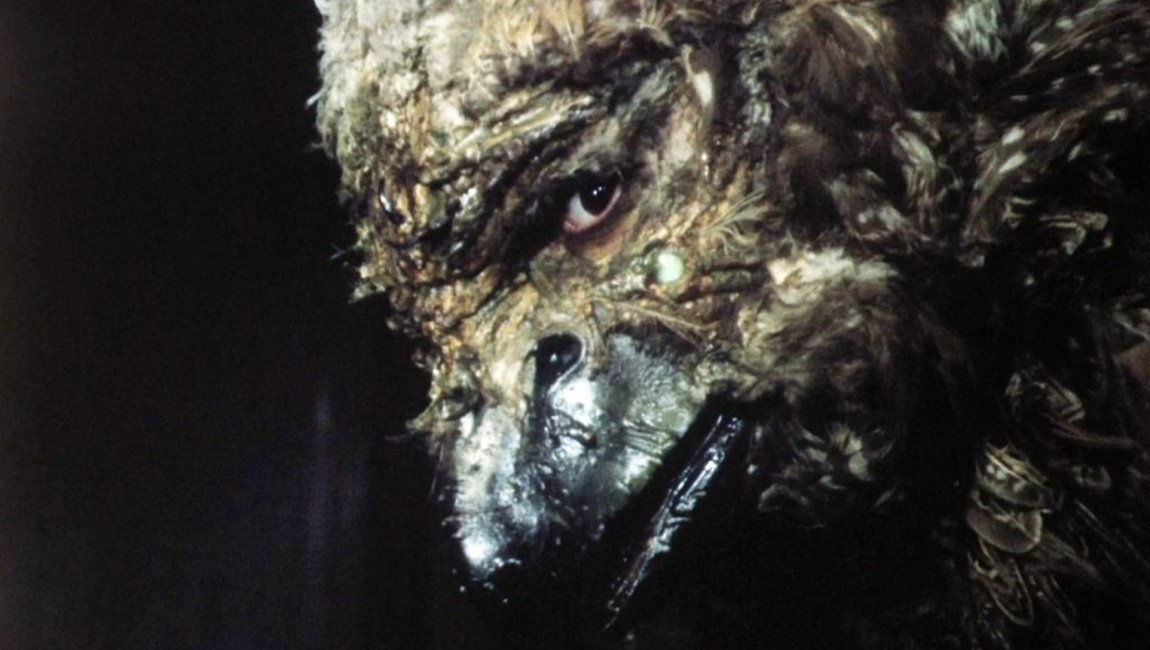
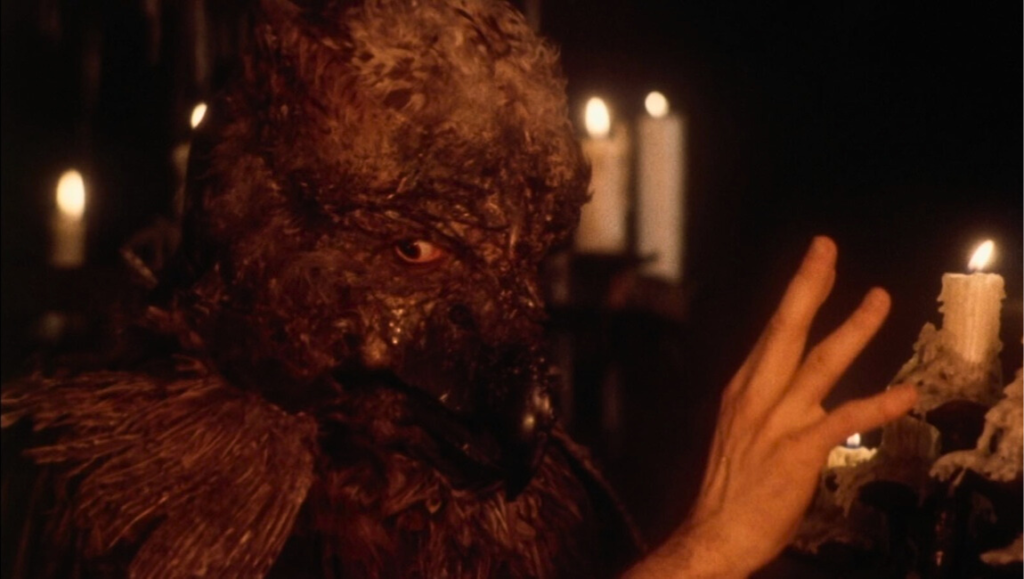
This is how the director removes the sentimental gloss that marked many adaptations of the tale and restores to the narrative its archaic, almost mythological dimension. The Beast is not just a temporarily deformed prince waiting for reintegration into the social order. The painting here is radically different. Its appearance is disturbing: a figure reminiscent of a bird of prey, like a humanoid hawk, with a rigid beak, strangely human eyes, and long, sharp claws that resemble exposed bones at the ends of its limbs. Throughout the film, these claws gradually dissolve, as if contact with the maiden corrodes the very structure of the monstrosity. His body does not suggest a hidden identity that just needs to be revealed; it is an otherness that does not promise assimilation. It’s interesting to note that by refusing the aesthetic domestication of difference, the film shifts the moral axis of the story; now the problem is no longer the monstrous appearance, but rather the way society organizes its imagination to make that appearance intolerable.
 Credit; Barrandov Studios
This narrative construction directly engages with the classical tradition of Eros and Psyche, narrated by Apuleius. In the myth, Psyche is carried by the wind Zephyr to live with an invisible husband who visits her only in the darkness. She loves blindly, unable to confirm if what she fears is also what she desires. The prohibition of the gaze is not just a device, but a reflection on the limits of human knowledge: to love requires accepting the opacity of the other and recognizing that not everything can be fully grasped or dominated. After being tempted and overtaken by curiosity, breaking her beloved’s request not to be seen, Psyche illuminates Eros’ face: her gesture is less betrayal than impulse, reflecting the deeply human need to transform the unknown into something visible, nameable, or classifiable. All for our illusion, the impression of control.
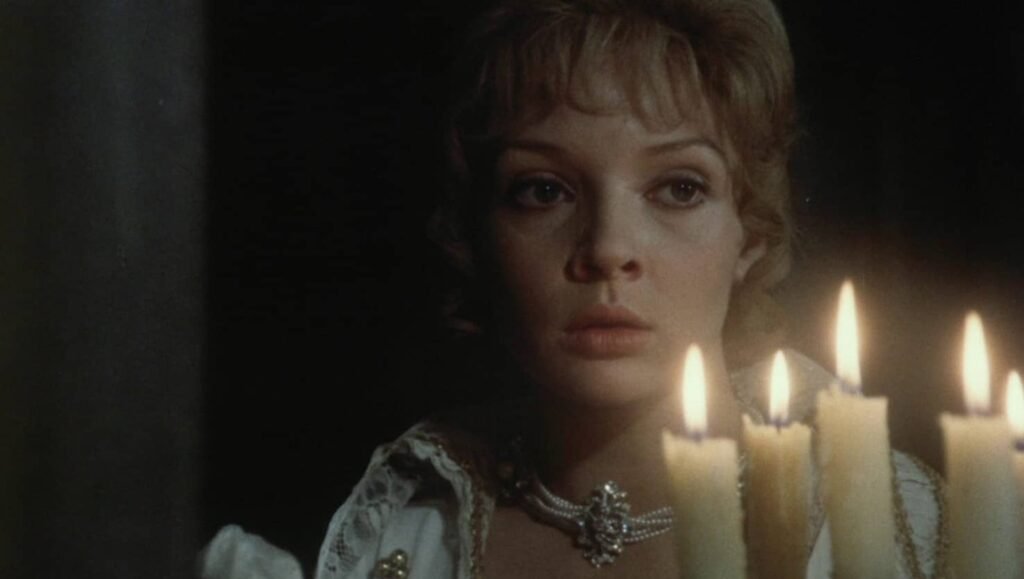
According to Herz, this tension must be exponentially radicalized. The young woman who enters the castle does not find an enchanted space as in the myth, but rather a decadent and gloomy organism, almost funereal. The castle goes beyond its role as a setting and takes on the position of a material extension of exclusion. The art direction and cinematography make this very evident when they construct an environment saturated with dense shadows and violent contrasts, evoking chiaroscuro not just as a plastic resource, but as a dramatic strategy: light and darkness cease to model volume to produce meaning. The shadow delineates what can be seen and, above all, what must remain outside the realm of the acceptable. The parallel is unavoidable, for we hide what we repel and reject.
The mise-en-scène now operates as a sociopolitical discourse, especially when the framing insists on the partiality of the vision. Through a deliberate obfuscation, the Beast is rarely presented to the viewer in a full and comfortable manner. Fragments of body, rough textures, low angles, and claustrophobic compositions produce a continuous effect of estrangement. The bizarre exceeds spectacle, becoming a method, as it prevents quick assimilation and forces the gaze to remain in the discomfort that reflects how real societies deal with what threatens their symbolic boundaries. Going further, this refusal of transparency reorganizes the viewer’s perception.
In this way, Herz subverts comfortable conventions by avoiding smooth continuity and classical editing, which would facilitate immediate empathy. The editing establishes an irregular rhythm that mirrors the instability of the bond between the characters, until the melodrama sets in. There is no harmonious integration without friction, and it is precisely in this friction that the film finds its political strength.
The Beast’s body can also be read as a metaphor for the foreigner, the displaced, or the one who does not conform to the community’s homogeneous imaginary. Every social order, regardless of its declared political system, depends on narratives of cohesion, and to sustain such narratives, it is necessary to produce figures of threat, presences that justify vigilance, closure, and exclusion. Monstrosity perfectly fulfills the purpose of this dichotomous and Manichean discourse by attributing grotesque characteristics to the otherness, legitimizing the community’s withdrawal into itself.
 Credit; Barrandov Studios
In the film, the village surrounding the castle is barely shown beyond the first act, and this absence is eloquent. The castle is isolated and the Beast has been pushed out of the visible social space without us knowing the reasons. Reflecting on this, symbolic geography echoes a recurring logic: that which cannot be assimilated is pushed to the margins, to shadowy zones where it ceases to disturb the narrative of normality. High walls, borders, palisades, immigrant detention camps, and exclusion zones may change shape over the course of history, but the imagination that sustains them remains surprisingly constant. Instead of recognizing that identity is always relational, hybrid, and in constant transformation, the community insists on a fixed, unmixed essence. The result is symbolic impoverishment. By expelling difference, society reduces its own capacity to imagine possible futures. The film seems to suggest that the true horror does not lie in bodily difference, but in the collective need to transform it into a threat to preserve a fragile idea of order.
Focusing on the chromatic aspect, the palette denotes this interpretation. Dark, greenish, and earthy tones dominate the castle space, associated with decay and isolation, while the young woman introduces brighter variations that create tension in the atmosphere. This opposition does not resolve into a comfortable synthesis at first, as the coexistence between the two presences generates a transformation through tragic recognition without full assimilation. Love, here, does not erase the difference without confronting it in the depths of the eyes.
If in the myth of Eros and Psyche, the overcoming is achieved through trial and persistence; in Herz, the journey is more ambiguous. The bond between the young woman and the Beast does not culminate in a festive restoration of social order outside the castle walls and the almost secret love between the two protagonists, as it remains marked by the awareness that difference will never be fully absorbed by the dominant imaginary. This refusal, despite the final dreamlike and triumphant sequence, breaks with the consoling logic of the fairy tale and brings the film closer to historical experience, in which communities rarely fully integrate those they once marked as others; at most, they learn to tolerate their presence under fragile treaties. The constructed allegory is powerful against any policy that demands absolute transparency, total assimilation, or the disappearance of what does not conform. Loving the other implies accepting the impossibility of reducing them to familiar categories. Let us remember that systems that do not tolerate this authenticity tend to transform difference into contravention, and contravention into crime.
Beauty and the Beast (1978) transcends the category of a dark adaptation of a fairy tale as it presents an incisive reflection on the mechanisms by which communities construct their boundaries and project their fears. Emerging in a period of ideological control, the film remains disturbingly relevant, in a world that continues to erect bureaucratic forms of borders, some visible, others inscribed in the collective imagination. Perhaps what is shown is more uncomfortable than any monstrosity: the Beast was never just the one who lives in the castle. She is also what a nation needs to invent to recognize itself as pure, cohesive, and threatened. And as long as this need persists, there will always be a designated body to bear claws that are not theirs, until, one day, as we get close enough, we discover that the claws have begun to dissolve into our own hands.