Comprehensive evaluation of research across scientific disciplines will be essential to advancing new discoveries about the relationships between food, nutrition and human health.
That was the message from Kellie Casavale, Ph.D., director of the Agriculture, Food and Nutrition Evidence Center, of Texas A&M AgriLife Research, during the Consumer Federation of America’s National Food Policy Conference in Washington D.C.earlier this month.
Casavale emphasized the importance of bringing together research from multiple scientific fields to strengthen the evidence used to guide decision-makers of nutrition policy and food system decisions.
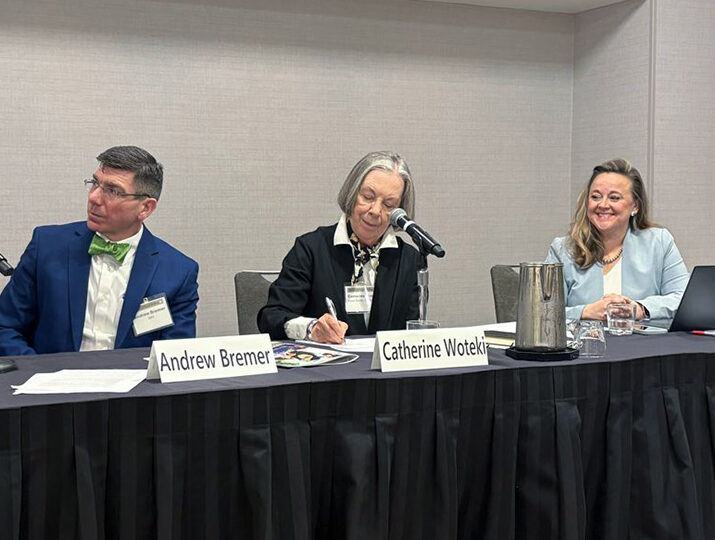
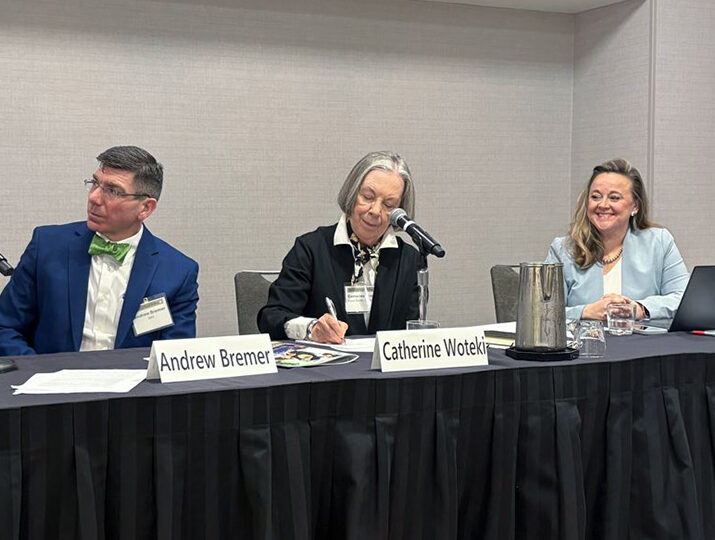 During a panel session at the Consumer Federation of America’s National Food Policy Conference in Washington, Kellie Casavale, Ph.D. (right) stressed the importance of comprehensive evaluation of research across scientific disciplines for advancing discovery. (Texas A&M Agriculture, Food and Nutrition Evidence Center)
The Evidence Center conducts systematic reviews on behalf of decision-making sponsors, like federal agencies, evaluating the state of science to inform their policies, programs and regulations. The center’s mission is to advance scientific understanding of society’s most challenging and vital questions related to the agri-food system and its effects on human, environmental and economic health.
“The Evidence Center’s mandate to develop new methods for multi-disciplinary evidence synthesis was a major reason for me joining as director in 2025,” Casavale said. “Systematic analyses from different disciplines, on equal standards of quality, can provide new and measurable leverage points for policy-makers.”
Sharing expertise in systematic review
Before joining the Evidence Center, over a 20-year career in federal service, Casavale led cross-organizational scientific collaborations and systematic review programs to inform federal research and policy at the U.S. Department of Agriculture, USDA, and the U.S. Department of Health and Human Services, HHS. The systematic review methodologies that continue to inform today’s Dietary Guidelines for Americans were founded during Casavale’s time at USDA.
She spoke during a panel discussion at the food policy conference in March titled “The Future of Nutrition Research.”
Her two co-panelists were Andrew Bremer, M.D., Ph.D., director of the National Institutes of Health Office of Nutrition Research, and Mduduzi Mbuya, Ph.D., director of knowledge leadership at Global Alliance for Improved Nutrition.
The panel moderator was Catherine Woteki, Ph.D., former undersecretary of the U.S. Department of Agriculture’s Research, Education and Economics mission area.
Unbiased, transparent research to inform future nutrition policy
As the discussion came to the topic of nutrition research to guide policy, Casavale highlighted the need for updated scientific data to inform national nutrition guidance, particularly for infants. She pointed out that aging Dietary Reference Intakes, or DRIs, for infants – guidelines for optimal growth and development during the first year of life – are based on evidence that in most cases is over four decades old.
“I don’t think we have a better opportunity than now to focus on infant nutrition,” she said. “Almost all DRIs for infants are Adequate Intakes, which means they are based on observations of what foods seemingly healthy infants ate.”
She stressed that nationally representative data on human milk composition in America does not exist, calling those insights foundational to inform DRIs for infants.
In addition to advancing science, the panel described ways individuals and organizations across the nutrition research community can work together toward transparent evidence that is clear in its applicability to inform policymakers and, in turn, for the food industry.
“I’m excited to be with an organization whose purpose is to conduct independent, rigorous, transparent, reproducible, unbiased evaluations of the state of the science and provide the outputs to decision-makers to use,” Casavale said. “It places us at the leading edge of research and its potential to impact lives.”
The panel closed with a call from Woteki for the nutrition research community to join in clear and broad championing for solutions to today’s most pressing scientific challenges.

Share or print this post: