The American College of Sports Medicine (ACSM) just published its first revision of guidelines for exercise in 17 years, and its conclusions should make you feel pretty encouraged if you feel like working out in big-box gyms or using sophisticated exercise equipment is too intimidating of off-putting.
The over-arching message: You don’t need a lot of gym equipment, if any, to stay healthy provided you are consistently exercising. And by consistenly, that means a total-body workout using whatever resistance equipment you want (or just plain old bodyweight) only twice a week. Not unreasonable, right?
“The best resistance-training program is the one you’ll actually stick with,” said Stuart M. Phillips, a doctor of kinesiology at McMaster University in Hamilton, Canada. “Training all major muscle groups at least twice a week matters far more than chasing the idea of a ‘perfect’ or complex training plan. Whether it’s barbells, bands, or bodyweight, consistency and effort drive results.”
The published conclusion came after compiling data from more than 30,000 participants in 137 reviews.
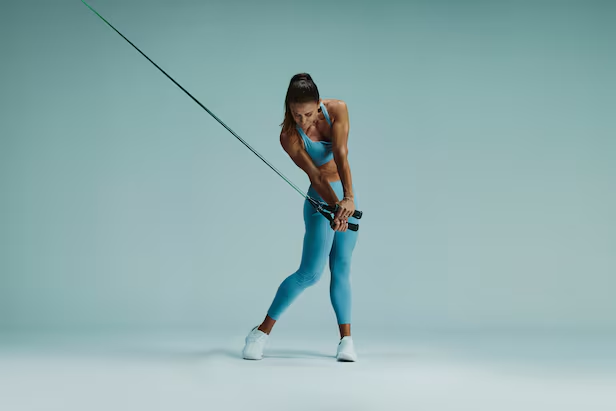
One of the most interesting findings from ACSM was that “non-traditional training is highly effective. Traditional gym settings are not needed to see results. Utilizing tools such as elastic bands, bodyweight exercises, and home-based routines yield marked benefits in strength, hypertrophy and physical function.”
That’s great news for golfers who would rather spend more time on the course or practice area than inside a fitness center. In short, you can get a decent workout at home and pocket the money you would have spent in a commercial gym. Buying some resistance bands costs less than lunch for two at a typical restaurant.
One other thing to note from the study is that you’d be better off not following a scripted program for the masses (think P90x) and instead have a program designed for your individual needs. For golfers, that might be to put an emphasis on resistance training that makes muscles of the legs, hips, chest, shoulders and lower back stronger.
To get a little more granular, the ACSM offers training recommendations based on broader goals: