Checks by The Straits Times in three neighbourhoods found beauty and wellness businesses made up between one-third and half of all shops.
Yuhua Place in Jurong East, like many other HDB precincts in Singapore, conforms to a typical layout – a central market and hawker centre, ringed by about 130 businesses in surrounding blocks.
But where mom-and-pop retail stores once flourished, beauty and wellness offerings now dominate. Today, nearly half the shops around the market are massage parlours, spas or hair salons.
This phenomenon is not limited to Jurong East. Checks by ST show that such businesses are common in neighbourhoods with clusters of privately owned Housing Board shops, where the authorities leave the trade mix to market forces rather than actively curate it.
An HDB spokeswoman said as of January, there were around 15,600 HDB shops, with about 8,500 privately owned and 7,100 rented out by HDB.
She said about 13 per cent of shops rented out by HDB are beauty and wellness establishments, including hair and beauty salons, traditional Chinese medicine (TCM) facilities and massage establishments.
She did not give numbers on the proportion of such establishments among privately owned HDB shops.
But in areas of the three neighbourhoods – Jurong East, Toa Payoh and Tampines – that ST visited between January and March, this proportion was between almost a third to half.
The proliferation of such businesses has sparked debate over the ideal tenant mix in heartland estates and drawn attention to allegations of vice in shops offering massages, as well as to aggressive sales tactics at some salons.
In the three neighbourhoods, these beauty and wellness businesses operate alongside food and beverage outlets, retail shops such as supermarkets, and services like clinics and tuition centres.
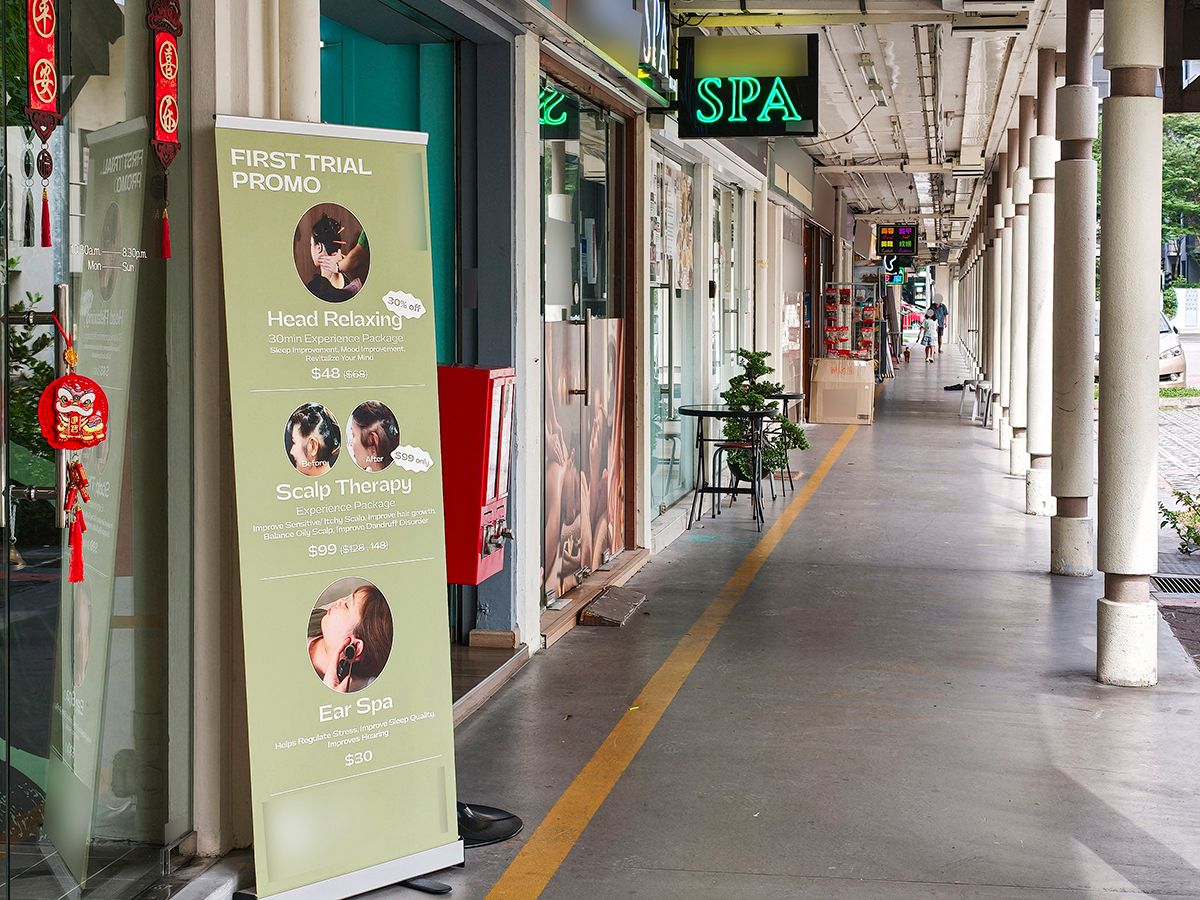 Signs for massage parlours and spas in Toa Payoh Palm Spring. ST PHOTO: BRIAN TEO
This means – regardless of any misgivings over the trade mix – residents in these areas enjoy easy access to essential amenities and daily necessities.
But smaller retail businesses are feeling the squeeze from changing consumer habits, the rise of e-commerce and competition from larger chains.
Ms Cherie Mah, who has owned Omega Minimart in Toa Payoh Palm Spring for more than two years, said: “It’s really hard to get business here, and maybe it’s the location, because there’s a FairPrice here.”
To increase revenue, the 40-year-old has expanded the store’s services. It now offers e-commerce parcel collection and SIM card registration and top-up services.
She pays more than $8,000 a month for rental and utilities – a figure she expects will increase in October when her shop’s current lease expires.
Property analysts told ST that they generally do not track data on the types of HDB shops.
But some have seen an uptick in interest in renting such shops for beauty and wellness trades, and have noticed their prevalence across neighbourhood shop clusters. These include salons, shops offering wellness treatments, and TCM services.
Mr Johnny Chia, senior associate director at real estate agency OrangeTee, said there have been fewer inquiries from those looking to start traditional retail businesses like minimarts or hardware stores in HDB shops.
“At the same time, there has been relatively stronger interest in service-oriented uses, which are less easily displaced by online channels and rely on proximity to residential catchments,” he said.
HDB shop rents are often attractive due to their affordability compared with units in malls, said Huttons Asia senior director of data analytics Lee Sze Teck.
Beauty and wellness offerings are often perceived as more affordable when located in the heartland, said Mr Donald Goh, the director of capital markets and investment sales at ERA Singapore.
He also noted that the businesses may have operating models that generate stronger upfront cash flows, such as selling packages or prepaid services, allowing them to better absorb rental costs than traditional retail shops.
But analysts said current data does not indicate that service-related businesses can afford higher rents than others.
Mr Norris Low, the director of corporate leasing at PropNex, said operators of fruit and vegetable stores, as well as F&B outlets, pay the highest rents among the portfolio of HDB shops the firm manages.
“With experienced landlords, the tenant’s profile is important – whether their business is viable and whether they can pay the rent,” he said, adding that it is therefore not guaranteed that tenants offering the highest rent will secure the space.
When it comes to viability, OrangeTee’s Mr Chia said beauty and wellness businesses may have a competitive edge as their services are typically appointment-based.
This allows for more flexible staffing than other trades, as operators can align working hours with customer demand, he noted, instead of requiring staff to stay throughout the day to serve walk-in customers.
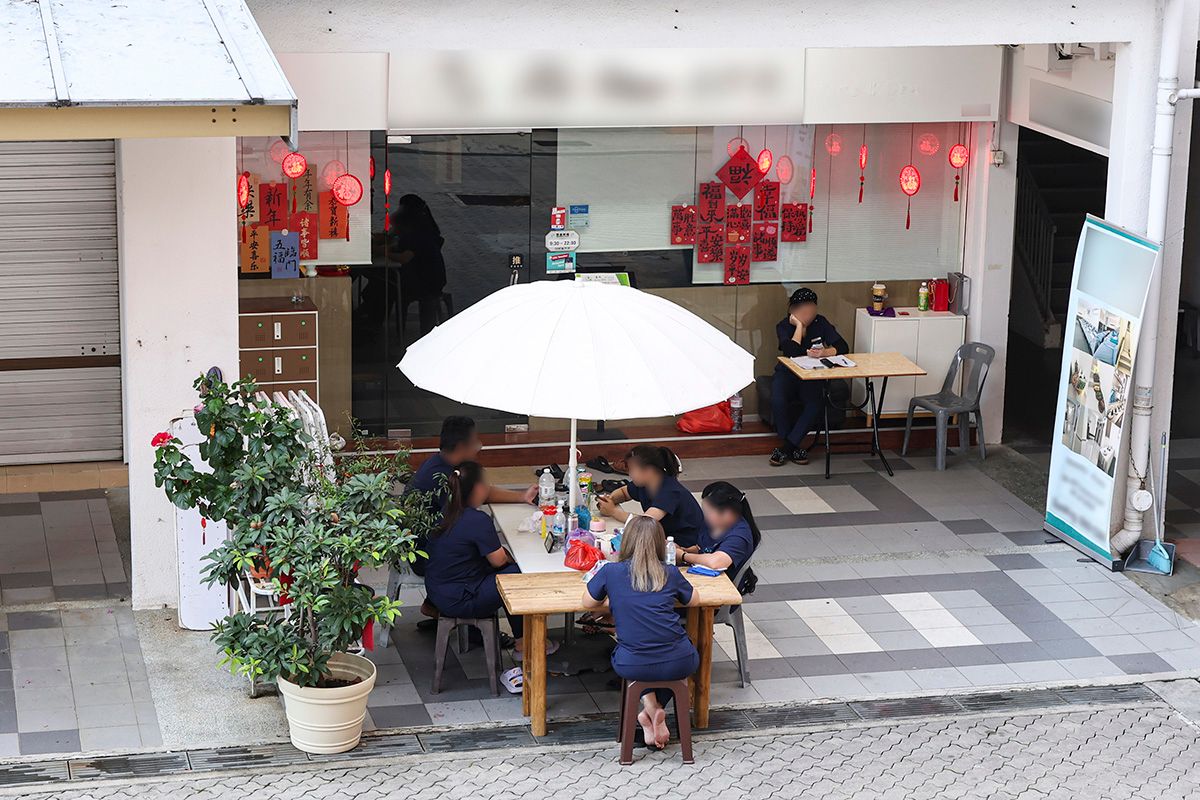 Massage parlour employees in Tampines West taking a break outside the shop. ST PHOTO: BRIAN TEO
These characteristics may explain the growing presence of beauty and wellness shops, even when the rent they pay may not be higher than what other tenants pay, he said.
Huttons’ Mr Lee said owners do not necessarily lease units to tenants who can pay the highest rent, as a change of use – for instance, from a provision shop to a massage establishment – requires HDB’s approval.
The HDB spokeswoman said owners of privately owned shops in HDB estates are not required to seek approval for change of trade, unless this constitutes a change of use.
Under the Planning Act, a change of use refers to altering a property’s purpose, such as converting a shop into a restaurant.
Examples of businesses classified as “shops” include those selling furniture, department stores and beauty salons.
That means a department store can reopen as a beauty salon without seeking approval from the authorities.
Massage establishments, however, are not considered to be shops. The HDB spokeswoman said the board sets a quota on the number of massage establishments in HDB estates and has tightened this quota since September 2024.
About a quarter of the 868 licensed massage establishments are in HDB estates.
The growing presence of beauty and wellness parlours has raised concerns over vice activities in the heartland.
Ms Elysa Chen, an MP for Bishan-Toa Payoh GRC, said a resident alleged that her husband contracted a sexually transmitted infection after visiting a massage parlour that positioned itself as a TCM shop, in the constituency.
According to the resident, the business had advertised on social media using “explicit and suggestive content”, Ms Chen told ST.
Such content is not unique to the shop she received feedback on.
Checks by ST found another business in Toa Payoh that claimed to specialise in TCM wellness services, including “manhood” and prostate massages.
ST also found massage parlour advertisements online, many of which prominently featured female masseurs from countries in the region. The advertisements often included close-up photos of the women and videos of them dancing.
Jurong resident Amy Tan, 23, said she once witnessed her male friend being offered “special services” by an employee of a massage parlour in Yuhua Place.
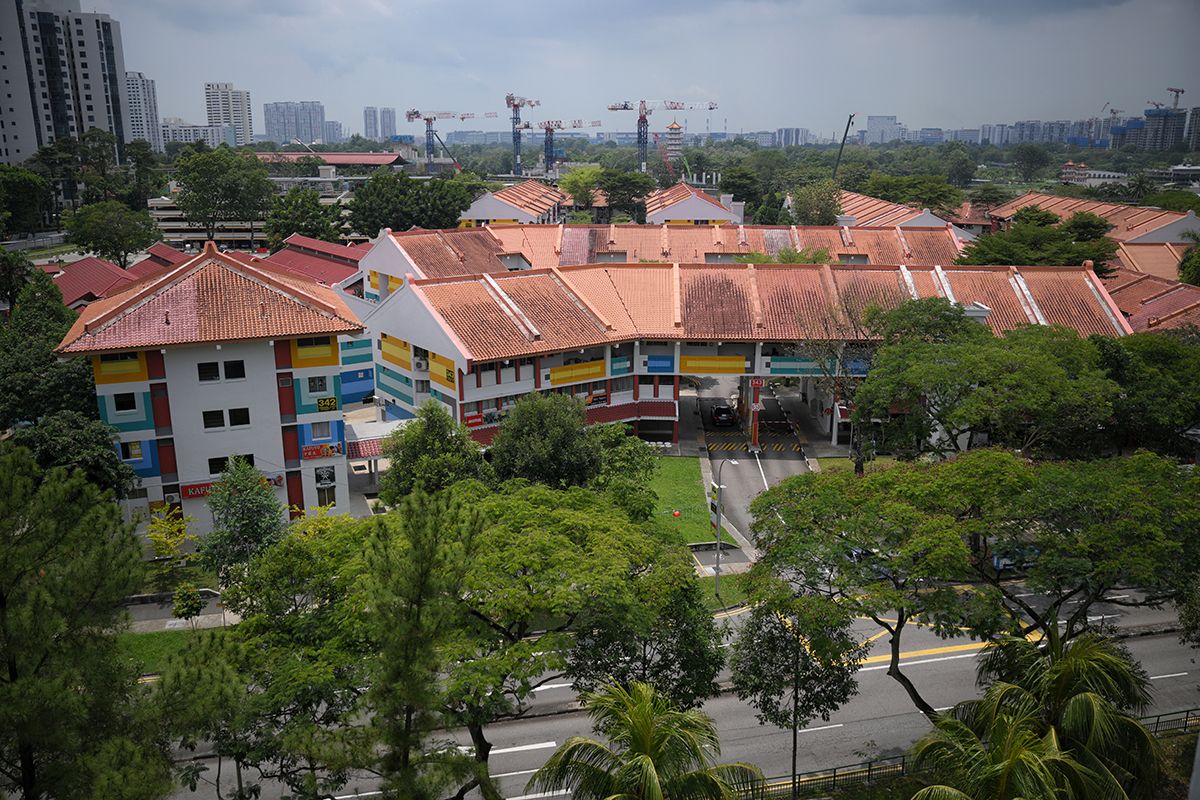 Roughly half of the 130 businesses in Yuhua Place are beauty and wellness outlets. ST PHOTO: MARK CHEONG
A hairdresser who has worked at a salon in the area for 12 years said the number of massage parlours there has increased significantly over the past six to seven years.
The 44-year-old woman, who wanted to be known only as Ms Ng, said she had observed massage parlour employees paying attention only to potential male customers when they walked past.
Ms Chen said several PAP MPs from various constituencies met the authorities in February to discuss solutions.
Jurong Central MP Xie Yao Quan said he welcomed the review.
“We are determined to restore neighbourhood centres like Yuhua Place to spaces that residents feel safe to move through and look forward to visiting,” he said in a Facebook post on Feb 3.
“We will bring the fight to the bad apples. Unwholesome activities have no place in our neighbourhoods.”
Bishan-Toa Payoh GRC MP Cai Yinzhou, who oversees the Toa Payoh Central ward, said he hopes any new regulations will not be too onerous for legitimate businesses.
He said he is especially concerned for TCM practitioners, many of whom have been operating in Toa Payoh for many years.
Mr John Soh, 70, is a long-time therapist who runs Relax and Comfort Reflexology Therapy in Toa Payoh Palm Spring, which is part of Toa Payoh Central. He said he has heard of massage shops in the estate having to close down owing to illicit activity.
When asked if new massage shops had any impact on his business, he said “no”. “I’m a therapist, so it’s different. My customers are my customers, and their customers are theirs.”
Beauty and wellness salons have also been known to use high-pressure sales tactics.
A Tampines West resident who wanted to be known only as Madam Tan, 68, said she once had her hair cut at a new salon that was having an opening promotion.
But at the end of the session, she was shocked to be charged $200 for the haircut and hair products she had unwittingly allowed the staff to use.
“A lot of them are like that now. I’ve resorted to cutting my own hair instead,” she said.
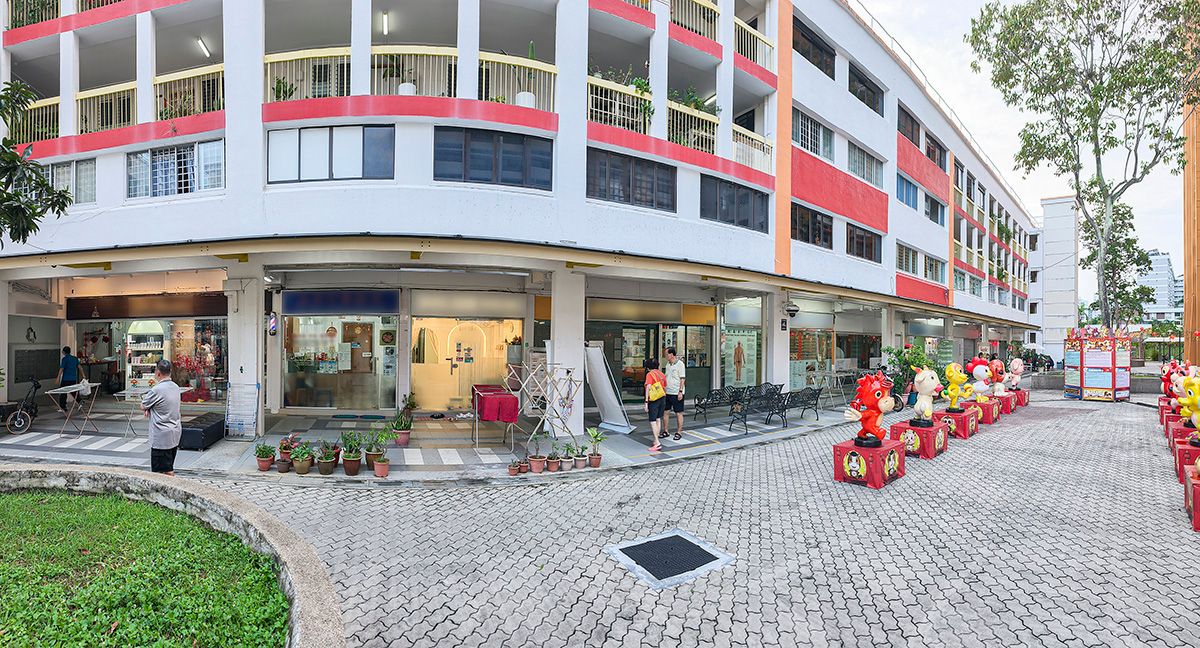 A row of beauty and wellness shops in Tampines West. ST PHOTO: BRIAN TEO
Another resident, who wanted to be known only as Mr Bob, said he was once pressured into spending about $200 on a hair product by a salon in the area.
“A $3.80 haircut usually ends with constant pressuring to buy products and treatments. I steer clear of such salons now,” the 34-year-old said.
In 2025, complaints to the Consumers Association of Singapore (CASE) against the beauty industry, which includes beauty salons, spas and massage parlours, rose sharply.
CASE received 2,113 complaints, an increase of 76 per cent from the 1,199 complaints in 2024.
This made up 15.3 per cent of the 13,786 complaints it received in 2025.
Of these, two in five complaints involved prepayment losses resulting from sudden business closures. CASE added that the beauty industry accounted for more than $2.1 million in prepayment losses in 2025.
One in five complaints involved unfair practices such as pressure sales tactics and misleading or false claims.
CASE president Melvin Yong said prepayment risks would be examined and stronger protections for consumers in higher-risk sectors, such as the beauty industry, would be recommended.
When asked about the proliferation of beauty and wellness shops in HDB estates, Dr Seshan Ramaswami, an associate professor of marketing education at the Singapore Management University, pointed to the “majority fallacy”.
“When many business owners all recognise the same opportunity, they create more intense competition among themselves,” he said.
“So there will be a shake-out some time when some of the less popular outlets will shut down. Tuition centres and gyms may also recognise the opportunity and try to move into the vacancies.”
Dr Ramaswami added that governments should generally not interfere with the free market in the provision of retail trade and services – except when national security and safety are at risk.
But in HDB estates with a large proportion of seniors, intervention may be beneficial in the interest of elderly residents, who may not be adept at using e-commerce or trust the technology involved, he said.
He suggested that in such cases, certain types of retailers, such as banks and post offices, could be encouraged to stay or open, and perhaps even have their rents subsidised.
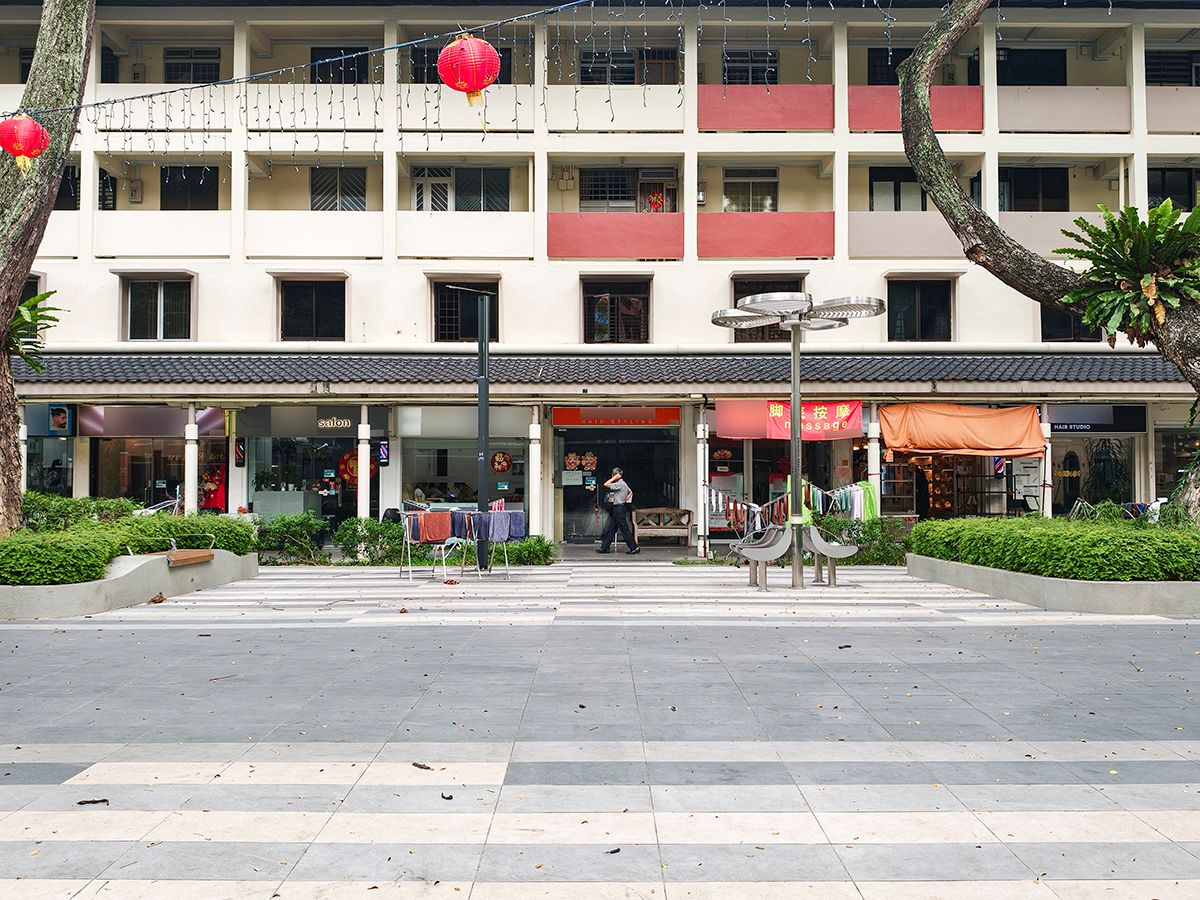 Toa Payoh Palm Spring is an estate with many seniors. ST PHOTO: BRIAN TEO
But for F&B and retail businesses, the problem goes beyond the proliferation of any one trade.
Ms Carin Wong, the owner of Shrove Tuesday, a cafe in Toa Payoh Palm Spring that has been in operation since 2013, said dining habits have changed since the Covid-19 pandemic, affecting foot traffic.
“While neighbourhood cafes once relied heavily on walk-ins, today we have to balance dine-in experiences with takeaway and delivery platforms,” she said.
She added that sustainable rentals are important for smaller businesses, as margins are not large and sharp rental hikes can make it very difficult to continue operating in the long term.
When asked what an ideal trade mix would look like, Ms Wong said it would comprise essential services, F&B options and a small number of unique retail shops.
“Essential services like clinics, provision shops and household services ensure steady daily footfall,” she said. She added that F&B businesses that complement one another can create a destination effect, drawing people to spend more time in the area rather than just run errands and leave.
Produced by: Alyssa MungcalCharles TampusJananee Yegambaram Like to see more graphics?
Here are some other original graphics you might enjoy. Or visit our graphics homepage.
MCI (P) 066/10/2023. Published by SPH Media Limited, Co. Regn. No. 202120748H. Copyright © 2026 SPH Media Limited. All rights reserved.