Bears have been around since the 70s. 1979 to be exact. OK, so the types of big, burly, hairy gay men who call themselves “bears” have probably been around for much longer, but Out’s sister publication The Advocate first coined the term in a July 26, 1979 article titled “Who’s Who at the Zoo?” by George Mazzei.
Bear culture has exploded since then — they even have their own flag, events, and cruises — and at this point, there is a whole glossary of bear vocabulary, including “cubs” (younger bears, often with a smaller frame), “otters” (a slimmer and less hairy bear), “grizzly” (a bear who is large, tall, and usually dominant), and even “lesbian bears” (yes, they exist).
But what if you want to keep your iconic bigger body while gaining some strength and definition, or if you want to turn into a “muscle bear,” a.k.a. a bear whose bulk comes mostly from muscles?
“The ‘bear’ aesthetic is all about power and presence, not being a shredded fitness model,” explained Joe Ghafari, a personal trainer and nutritionist who cofounded the premium LGBTQ+ fitness retreat Visiting Wrld. “To get that definition without losing the ‘bulk,’ you have to focus on body composition rather than just chasing a lower number on the scale. You want to build dense, functional muscle underneath that layer of softness. This means prioritizing strength training to preserve and grow lean tissue while maintaining a slight calorie buffer so you don’t lean out too much. It’s about being ‘solid,’ not ‘skinny.’”
Ghafari and gay Nike trainer Cole Francum, who is also a coach at Session Training in New York City, agree that in order to gain some muscle and strength without getting so shredded that you’re forced to turn in your bear card, you’ll need to pay attention to the way you’re working out and how much you’re eating.
“Gaining muscle requires strength training and eating enough to repair the muscle broken down during exercise,” Francum said.
Luckily, these fitness experts have a full plan to take you from an average bear to a cuddly bear who can also bench press your own weight.
Nutrition
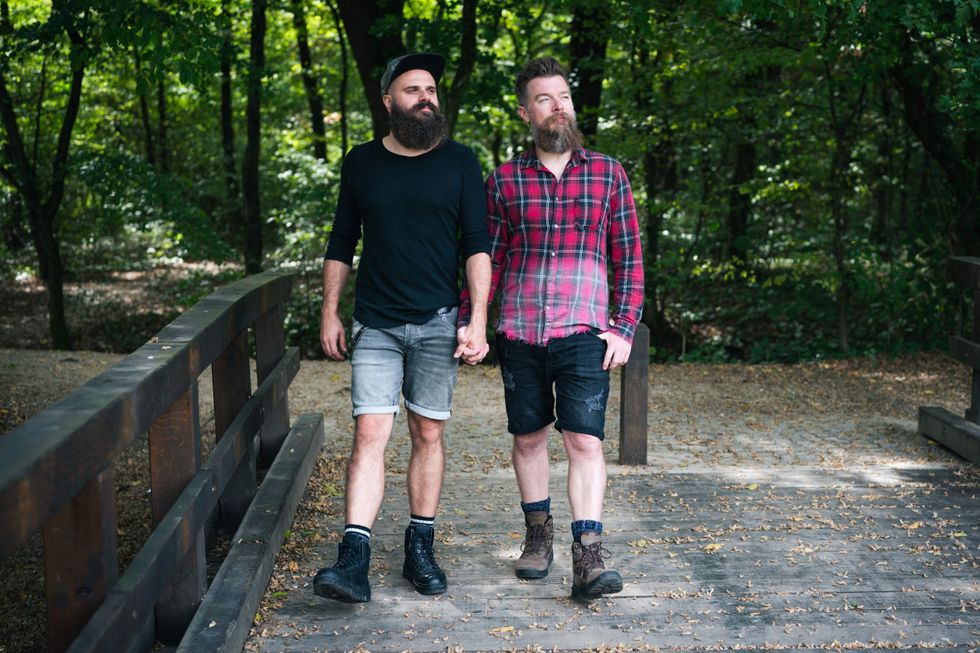
Two men holding hands while walking in a park.
Robert Petrovic/Shutterstock
To build up your muscles while keeping some of that softness bear lovers can’t get enough of, you need to pay attention to how much you’re eating and what you’re eating.
“Nutrition is the ‘insurance policy’ for your hard work,” Ghafari said. “To keep the muscle growing while maintaining your size, you cannot live in a massive calorie deficit.”
According to Ghafari, you need to make sure you are eating enough protein to “repair the muscle you’re breaking down.” But you also shouldn’t “fear” carbs, since they “fuel your heavy lifts and actually help your muscles look ‘full’ because they store water inside the muscle tissue.”
Francum explained that while many people focus on eating in a calorie deficit to trim down, bears who want to gain muscle without losing their characteristic bulk will need to do something a little different: Eat in a calorie-maintenance or calorie-surplus state.
“Bears typically identify by their size or shape, and to maintain that, they’ll want to be sure to prioritize either maintaining or being in a calorie surplus,” he said. “Ensuring that you’re getting enough protein — 0.7 to 1.0 grams of protein per pound of bodyweight — will help promote muscle growth. Balance out carbs and fats with fibrous foods for a well-rounded diet, even if you want to retain body mass.”
Results
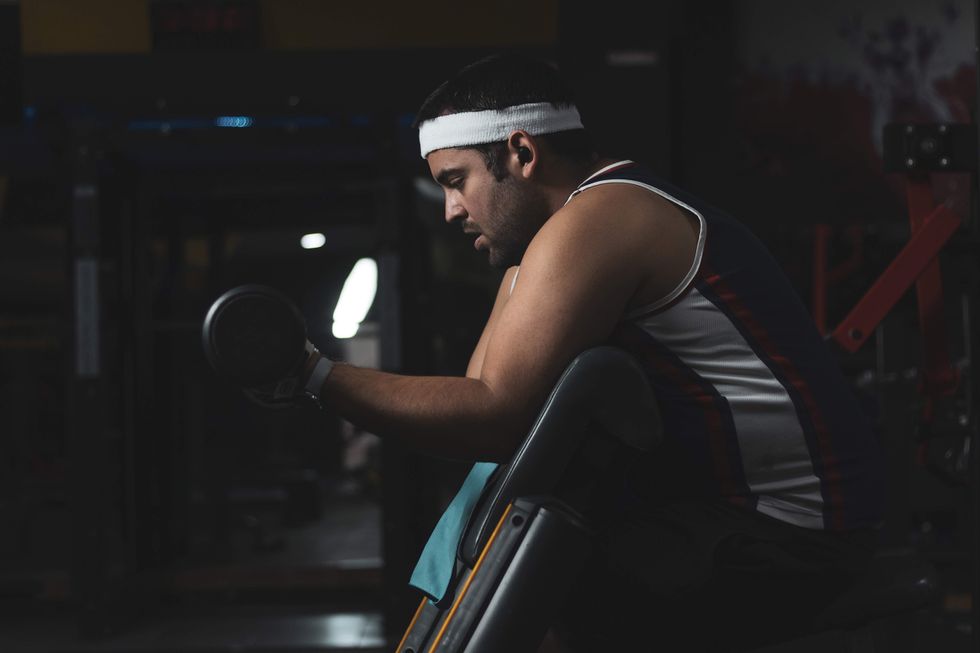
Man working out.
Yiistocking/Shutterstock
If you hit your protein goals, you’ll probably start to feel stronger in the first few weeks, but it will take longer for your body composition to change. Don’t get discouraged!
“In terms of the mirror, real structural change, where your clothes fit differently, and your muscles look ‘fuller’ underneath, usually takes about 8 to 12 weeks,” Ghafari said. “Remember, fat loss and muscle gain aren’t a straight line; focus on the trends over months, not the day-to-day scale drama.”
Everyone wants the quick fix, but if you want to build muscle, it takes time, Francum explained.
“Newcomers or beginners will usually see results in the first six to eight weeks if working out three or more times per week, probably all the way through the first year of strength training,” he said. “After that, more advanced people will see smaller incremental changes over time, which is where measuring performance and other data come into play.”
The workout
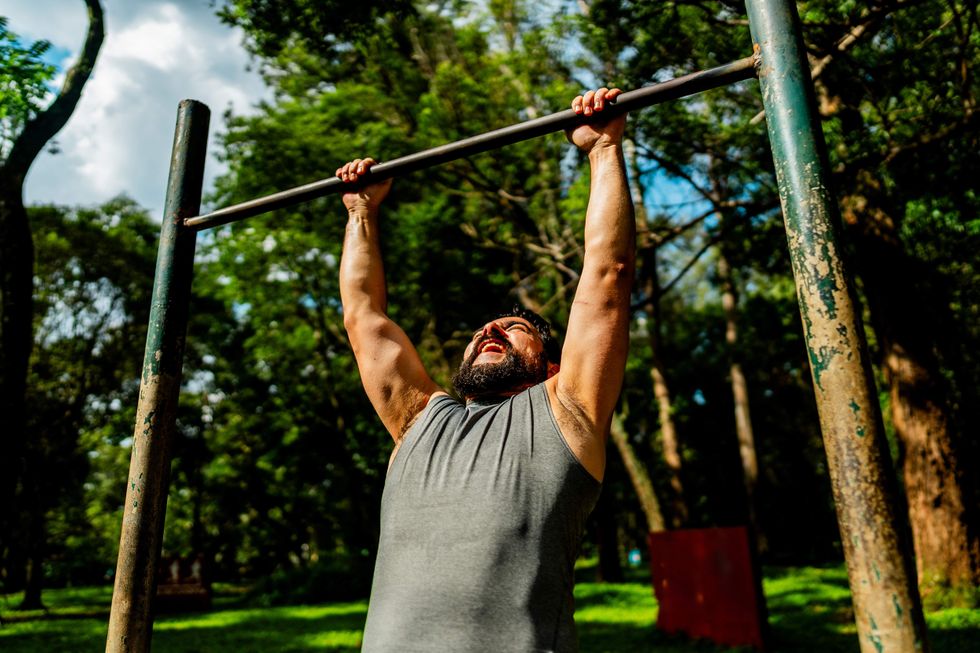
Man doing a pull up in the park.
FG trade/Getty Images
Francum’s “bear” workout routine:
“Any worthwhile routine will have some kind of push, pull, squat, hinge, rotation, counter-rotation, and carry elements,” he said. “Compound lifts will get you the most bang for your buck because they require multiple muscle groups to work at the same time to accomplish the exercise; essentially more work in less time.”
Squats, deadlifts, bench press, overhead press, rows, pull-ups, push-ups, dips, and lunges are where you should start.
Francum also suggested doing a “hypertrophy superset” where you work out your upper and lower body back-to-back so that you’re utilizing different muscle groups.
An example: back squats and dumbbell rows for three heavy sets. Or chest press plus single leg Romanian deadlifts.
Ghafari’s “bear” workout routine:
“To build that iconic, powerful frame, you need big, compound movements that recruit the most muscle mass,” he said.
Barbell bench press: For that thick, wide chest.Overhead press: To build “boulder shoulders” and that broad upper-body silhouette.Deadlifts: For total body power and a thick “posterior chain” (back and glutes).Barbell Rows: To add depth and width to your back.Weighted lunges or squats: for powerful, sturdy legs.Dips: To build the triceps and give the arms that “filled-out” look in a t-shirt.
According to Ghafari, you can also get results at home if you don’t want to go to a gym. “You don’t need a 24-hour mega-gym to get strong, but you do need progressive overload, meaning the workout has to stay challenging,” he said.
Push-ups (and variations): Elevate your feet to make them harder as you get stronger.Pull-ups: If you have a doorway bar, these are the gold standard for back width.Bulgarian split squats: Use a chair or your couch for rear-foot elevation; these are brutal for leg strength.Dips: Use the edge of a sturdy coffee table or chair.Incline walking: If you have a treadmill at home, the 12-3-30 method (12 percent incline at 3 mph) is incredible for building glute and hamstring power without the joint-pounding of running.