What are the beauty device market drivers in China?Who are the main consumers?
From a demographic perspective, Gen Z and Millennials have firmly established themselves as the primary beauty device market drivers in China. As of 2022, young women aged 25 to 34 represented the largest consumer segment, accounting for 44% of the market. These consumers are increasingly moving beyond traditional topical cosmetics in favor of high-tech devices. While the market remains heavily female-skewed, there is a burgeoning and significant growth potential among male consumers. This shift is visible among urban Gen Z men. This group is specifically driving demand for high-performance cleansing devices, scalp health technology to combat early hair loss, and specialized facial massagers designed for jawline contouring.
Download the 2026 China Beauty Report here A market that is not defined solely by Gen Z
Geographic nuances further refine these consumer profiles, necessitating localized strategies for brands entering the Chinese market. In the Northern provinces, consumers prioritize devices focused on skin whitening and intensive anti-aging regimens. In the Southern regions, the aesthetic focus shifts toward body contouring solutions.
However, the market’s reach extends beyond the youth segment. A significant opportunity lies within the Silver Beauty economy. Unlike younger cohorts, these consumers are not necessarily striving to look young. Rather, they demand products that respect their life stage, enhance their quality of life, and offer a high degree of trustworthiness. This rising demand is expected to drive a +2.3% impact on the growth of the beauty device market.
The beauty device market in China faces numerous demands
A general trend can be observed across all consumer categories. There is a fundamental change in market expectations moving from a price-first mentality to a proof-first requirement. The traditional growth engine of heavy promotions and deep discounts is losing its effectiveness as consumers demand measurable efficacy, safety, and authenticity. This proof-first mentality is forecasted to have a +1.9% impact on the growth of the beauty device market. To remain competitive, the industry must pivot from emotional marketing hype toward biotech-led innovation and consumer science.
The various drivers of growth in the beauty device market in China
Driver% impact on CAGR forecastGeographic relevanceImpact timelineRising prevalence of obesity and weight-related concerns+2.8%National (stronger in tier-one cities)Medium term (2-4 years)Growing popularity of minimally invasive cosmetic treatments+3.2%Urban centersShort term (less than 2 years)Accelerated innovation in energy-based device technologies+2.1%NationalLong terms (more than 4 years)Social commerce and live-streaming are driving patient acquisition+1.9%NationalShort term (less than two years)Regulatory acceleration via NMPA measures+1.7%Hainan Free-Trade Port, Greater Bay AreaShort term (less than 2 years)An aging population is fueling demand for age-related interventions+2.3%National, 60+ cohort concentrationLong term (more than 4 years)
Data source: Euromonitor International website, designed by Daxue Group Consulting, the various factors influencing the growth of the beauty device market in China
Why biotech and NMPA Compliance are the new drivers
The most potent catalyst is the growing popularity of minimally invasive cosmetic treatments (which is projected to contribute a +3.2% impact on CAGR within the next two years). These devices appeal to both savvy clinic clients seeking post-treatment maintenance and clinic-curious beginners. Brands are capturing a wider audience by positioning high-tech tools as a convenient, cost-effective alternative to frequent clinic visits. This is also perfectly aligned with China’s lazy economy trend (a consumer trend focused on products and services that save time and effort by simplifying daily tasks). In the short term, social commerce and live-streaming are further accelerating the sales of these minimally invasive cosmetic treatments (+1.9%).
In the medium to long term, the market’s trajectory is anchored by demographic and technological shifts. The rising prevalence of obesity and weight-related concerns represents a significant +2.8% driver over the next 2-4 years. This trend specifically fuels demand for at-home body contouring and cellulite-reduction tools as consumers seek non-invasive ways to manage their silhouettes.
However, we should not underestimate the importance of regulatory acceleration through NMPA measures (+1.7%) in the short term. The regulatory landscape has changed in recent years. In 2022, the National Medical Products Administration required manufacturers to undergo testing and conduct clinical trials. In 2024, with the issuance of the “Radiofrequency Beauty Device Registration Review Guidelines,” radiofrequency devices were reclassified as Class III medical devices (the highest-risk category reserved for products requiring the strictest supervision). These regulations will have a positive effect on the development of the beauty device market, as the market will be purged of dangerous or counterfeit products. This strict regulatory landscape will affect the promotional ecosystem, particularly regarding live-streamed commerce. In other words, customers may become less and less wary.
For companies to thrive in this environment, they must pivot their product design toward consumer science and biotech-led innovation.
The development and trends of the beauty device marketWhich companies are major players in the beauty device industry?
While Japanese brands like Ya-Man maintain a strong foothold by leveraging their professional salon heritage and multifunctional RF technology, they face intense competition from domestic leaders such as Ulike, Amiro, and Jmoon.
These local players have successfully captured the lazy economy by specializing in beauty devices that prioritize both comfort and speed.
Ya-Man maintains its edge through its evidence-based clinical credibility and high-end technological patents with premium price points to signal luxury and safety. In contrast, local brands like Amiro and Jmoon are adopting an internet company mindset. They dominate the mid-to-high-end mass market by offering high-spec features like sapphire-cooling and RF technology at competitive prices.
These brands are no longer competing solely on price, but on their ability to integrate medical-grade technology into sleek, consumer-friendly designs that are heavily promoted through the country’s dominant social commerce and live-streaming ecosystems.
Furthermore, the battle for distribution has shifted almost entirely to social commerce, where local players excel at high-frequency live-streaming on platforms like Douyin. This allows them to convert viral interest into immediate sales far more efficiently than traditional retail-heavy international brands.
The synergy between products and the integration of beauty devices into beauty routines
The synergy between technology and skincare has become one of the key beauty device market drivers in China, where effectiveness is increasingly measured by a device’s ability to work in harmony with topical products. In the competitive Chinese market, the value proposition of a beauty device is no longer judged in isolation. Its appeal lies in its capacity to amplify the results of a broader skincare regimen. This trend toward integrated routines is amplified by social media influencers. These KOLs and KOCs play a critical role in educating the public on how to maximize efficacy by pairing specific devices with compatible serums or creams.
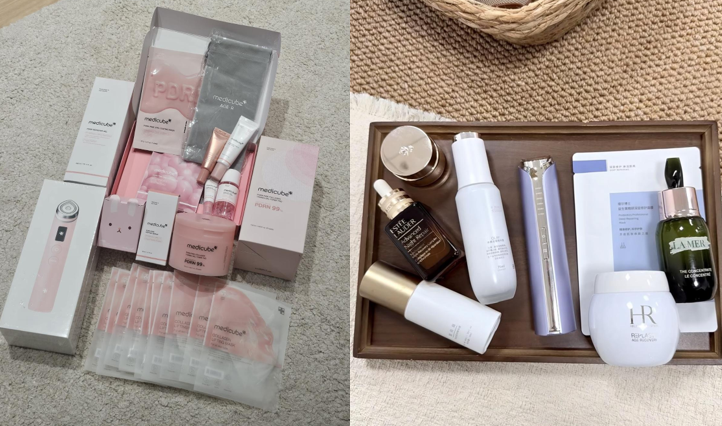 Source: RedNote, Netizens shared customized routines combining beauty devices and topical productsBuilding consumer loyalty in China’s beauty device market
To capitalize on this demand for synergy, some brands are moving away from selling standalone products in favor of offering comprehensive beauty solutions. This is the case, for example, with Medicube and its Glow-Up Full Facial Set, which includes both a beauty device (Booster Pro) designed to improve skin elasticity and reduce signs of aging, and beauty products. From a marketing perspective, this strategy draws its strength from the synergy between the different products. This is intended to both enhance the products’ effectiveness and support the consumer throughout their beauty routine. From an economic perspective, this strategy makes it easier to build consumer loyalty by encouraging them to gradually acquire the entire product line.
The ability to create and prove this synergy is becoming a prerequisite for commercial success. As the market matures, companies will need to demonstrate a deep understanding of how their technology interacts with active ingredients to deliver superior, measurable outcomes. For brands looking to secure a foothold in the personal use beauty device sector, developing these ecosystems is no longer an option but a necessity to meet the evolving expectations of a sophisticated consumer base.
How traditional beauty brands adapt to beauty devices
This shift toward high-tech beauty solutions is most visible with the adaptation of heritage cosmetic brands.
A prime example of this cross-industry synergy is the collaboration between Dior and the French lighting specialist Lucibel (specialized in light technology). Together, the two brands have developed an innovative LED beauty mask that stimulates and regenerates skin cells at a level that topical applications alone cannot achieve.
Similarly, Lancôme has formally entered the hardware sector with the launch of its first anti-aging beauty device. The company unveiled this technology at the China Import Expo. This is particularly significant and serves as a powerful statement regarding the central importance of the Chinese market to the brand’s global growth strategy. Lancôme also signals its commitment to meeting the sophisticated demands of Chinese consumers. The brand emphasized the booster effect, demonstrating that the device is most effective when used in direct conjunction with its existing serums.
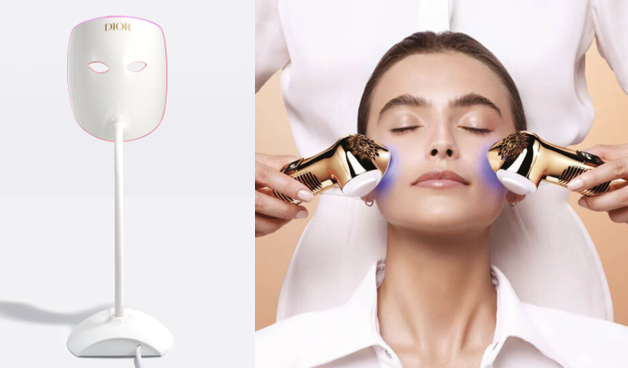 Source: Dior and Lancôme websites, conventional beauty brands have begun their transition to integrate beauty devices into skincareA market that emphasizes product customization and the use of AI
The evolution of the Beauty Device Market in China is characterized by a shift toward mass personalization. This is done with the integration of Artificial Intelligence and the Internet of Things (IoT). These devices provide comprehensive skincare analysis through mobile applications and allow for the creation of customized programs that address specific dermatological concerns.
An example of this intelligent shift is the Chinese brand OGP. The company has introduced a sophisticated photorejuvenation system using an intelligent interface. Through a connected app, the system analyzes the user’s skin to customize the usage cycle, duration, and specific light settings. These features ensure the treatment is tailored to the individual’s real-time needs.
L’Oréal Group has introduced AI-connected skincare devices in China, integrated with mobile skin analysis platforms. This highlights how tech connectivity has become one of the essential beauty device market drivers in China.
In this new landscape, the most successful participants in the personal use beauty device market will be those who leverage algorithms and data to guide every stage of the consumer journey.
The future of China’s tech-driven beauty ecosystemWhile Gen Z and Millennials (especially women aged 25–34) remain the primary drivers, the market is diversifying through the Silver Beauty economy and a growing interest from male consumers.Consumers are moving away from discount-driven purchases toward a “proof-first” mentality, prioritizing scientific efficacy, safety, and biotech innovation over emotional marketing.The value of a beauty device is now defined by its ability to amplify topical skincare. Brands are shifting from selling standalone hardware to offering comprehensive beauty solutions.Heritage brands like Dior and Lancôme are validating the market by launching high-tech hardware specifically tailored for the sophisticated Chinese consumer.The integration of AI, IoT, and mobile apps is transforming devices into personalized skincare consultants that offer real-time analysis and customized treatment cycles.