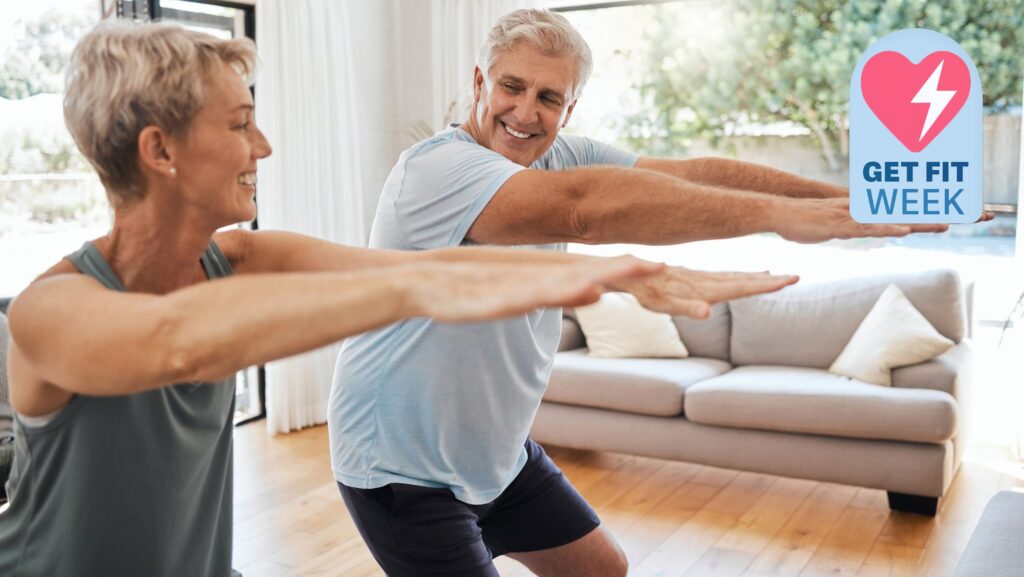
Did you know that your lower-body strength can decline by 5% per year after the age of 50? I know, not exactly good news, is it?
However, just because it might look like an alarming statistic, that doesn’t mean you’ll see or feel your body change overnight or that your exercise routine immediately needs to change. It just means that we all need to be more mindful of maintaining healthy, lean muscle and functional strength and mobility into those later years.
Article continues below
You may like
Watch: 3-move leg workout
Before we get started, let’s take a quick dive into the research that kicked this whole routine off.
The Journal of Strength and Conditioning Research published a study into how leg strength may decline with age despite older adults engaging in regular endurance exercise. The research included men and women, ranging between 50 and 80 years old, and concluded that there was a significant loss of isometric knee extension (roughly 5% per year) and knee flexion (roughly 3.6% per year) strength in both men and women.
Researchers suggest that older adults should engage in resistance training into their later years and that running alone isn’t sufficient for the prevention of muscle strength loss associated with aging. They also suggest that muscle mass loss (sarcopenia) seems to occur in sedentary adults at the rate of upto 1% per year after 50.
Muscle mass loss can mean decreased strength and metabolic rate. A loss in strength can increase the likelihood of falls, fractures and loss of independence, and women remain more at risk than men.
But it’s not doom and gloom because we can fight it off; it’s never too late to build or maintain strength and muscle. Here are three moves to get you started.
1. Supported pistol squats
Supported pistol squats can be done by standing on one leg, extending the other in front of you and lowering your butt onto a box, reformer bed, chair, or bench.
What to read next
This is a great way to develop pistol squat technique and build the prerequisites for the full version if you want to take it there. It also isolates one leg at a time, which mimics the type of forceful leg movements we perform in daily life, like jumping, climbing, walking, or running.
That’s why single-sided movements are so important for balance, coordination and stability; it’s also a great way to work both sides of the body more evenly. As your legs are performing the same movement each rep, you’ll notice any limitations in strength and range of motion almost immediately. Then, once you’re aware of this, you can work on improving it.
This move will improve unilateral leg strength, as your dominant side can’t overtake to produce the most force; instead, your legs work independently, improving overall power and mobility.
2. Reverse lunges with arm raise
The beauty of performing reverse lunges on the reformer is that you can push your back leg behind you to perform the lunge rather than stepping, which keeps your muscles under tension throughout the entire move as you draw the leg forward and back with less stress on the knees.
As you lunge, lift your arms into the air to further test your balance and stability, engaging more of your upper body. Keep your back leg straight with a soft knee bend and stay on the ball of your back foot; you’ll feel a deep stretch in your hip flexors along the back leg, whereas the gluteal muscles in the standing leg will be working hard to stabilize you and your hips.
Lower as far as you can, and don’t be afraid to wobble or reduce your range of motion until you’re comfortable. If you don’t have access to a reformer, you can use sliders, a towel, or a dishcloth to allow you to push your leg out and back. I recommend holding a weight to progress this move further.
3. Side lunge ‘slide’
Again, you don’t need a reformer bed for this movement to work, but if you have access to one, the springs will allow you to increase the intensity and resistance your muscles move against.
If you do use a reformer, position your standing leg on the standing platform so that you can drive your other leg outward and back in with control.
This move hits the inner thighs (adductors), glutes, quads, hamstrings, hips and core and requires slow movement and a full range of motion. Only push your leg out to your end range, which means a distance that you can control, then use your inner thighs to “pull” the reformer bed back in. Remember to switch sides!
Each time, you’re coming to a static squat hold, using one leg to push the bed out and back while stabilizing through the other; this means your legs are under constant tension, known as time under tension. Trust me, this will kick up a major burn in those legs, glutes and core.
Focus on engaging your core muscles and keep your chest lifted and back straight.
Trainer tips
You can work these moves into a circuit for a time-on, time-off workout, such as 45 seconds on and 15 seconds rest for 4-5 rounds. I prefer sets and reps, so I recommend 8-12 reps per leg per exercise and 3-4 sets total. Take a brief rest between sets (30-60 seconds), but try to move from one move to another with minimal rest.
Looking for more fitness ideas?
Follow Tom’s Guide fitness below!

Follow Tom’s Guide on Google News and add us as a preferred source to get our up-to-date news, analysis, and reviews in your feeds.
More from Tom’s Guide