Report Overview
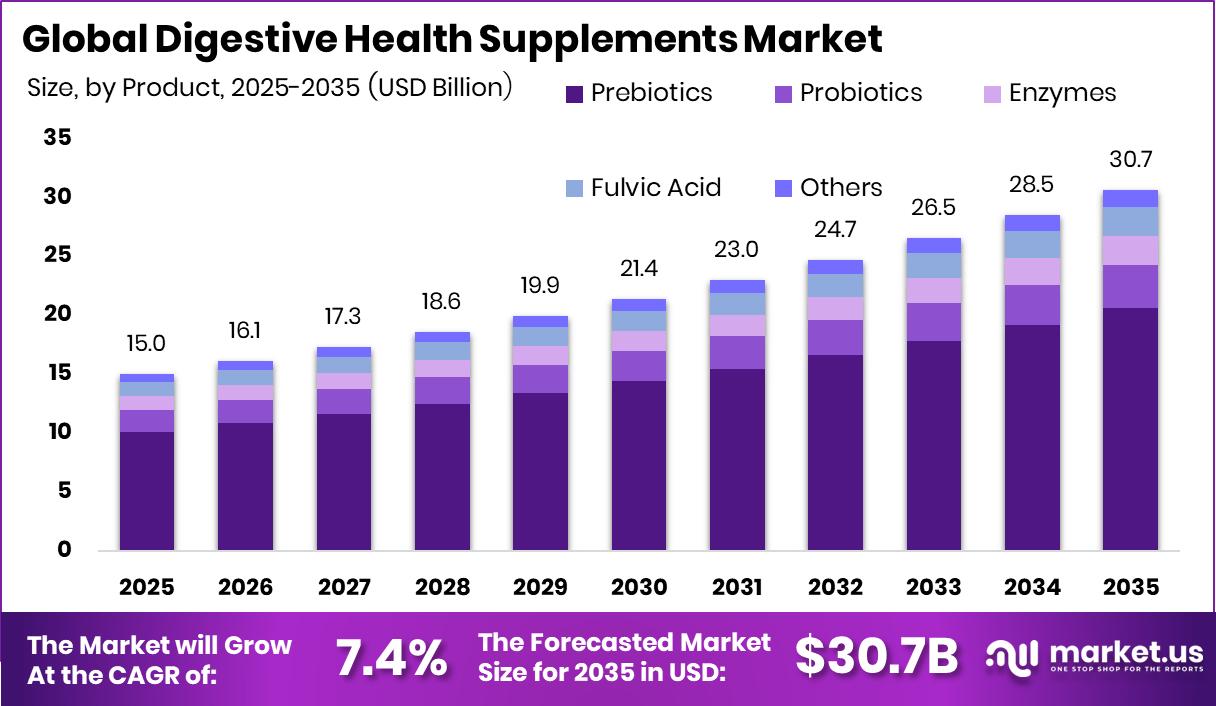
The Global Digestive Health Supplements Market is expected to be worth around USD 30.7 billion by 2034, up from USD 15.0 billion in 2024. It is projected to grow at a CAGR of 7.4% from 2025 to 2034. The Digestive Health Supplements Market in North America accounts for 39.1%, totaling USD 5.8 Bn in 2025.
The Global Digestive Health Supplements Market is structured across multiple segments, including product, form, and distribution channels, reflecting diverse consumer preferences and health needs. By product, the market includes prebiotics, probiotics, enzymes, fulvic acid, and other specialty supplements that support gut balance and digestion. In terms of form, capsules lead alongside tablets, powders, liquids, and other convenient formats that cater to varying consumption habits.
Distribution channels such as supermarkets/hypermarkets, drug stores and pharmacies, convenience stores, online platforms, and others play a key role in accessibility and consumer reach. This segmentation highlights a well-diversified market where innovation in ingredients and delivery formats continues to shape product offerings and consumer adoption across global regions.
Digestive health supplements are products designed to support the proper functioning of the digestive system. These include ingredients such as probiotics (beneficial bacteria), prebiotics (fibers that feed good bacteria), digestive enzymes, and other compounds that help improve gut health, nutrient absorption, and overall digestion. They are widely used to manage common digestive issues such as bloating, constipation, and irregular bowel movements while also supporting immunity and general wellness.
The Digestive Health Supplements Market refers to the global industry involved in the production, distribution, and sale of supplements that promote digestive and gut health. It includes a wide range of products formulated to maintain microbiome balance and improve digestive efficiency. The market encompasses various stakeholders, including manufacturers, suppliers, retailers, and consumers, with an increasing focus on preventive healthcare and daily wellness solutions.
One of the key growth factors driving the market is the rising awareness of gut health and its connection to overall well-being. Consumers are increasingly recognizing the importance of maintaining a healthy microbiome, leading to higher adoption of supplements such as probiotics and prebiotics. Additionally, changing lifestyles, unhealthy eating habits, and growing cases of digestive disorders have accelerated the need for preventive solutions, further supporting market expansion.
Demand for digestive health supplements is growing steadily due to increasing consumer preference for natural and functional health products. Individuals are actively seeking supplements that offer multiple health benefits, including improved digestion, enhanced immunity, and better nutrient absorption. The availability of products in convenient forms and through multiple distribution channels has further strengthened demand across different consumer groups globally.
The market also presents significant opportunities driven by innovation and investment in gut health solutions. Companies such as Bactolife, raising $35 million in Series B funding to commercialize binding protein-based gut health ingredients, Resbiotic securing $14.5 million for lung-health probiotics expansion, and Seed Health obtaining $40 million in Series A funding highlight strong investor interest. Additionally, Lallemand Health Solutions is receiving a $1.3 million study grant for probiotic research, and Roquette is backing Advanced Protein Technologies with €15 million for human milk prebiotics, further demonstrating the growing scope for innovation and development in this market.
In October 2025, Herbalife announced the development of a new global Center of Excellence for nutrition innovation. The company works in dietary supplements and wellness products, and this step helps improve product development, including digestive health solutions like probiotics and gut-support formulas. This shows Herbalife’s focus on research and better product quality across its supplement portfolio.
Key Takeaways
The Global Digestive Health Supplements Market is expected to be worth around USD 30.7 billion by 2034, up from USD 15.0 billion in 2024. It is projected to grow at a CAGR of 7.4% from 2025 to 2034.
Digestive Health Supplements Market is dominated by prebiotics, accounting for 67.3% share globally today overall.
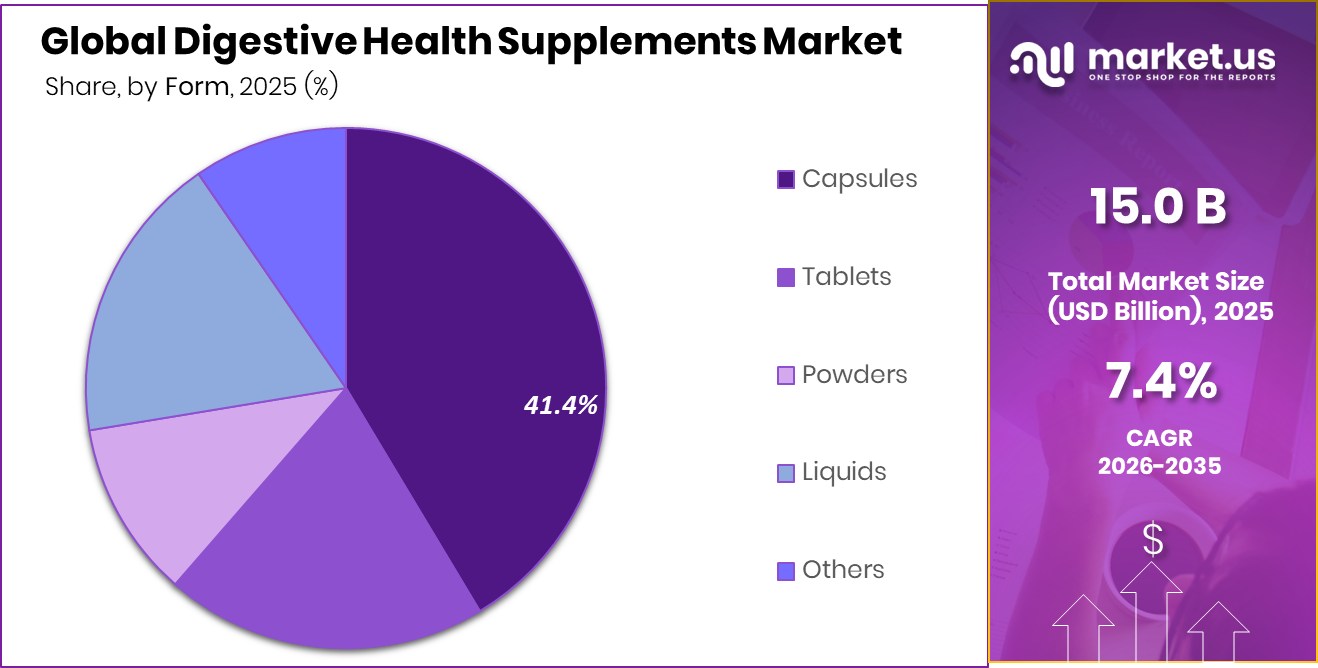
In the Digestive Health Supplements Market, the capsule form segment with 41.4% market share globally.
Supermarkets and hypermarkets dominate distribution in the Digestive Health Supplements Market, contributing 38.6% overall sales total.
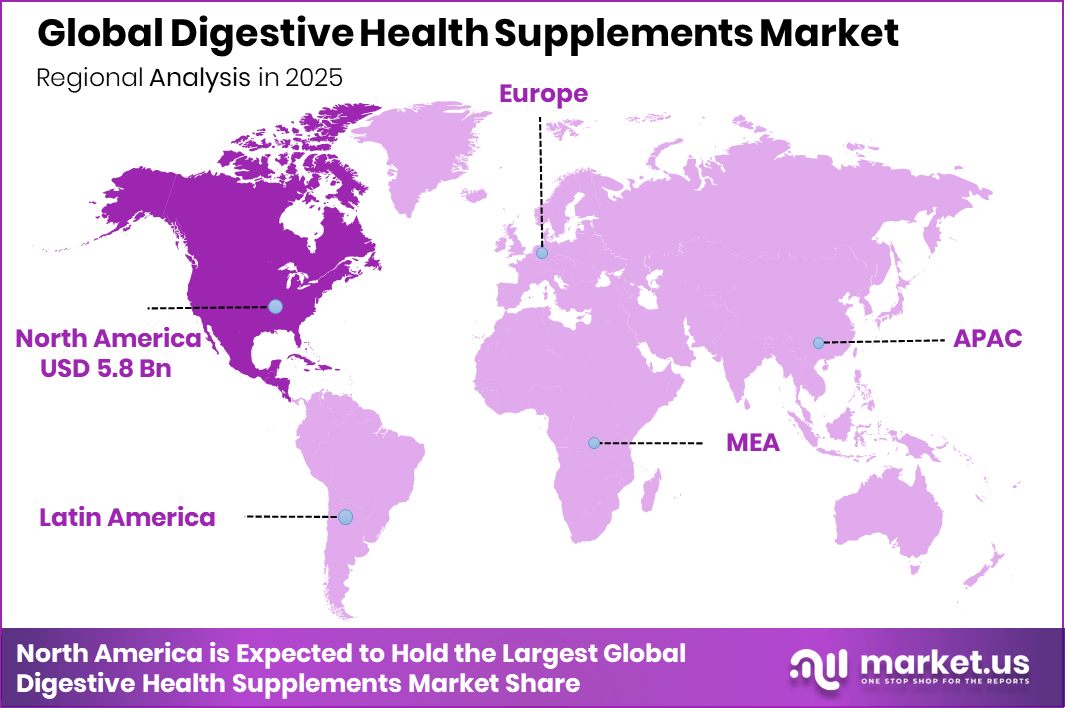
North America leads the Digestive Health Supplements Market with 39.1% share, reaching USD 5.8 Bn in 2025.The
By Product Analysis
Prebiotics dominate the Digestive Health Supplements Market, accounting for 67.3% share globally.
In 2025, the Digestive Health Supplements Market continues to show strong momentum, with prebiotics emerging as a dominant product segment, accounting for 67.3% of the market share. This growth is largely driven by increasing consumer awareness about gut health and its connection to overall well-being. Prebiotics, known for nourishing beneficial gut bacteria, are gaining preference among health-conscious individuals seeking preventive care rather than reactive treatments.
The rising incidence of digestive disorders, coupled with a growing inclination toward natural and plant-based solutions, has further fueled demand. Additionally, advancements in formulation and the inclusion of functional ingredients in daily diets have made prebiotic supplements more accessible and appealing across various age groups.
By Form Analysis
Capsules lead the Digestive Health Supplements Market by form with 41.4% share.
In terms of form, capsules hold a significant 41.4% share in the Digestive Health Supplements Market, reflecting consumer preference for convenience, precision in dosage, and ease of consumption. Capsules are widely perceived as a reliable and efficient delivery method, especially for busy individuals looking to incorporate supplements into their daily routines without hassle. Their longer shelf life and ability to mask unpleasant tastes also contribute to their popularity.
Manufacturers are increasingly focusing on innovative capsule technologies, including delayed-release and targeted delivery systems, to enhance efficacy. This segment continues to expand as consumers prioritize both effectiveness and convenience, making capsules a leading choice among various supplement forms such as powders, liquids, and chewables.
By Distribution Channel Analysis
Supermarkets and food stores drive 38.6% of the digestive health supplements market distribution.
By distribution channel, supermarkets, hypermarkets, and food stores collectively account for 38.6% of the market, highlighting their crucial role in product accessibility and consumer reach. These retail outlets offer a wide range of digestive health supplements, allowing customers to compare brands, read labels, and make informed purchasing decisions in a single location. The physical presence of products, combined with promotional displays and in-store guidance, enhances consumer trust and encourages impulse buying.
Despite the rise of online channels, traditional retail remains a key driver due to its established infrastructure and widespread presence, particularly in urban and semi-urban areas. As consumer demand grows, retailers continue to expand their health supplement offerings to meet evolving preferences.
Key Market Segments
By-Product
Prebiotics
Probiotics
Enzymes
Fulvic Acid
Others
By Form
Capsules
Tablets
Powders
Liquids
Others
By Distribution Channel
Supermarkets/Hypermarkets/Food Stores
Drug Stores and Pharmacies
Convenience Stores
Online
Others
Driving Factors
Rising awareness of gut health
The Digestive Health Supplements Market is significantly driven by rising awareness of gut health and its impact on overall wellness. Consumers are increasingly linking digestion with immunity, energy levels, and long-term health outcomes, encouraging daily supplement use. The growing popularity of functional beverages and gut-friendly products reflects this shift.
A notable example is Olipop, led by CEO Goodwin, which offers a prebiotic soda positioned as a healthier alternative and is projected to surpass $200 million in sales. Such developments highlight how consumer awareness is translating into strong product adoption and commercial success, reinforcing the importance of gut health in mainstream dietary habits and supporting continuous market expansion across multiple product categories.
Increasing digestive disorders globally
The increasing prevalence of digestive disorders globally continues to act as a strong driver for the Digestive Health Supplements Market. Rising cases of conditions such as bloating, irritable bowel syndrome, and indigestion are encouraging consumers to seek preventive and supportive solutions through supplements. Changing dietary patterns, high stress levels, and sedentary lifestyles are contributing to these issues, further accelerating product demand.
Consumers are becoming more proactive in managing their digestive health, leading to consistent growth in supplement consumption. This trend is also pushing manufacturers to develop targeted formulations that address specific digestive concerns, ensuring wider product acceptance and sustained demand across different age groups and regions.
Restraining Factors
High cost of premium supplements
The high cost of premium digestive health supplements remains a key restraint in the Digestive Health Supplements Market. Advanced formulations, clinically tested ingredients, and branded products often come at higher price points, limiting accessibility for cost-sensitive consumers. This pricing challenge can slow adoption, especially in price-conscious markets.
At the same time, investments such as the $3M grant awarded to an orthopedics researcher to study the role of the gut microbiome in osteoarthritis indicate ongoing scientific exploration, which can further increase development costs. While such research strengthens product credibility, it also contributes to higher-end product pricing, creating a balance between innovation and affordability that continues to influence market penetration.
Limited awareness in developing regions
Limited awareness in developing regions continues to restrict the full growth potential of the Digestive Health Supplements Market. In many areas, consumers still rely on traditional remedies or lack knowledge about the benefits of supplements for digestive health. This results in lower adoption rates despite increasing health concerns.
However, funding activities such as Israeli vegan yogurt brand Yofix securing $3.5M from a food tech fund indicate gradual progress in introducing innovative, gut-friendly products. These developments suggest growing interest, but awareness gaps still remain a challenge. Addressing education, accessibility, and affordability will be essential for expanding market reach and driving consistent adoption in these regions.
Growth Opportunity
Expansion of probiotic product innovations
The expansion of probiotic product innovations presents a major growth opportunity in the Digestive Health Supplements Market. Companies are increasingly focusing on advanced formulations, including targeted and designer probiotics, to address specific gut health needs. This innovation trend is supported by investments such as BiomEdit, raising $18.4 million in Series B funding to expand its designer probiotics platform.
Such developments highlight the growing emphasis on precision-based digestive solutions and the potential for differentiated products in the market. As consumers seek more effective and science-backed options, innovation in probiotic strains and delivery methods is expected to unlock new revenue streams and strengthen competitive positioning for companies.
Emerging markets are increasing supplement adoption
Emerging markets are creating strong growth opportunities for the Digestive Health Supplements Market as awareness and accessibility continue to improve. Rising disposable incomes, urbanization, and changing lifestyles are encouraging consumers in these regions to adopt preventive healthcare solutions, including digestive supplements.
Financial support, such as Sun Genomics closing its first Series A financing round at $8.65M, reflects increasing confidence in expanding personalized gut health solutions into broader markets. These developments indicate a shift toward wider adoption beyond established regions. As distribution networks improve and education increases, emerging markets are expected to play a crucial role in driving long-term growth and expanding the global consumer base.
Latest Trends
Personalized nutrition and gut health solutions
Personalized nutrition is emerging as a key trend in the Digestive Health Supplements Market, with consumers seeking tailored solutions based on individual gut microbiome profiles. Advances in technology and testing are enabling more customized supplement recommendations, improving effectiveness and user engagement.
Funding activities such as Cellbox Labs, attracting €3.3 million, demonstrate growing interest in personalized health approaches. This trend is reshaping product development, with companies focusing on precision nutrition and data-driven insights. As personalization becomes more accessible, it is expected to transform consumer expectations and drive demand for highly targeted digestive health solutions that align with individual health needs and lifestyles.
Growing demand for plant-based supplements
The growing demand for plant-based supplements is a prominent trend in the Digestive Health Supplements Market, driven by consumer preference for natural, clean-label, and sustainable products. Plant-based ingredients are perceived as safer and more compatible with long-term health goals, particularly in digestive wellness.
Investment activity such as Seed Health securing $40 million in Series A funding reflects strong market interest in innovative and sustainable gut health solutions. This trend is encouraging companies to develop vegan and plant-derived formulations, catering to a broader audience. As environmental and health consciousness continue to rise, plant-based digestive supplements are expected to gain further traction globally.
Regional Analysis
In 2025, the North America Digestive Health Supplements Market holds 39.1% share valued at USD 5.8 Bn.
The Digestive Health Supplements Market demonstrates varied regional performance across North America, Europe, Asia Pacific, the Middle East & Africa, and Latin America, reflecting differences in consumer awareness and market maturity. North America stands as the dominating region, accounting for 39.1% of the global market, with a valuation of USD 5.8 Bn. This leadership is supported by a strong consumer focus on preventive healthcare and the widespread availability of digestive health products.
Europe follows with steady growth, driven by increasing demand for gut health solutions and well-established supplement consumption patterns. The Asia Pacific region is witnessing rising adoption due to growing health awareness and expanding retail distribution networks. Meanwhile, the Middle East & Africa region is gradually emerging, supported by improving healthcare infrastructure and a shift toward wellness-oriented lifestyles.
Latin America is also experiencing consistent growth, with increasing accessibility of supplements and a growing middle-class population contributing to demand. Overall, regional dynamics highlight North America’s clear dominance, while other regions continue to evolve with expanding consumer bases and awareness levels.
Key Regions and Countries
North America
Europe
Germany
France
The UK
Spain
Italy
Rest of Europe
Asia Pacific
China
Japan
South Korea
India
Australia
Rest of APAC
Latin America
Brazil
Mexico
Rest of Latin America
Middle East & Africa
GCC
South Africa
Rest of MEA
Key Players Analysis
In 2025, Bayer AG continues to demonstrate a structured approach within the Digestive Health Supplements Market by leveraging its established presence in health and wellness. The company benefits from strong brand recognition and a diversified product portfolio, enabling it to maintain relevance among consumers seeking trusted digestive solutions. Its focus on quality and consistency supports sustained engagement across key consumer segments.
Abbott remains a significant participant, emphasizing science-backed formulations and consumer-centric offerings. The company’s strength comes from its ability to combine nutritional knowledge with digestive health needs, which makes its products fit well into everyday wellness routines. Abbott’s constant focus on making sure its products are reliable and easy to get keeps it ahead of the competition in this area.
Glanbia plc plays an important role by aligning digestive health with broader nutritional solutions. The company’s capabilities in ingredient innovation and formulation support its presence in this category. By catering to evolving consumer preferences for functional and performance-oriented products, Glanbia plc continues to strengthen its positioning within the digestive health supplements landscape.
Top Key Players in the Market
Bayer AG
Abbott
Glanbia plc
Herbalife Nutrition Ltd.
Nature’s Bounty
Amway Corporation
Garden of Life
NU SKIN
Lonza Group Ltd.
NOW Foods
Recent Developments
In September 2024, Bayer introduced the Age Factor ecosystem, which includes a dietary supplement along with a wellness app and a biological test. The supplement is designed to support overall health, including functions linked to cellular and digestive wellness. This development highlights Bayer’s move toward combining supplements with digital health tools to improve user experience and health tracking.
In November 2025, Abbott, a global healthcare and nutrition company, launched a new and improved version of Ensure Diabetes Care. This nutritional supplement is designed for people with diabetes and includes high fiber, prebiotic FOS, and nutrients that support digestive health. The formula helps maintain gut health by promoting good bacteria and improving digestion, along with blood sugar control. This shows Abbott’s focus on combining digestive health with medical nutrition solutions.
Report Scope