The full release of Beat The Beats settles into a middle ground between a rhythm game and a boxing-style workout, combining elements of both into a cohesive experience.
I’m coming at this from the perspective of someone who uses VR for daily workouts, primarily through structured apps like Supernatural, FitXR, and FunFitLand. Those experiences are built around consistency, progression, and measurable goals. Beat The Beats takes a different approach, leaning more into play and flow than structured training.
Boxing Rhythm Game Beat the Beats Gets Quest, Pico & PC VR Release Date
The VR rhythm boxing game Beat the Beats is coming to Meta Quest, SteamVR, and Pico 4 in April.
The full release builds on the early access demo previously covered by UploadVR in 2024, adding new modes and expanding the music catalog. While those additions give players more variety, the core experience remains centered on timing, movement, and rhythm.
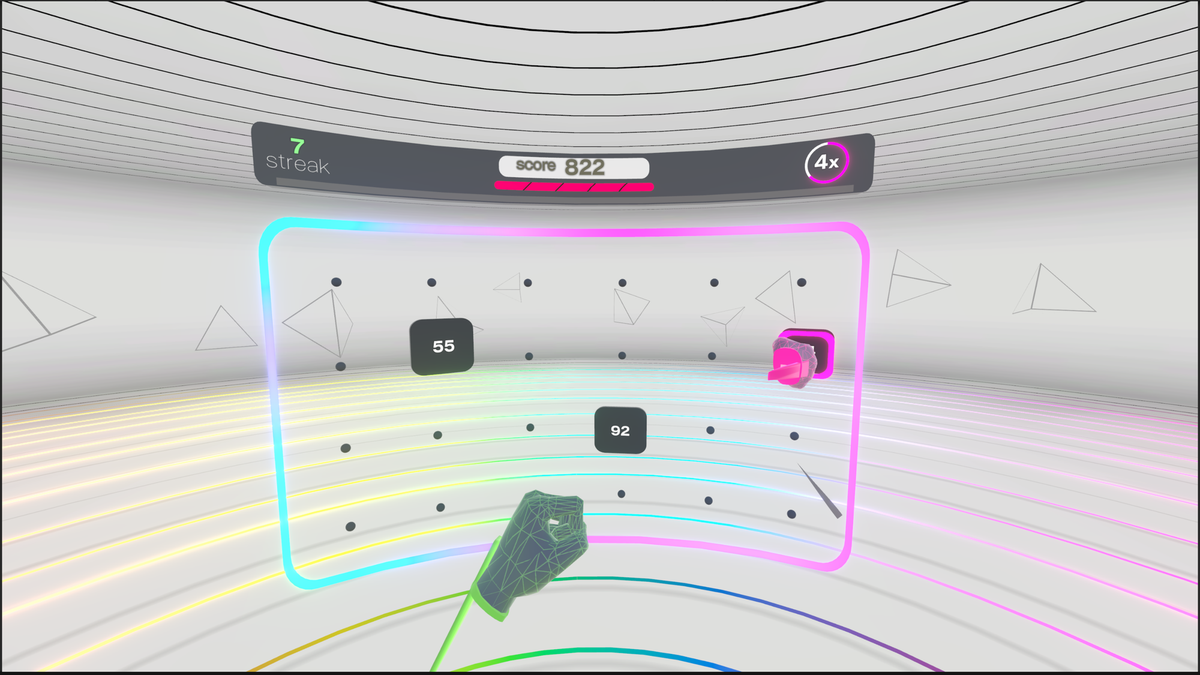
The new challenge modes each focus on a different aspect of performance. Agility places you in front of a grid where targets appear and quickly disappear, pushing you to react and hit as many as possible. Hit Speed gives you a set amount of time to throw the maximum number of punches, emphasizing pace and endurance, while Power measures punch strength by challenging you to drive hits through multiple layers of virtual glass. These sit alongside the main arcade mode as optional additions, letting you focus on specific skills like speed, reaction time, and punch strength, and add variety without fundamentally changing the core experience.

Like rhythm games such as Beat Saber and Synth Riders, Beat The Beats is built around timing and flow, but replaces sabers and hand trails with punches, blocks, and evasive side lunges. Targets arrive in quicker succession as you advance, creating a steady rhythm of movement. As the intensity ramps up, it settles into that middle ground between a rhythm game and a workout, with well-choreographed sequences and targets that land cleanly on the beat, creating a satisfying flow state.
There are a few rough edges in the current build. Punch detection, particularly for uppercuts, can feel overly strict, requiring a very specific angle to register correctly. During the tutorial, I found myself repeating certain movements a few times before they would consistently register.
The dodge mechanics also feel slightly too aggressive. Obstacles approach close enough that avoiding them can push you outside your play space. Pulling these back slightly would make the movement feel more natural without reducing the challenge.

Environments shift between lighter, more open spaces and darker, club-like settings. The darker environments stand out, giving the experience a strong techno-disco energy that better matches the pacing and music. The visual design is vivid throughout, with colorful backdrops that enhance the sense of motion, and the inclusion of a daltonic mode adds a welcome accessibility option.
The music selection is one of the game’s strongest elements. There’s a wide range of genres, and while I didn’t recognize many of the artists, the tracks consistently match the rhythm and flow of the gameplay. I found myself occasionally moving to the beat between sequences, almost dancing along in between punches. It’s easy to get pulled into the experience, to the point where it starts to feel more like dancing than exercising.
Gameplay: Craig Storm on Meta Quest 3
On Quest and Pico, the base game includes 30 tracks at launch for $12.99, with three additional DLC packs, Energy, Recall, and Dubstep, adding five tracks each. These are priced at $2.99 individually or $6.99 as a bundle. On SteamVR and PlayStation VR2, all tracks are included for $19.99. PlayStation VR2 receives full access to all content on March 24, while the other platforms receive access on April 2.
Beat The Beats ultimately lands somewhere between a rhythm game and a fitness app, without fully replacing either. It delivers a well-designed, music-driven experience that keeps you moving and engaged, but lacks the structure and progression of more dedicated fitness platforms.
For players looking for a fun, active rhythm experience that can still break a sweat, it’s an easy recommendation.