By John Dobberstein, Editor
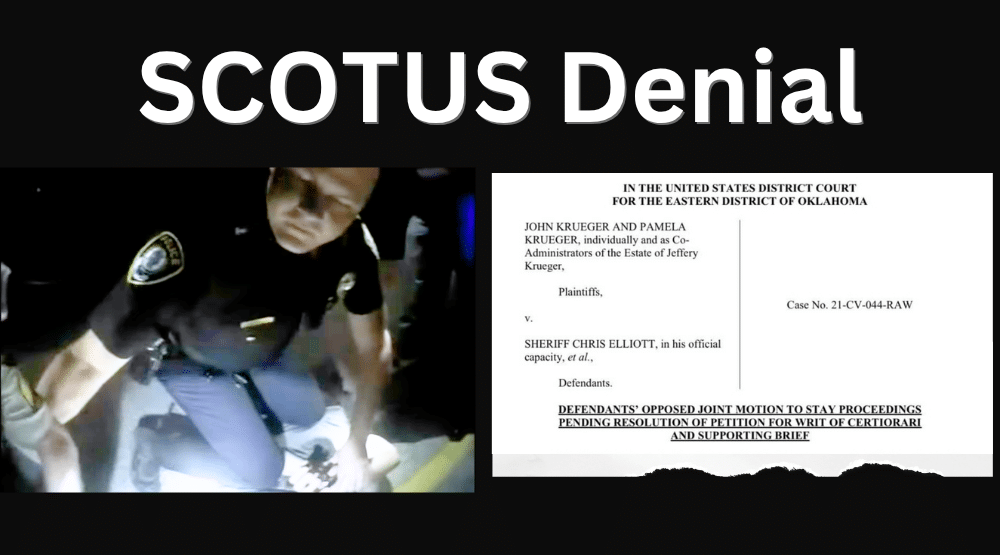
WASHINGTON — The U.S. Supreme Court declined Monday to review a lower court’s ruling about qualified immunity for the Wagoner County sheriff and deputies potentially facing trial in a $50 million wrongful death lawsuit.
Attorneys for Wagoner County Sheriff Chris Elliott and several officers named in the federal lawsuit filed a request last year for SCOTUS justices to take another look at the 10th Circuit Court of Appeals’ decision, which denied “qualified immunity” for the officers based on the allegations of excessive force.
Qualified immunity is a legal principle that protects government officials, including police officers, from being sued for actions performed within their discretionary duties, unless they violated “clearly established” statutory or constitutional rights.
Attorneys for the officers argued Court of Appeals judges mistakenly evaluated qualified immunity for the officers as a group rather than individually.
In a February brief filed in Washington, the officers’ attorneys said the 10th Circuit’s decision, “threatens law enforcement and public well-being everywhere because it will chill law enforcement officers in the performance of their duties, and endanger them in the field.”
There was no summary from SCOTUS available Monday explaining the reasons for the high court’s denial.
But unless a settlement is reached, the decision appears to open the door for the trial to begin in the lawsuit, filed in 2019 and Elliott, Nicholas Orr, Kaleb Phillips, Matthew Lott, Elizabeth Crockett, Drew Craig, Tyler McFarland, Corey Nevitt and Ben Blair.
The lawsuit alleged Jeff Krueger, who was 6 feet tall and weighed about 150 pounds, was pulled from his vehicle, slammed to the ground, handcuffed, chained, tased numerous times while in a prone position and kneeled on during a traffic stop. Krueger stopped breathing and died during the incident.
Last year, lawyers for Elliott and the deputies filed a motion for summary judgment, claiming qualified immunity shielded them from the lawsuit’s claims.
A Wagoner County court ruled the deputies still currently named in the case do not enjoy qualified immunity from prosecution from allegations of excessive force and failure to intervene by officers during the incident, a decision that was affirmed recently by the 10th Circuit.
The defendants then asked a federal judge to delay the trial, scheduled for last December, so attorneys could ask SCOTUS to review that decision.
Randall Wood, attorney for Elliott and the officers, said last year that lumping the actions of officers together is “improper and in contravention of Supreme Court precedent.” Wood also said the Appeals Court was mistaken to find individual officers could be liable on “a previously un-plead failure-to-intervene claim.”
Mark D. Lyons, the attorney representing Krueger’s family, said the 82-page opinion shows the Appeals Court, “was not swayed by (the defendants’) claim their acts of excessive force should be individually analyzed rather than jointly.”
Related Posts

U.S. Supreme Court to hear Glossip case
OKLAHOMA CITY (Jan. 22, 2024) – Attorney General Gentner Drummond said the U.S. Supreme Court will hear the case of Oklahoma death row inmate Richard Glossip. Drummond has supported Glossip’s July…