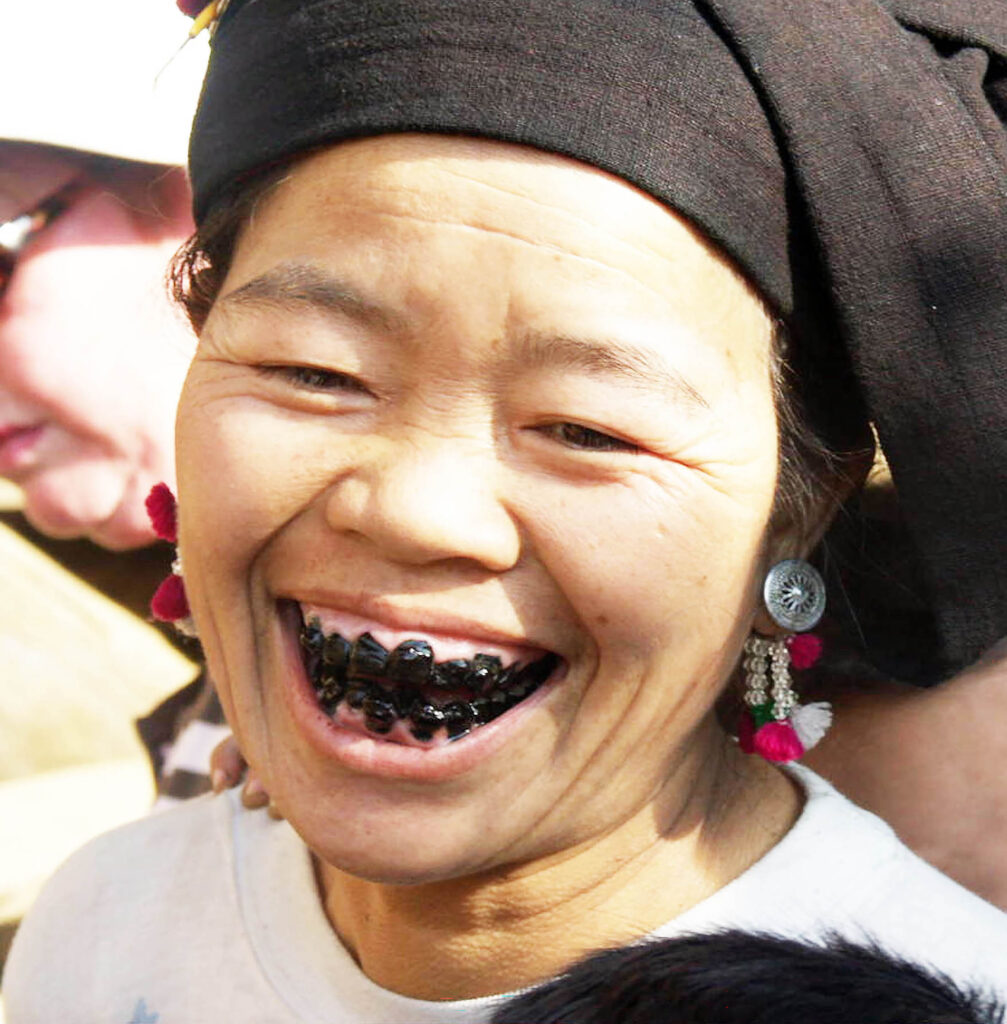
A new study has found that people in ancient Vietnam were blackening their teeth with an iron-rich paste at least 2,000 years ago.
The finding turns one of the region’s most striking beauty customs from inference into direct evidence of identity, taste, and chemical skill.
Skeletons show tooth blackening

At Dong Xa in northern Vietnam, three burials preserved teeth coated in a dark layer too deliberate to dismiss as ordinary staining.
Working from those remains, archaeologist Yue Zhang at the Australian National University matched the ancient coating to intentional tooth blackening.
Two of the teeth came from the Iron Age and a third from about 400 years ago, extending the practice across a long stretch of Vietnamese history.
That continuity made the dark enamel harder to treat as an isolated curiosity and set up the need to test what had actually colored it.
Not caused by betel chewing
Betel chewing was the obvious alternative, because earlier work had already linked dark teeth in ancient Vietnam to betel residues.
Yet earlier Vietnamese betel stains were reddish-brown, not the dense black seen at Dong Xa and in later blackened smiles.
Burial chemistry also fell short, since random soil exposure would not lay down the same iron-sulfur signal on separate teeth.
By ruling out those two paths, the study narrowed the answer to a cosmetic treatment mixed and applied by people.
Iron and plants used for tooth blackening
What made the color last was likely tannins, natural plant chemicals that readily bind metal, mixed into the paste.
When heated extracts met iron salts, iron compounds that dissolve and react easily, the mixture could turn intensely dark.
Air exposure then finished the job, because oxygen helped lock the pigment into a black, more durable coating.
That chemistry also explains why the same ingredients colored medieval inks and textiles, giving the custom a chemical backbone.
Long and careful tooth process
Vietnam’s most elaborate recipes did not stop at a single smear of dye, and the process could stretch for 20 days.
Workers first roughened the tooth surface, then laid down plant extracts, acids, and sticky binders over several nights.
Polishing with ash or coconut tar likely supplied the mirrorlike finish that made blackened teeth look deliberate and refined.
Because the treatment demanded time, discomfort, and upkeep, the result probably signaled commitment as much as appearance.
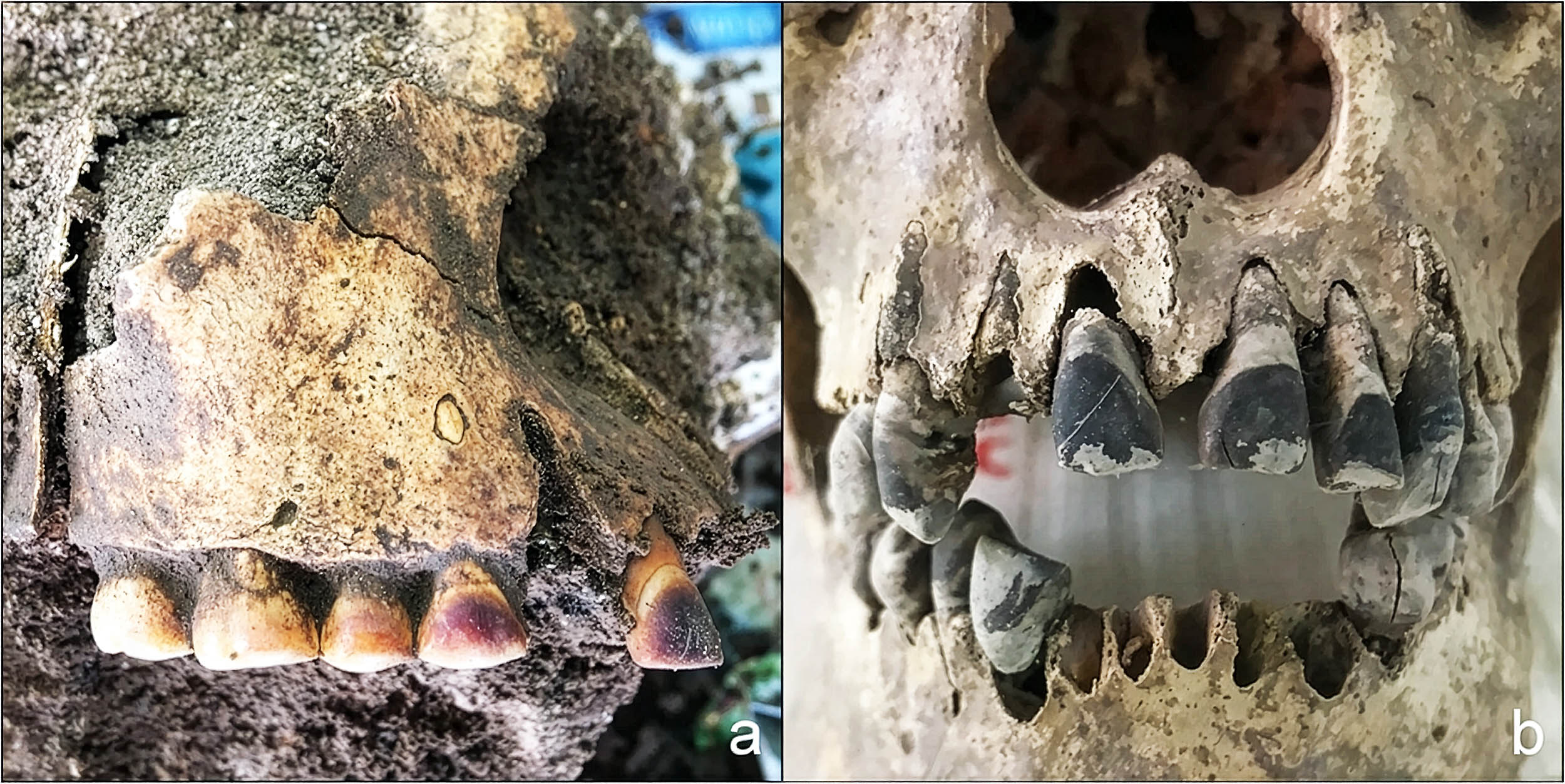 Comparison of dental residue possibly resulting from different practices: (a) reddish-brown staining on teeth from Gua Harimau, Sumatra (courtesy Prof. Truman Simanjuntak; photograph by Hsiao-chun Hung); (b) a black pigment layer on teeth from Dong Xa, Vietnam. Credit: Archaeological and Anthropological Sciences. Click image to enlarge.Black teeth showed identity
Across Asia and beyond, tooth blackening marked beauty, adulthood, and the boundary between people and something less human in one broad review.
Outside experts saw the Dong Xa teeth as proof that a living custom reached deeper into history.
At Chiang Mai University, environmental archaeologist Piyawit Moonkham read the find as evidence that the custom once stood in public view.
“It suggests that this practice might have been more common and celebrated among prehistoric and early historic communities,” Moonkham said.
Iron use made this possible
The custom appeared when iron tools, weapons, and probably mines were becoming easier to reach in northern Vietnam.
That mattered because utensils could leach iron into heated plant mixtures, feeding the dark reaction behind the dye.
“And sulfur is everywhere in nature,” Zhang said, underscoring how ordinary ingredients could support a specialized cosmetic tradition.
Placed beside early Chinese descriptions of blackened teeth to the southwest, the chemistry made the old references harder to dismiss.
Practice continued for centuries
This was not a one-skull oddity, because blackened teeth appeared on many Iron Age individuals linked to the Dong Son world.
The paper noted that at least one-fifth of observed people showed dental color changes, and some reports pushed near 40%.
A later burial from about 400 years ago carried the same black coating, suggesting long continuity rather than a brief fad.
That rise also fits another study suggesting older tooth removal gave way to less damaging marks of adulthood.
Limits of the evidence
Only three archaeological teeth went through the new analysis, and preservation problems forced the team to work carefully.
Two Iron Age teeth kept patches of sediment, while the younger sample had begun to crumble before testing.
Because the method left the remains largely intact, future researchers can examine more collections without cutting apart rare specimens.
That balance between care and proof may matter as much as the black teeth themselves, especially for museum-held remains.
Tooth blackening in modern times
The Dong Xa teeth also connect a deep past to memories still within reach in parts of Vietnam.
Historical accounts describe blackening as a multistep craft that lasted into modern times before Western standards drove decline.
Some communities kept the practice much longer, preserving recipes that link plant extracts, iron utensils, patience, and polish.
Seen beside the ancient burials, that survival makes the custom less like an isolated curiosity and more like cultural continuity.
Blackened teeth now stand beside bronze drums, graves, and old texts as direct evidence that bodily style carried real social weight.
More samples from Vietnam and neighboring regions could show whether the chemistry stayed local, traveled with people, or spread with ideas.
The study is published in Archaeological and Anthropological Sciences.
—–
Like what you read? Subscribe to our newsletter for engaging articles, exclusive content, and the latest updates.
Check us out on EarthSnap, a free app brought to you by Eric Ralls and Earth.com.
—–