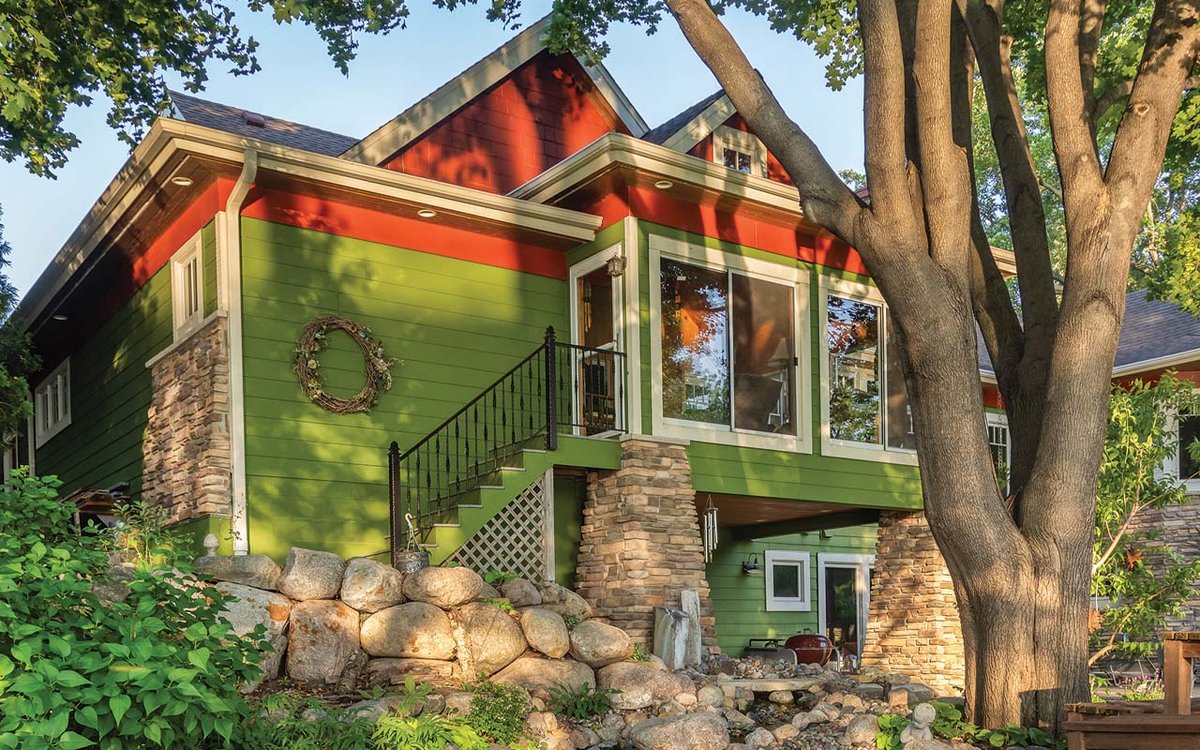
Heidi Heiland thinks of her one-acre garden, on the shores of Gleason Lake just outside of Wayzata, as a living laboratory. This is where she practices the principles of a garden philosophy that involves working with, rather than against, nature, called permaculture.
“My garden is a blend of aesthetics, functionality, and plants that spark joy,” she says. “It’s my lab to experiment on pushing the envelope of sun versus shade, zone hardiness, and capacity for growing food and cut flowers. I want my garden to pull its own weight by capturing water, providing food, creating wildlife habitat, while being interesting in all seasons.”
Readers may recognize Heidi from her garden TV segments or from her sustainable greenhouse and landscaping business in Corcoran, Heidi’s GrowHaus and Lifestyle Gardens, which the Minnesota native started more than 40 years ago. “Professional gardening or ‘high-touch horticulture’ is my company’s primary revenue stream,” she says, “but we also provide landscape design and installation services. And then there’s the GrowHaus, which is a five-and-a-half-acre nursery and garden center. We focus on healthy soils, employing beneficial insects, and the capture and reuse of water. We grow a variety of plants that’s unsurpassed in the Twin Cities.”
“Gardening is the slowest moving performance art, and it is always evolving. I learn a lot from watching and experiencing my garden.”
— Heidi Heiland, gardener
Heidi’s home garden wraps around an Arts and Crafts two-story house she and her husband built in 2006 on the site of a 1960s “rambler walk-out” ranch that the couple sold and recycled to another location. “We kept the existing foundation,” says Heidi, “but went higher with the block work to be more generous for my six-foot height and to provide better views of the water. We also prioritized various technologies for sustainable design, like geothermal heat, high-R-grade windows, and spray-foam insulation.”
Strolling around the garden, visitors are surrounded by meandering garden beds packed with edible plants and ornamental native plants grown in eye-catching combinations. The generous hardscaping is the handiwork of Heidi’s husband, Dan, a mason by trade. “We grow strawberries as a ground cover, blueberries as a hedge, and asparagus, which waves in the wind and rivals the look of any ornamental grass I’ve ever seen,” says Heidi. “We walk through a pear tree arch to get to our front courtyard. We have grapes over an arbor and a small raspberry patch. Goji berries line the front border along the street, and walking onions provide an ornamental look along the driveway with melons and squash along the edge.”
Heidi tucks in edibles wherever she can find space. For example, since leafy greens don’t need to bloom, she plants sorrel and lovage in shady spots. “I also grow my mint in the shade,” she says, “so it’s not as aggressive as it would be in full sun.” Fruit trees are dotted around the property and include cherry, plum, apple, serviceberry, chokeberry, and even a hardy kiwi vine. “As I’ve only gardened in Minnesota,” she adds, “I have adapted to all of our unique challenges. I don’t find the winters or our Zone 5 to be a challenge. After all, I want to take the winters off from gardening, as I am ready for a break.”
A passion for gardening runs in Heidi’s family. Her great-grandmother’s garden in Llewellyn Park, New Jersey, was designed by Ellen Biddle Shipman, one of America’s first female landscape architects, and won awards in the 1930s from The Garden Club of America, of which both Heidi and her mother are members. Although she majored in English at the University of Colorado and the University of Minnesota, she’s also studied at the London Flower School and the Horticultural Therapy Institute at Colorado State University, as well as permaculture design with a Minnesota practitioner. “I believe this is my God-given talent to bring the people and plant connection to my community,” she says. “I’m definitely living my legacy.”
“I want my garden to pull its own weight by capturing water, providing food, creating wildlife habitat, while be interesting in all seasons.”
— Heidi Heiland, gardener
What Is Permaculture?
According to Bill Mollison, who coined the term permaculture (a portmanteau of “permanent agriculture”) in 1978, the concept “is the conscious design and maintenance of agriculturally productive ecosystems which have the diversity, stability, and resilience of natural ecosystems.” It’s a philosophy that combines land, resources, people, and the environment without producing any waste. Here are a few of the principles Heidi Heiland practices in her home landscape.
Double Duty: Employing plants with multiple functions—like one that’s both edible and ornamental or one that benefits pollinators and has winter interest—is what Heidi calls stacking functions. “Our serviceberry tree is not only native but incredibly ornamental as it blooms in the spring, bears fruit in the summer, and its foliage turns a tawny glow in the fall. Its berries are abundant for the birds and for us,” she says. “Several bangs for your buck—stacking functions—all with one plant.”
Fair Share: Heidi shares her harvest with others. “I have an abundance in my landscape and appreciate sharing—not only with my neighbors, but there’s plenty for the critters, too,” she adds. “I can go to the grocery store to buy food, but the animals don’t have that luxury.” Instead of turfgrass, Heidi grows a “bee lawn” developed by the University of Minnesota that includes white clover. “It provides a lot of fodder for the critters,” she says. “This encourages them to eat the lawn instead of the vegetables I want to harvest.”
Chop and Drop: Whenever Heidi prunes or cuts back a plant in her garden, she simply drops the cuttings right in the garden bed. “I garden differently today at 65 than I did at 45,” she says. “This means that after I’ve deadheaded or removed some foliage from a plant, I will simply let it decompose in place, right where it is, instead of hauling the debris off to a compost heap.”