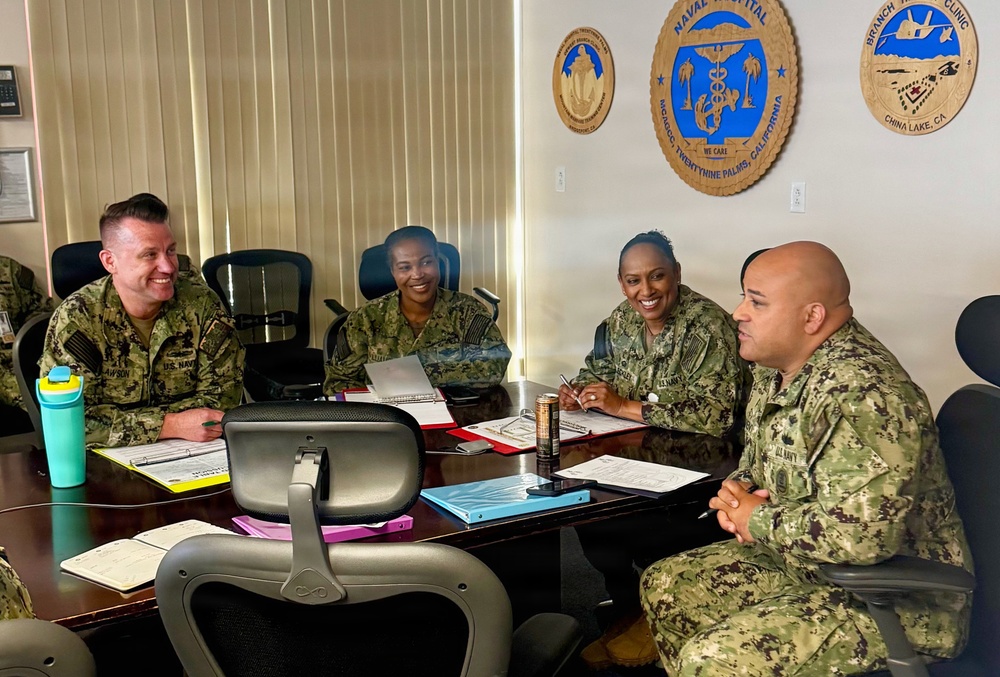
TWENTYNINE PALMS, Calif. — Occupational therapy plays a critical role in restoring warfighter readiness by bridging the gap between injury recovery, functional performance, and mission requirements. At Navy Medicine Readiness and Training Command (NMRTC) Twentynine Palms, that impact was highlighted March 19 when Lt. Angelique Williams, an occupational therapist, served as ‘Commanding Officer (CO) for a Day,’ offering a clinical perspective that reinforced the connection between patient care, leadership, and operational effectiveness.
Williams, a native of San Diego and a former hospital corpsman, said her path to occupational therapy began during a tour at Camp Pendleton, where she discovered a profession that aligned with her passion for physical fitness, health, and overall function.
“I came across occupational therapy, and it stood out to me because it combines people with physical fitness, health, and overall function,” Williams said. “I enjoy helping service members regain their function after injury and getting them back to activities that matter most to them.”
In her current role, Williams primarily treats upper extremity injuries, including hand and wrist conditions, post-surgical cases, and overuse injuries that can directly impact a service member’s ability to perform mission-essential tasks. Her work emphasizes not only recovery, but also safe, sustainable return to duty.
“One of the biggest challenges is balancing the need to return service members to duty quickly while ensuring they’re fully recovered and not at risk for reinjury,” Williams said. “The most rewarding part is seeing them regain their confidence and knowing they can safely return to their meaningful occupations.”
Williams said occupational therapy is uniquely positioned to support operational readiness through a comprehensive, whole-person approach that considers the individual, their environment, and the demands placed upon them.
“Occupational therapy bridges the gap between recovery and real-world performance, ensuring service members are not just healed, but fully ready to perform,” she said.
That same holistic mindset carried into her experience shadowing NMRTC Twentynine Palms commanding officer and Naval Hospital Twentynine Palms director Capt. Janiese Cleckley. Williams said she sought out the opportunity to better understand how command-level decisions affect patient care, staff well-being, and mission readiness.
“As a clinician, I see the impact of those decisions every day, and I wanted to see how they were made firsthand,” Williams said.
During her time as ‘CO for a Day,’ Williams observed the complexity of balancing competing priorities across the command.
“One of the biggest takeaways was how much balance is required while in command,” she said. “The focus always has to be mission readiness, patient care, and staff well-being, all while constantly weighing the balance of each.”
She added that even seemingly small decisions can have broad organizational impacts.
“Being ‘CO for a Day’ gave me a deeper appreciation for how even small decisions can have a wide-reaching effect across the entire command,” Williams said.
Williams also drew direct parallels between occupational therapy principles and effective leadership.
“As an occupational therapist, I look at the whole person, their environment, demands, and goals,” she said. “That same approach applies to leadership as well. You are constantly evaluating the entire organization, the people, and removing barriers, completing tasks, all while putting people first in order to get the job done.”
Cleckley said Williams brought enthusiasm, curiosity, and a strong desire to learn, demonstrating the qualities expected of future Navy leaders.
“Lt. Williams was enthusiastic, and her inherent drive led to her wanting to be more than just a passive observer; she was an active and engaged participant,” Cleckley said. “She asked insightful and forward-thinking questions that went beyond the surface, demonstrating a genuine effort to understand the complex layers of command decision-making.”
Cleckley noted Williams explored topics such as congressional decisions, budget determination, and manpower considerations, reflecting an understanding of how strategic decisions shape operational outcomes.
“Her willingness to learn was her greatest asset,” Cleckley said. “She left a lasting positive impression, not only on me, but also on our board of directors through her interaction, showing promise and potential that the Navy looks for in its future leaders.”
Beyond leadership development, Cleckley emphasized the value of occupational therapy’s perspective within a command environment.
“Having an occupational therapist as ‘CO for a Day’ was an incredibly insightful experience,” Cleckley said. “My biggest takeaway was a reinforced understanding of how a person-centric, holistic approach can be applied to leadership and decision-making in a command setting.”
Cleckley said occupational therapists bring a distinct lens to both patient care and leadership.
“Occupational therapists are trained to see the whole person and the environment they’re in,” she said. “They don’t just see a Sailor with a task; they see an individual with a unique background, motivations, and potential challenges.”
The experience also provided a two-way learning opportunity, expanding awareness of occupational therapy’s broader role within military medicine.
“I now have a much deeper appreciation for the breadth of occupational therapy,” Cleckley said. “It’s not just about recovery from injury. It’s about helping people of all ages and abilities live life to its fullest by promoting health and preventing injury.”
Cleckley said the experience reinforced her leadership philosophy and commitment to prioritizing people in mission execution.
“Having an occupational therapist as ‘CO for a Day’ was a valuable experience that brought a fresh and beneficial perspective to my command,” she said. “It highlighted the importance of a holistic approach to healthcare, and solidified my ‘people-first’ approach to leadership, and I am a better commanding officer for it.”
Occupational therapy remains a vital component of Navy Medicine’s mission to maintain a medically ready force and a ready medical force. By focusing on functional recovery, injury prevention, and performance optimization, occupational therapists like Williams ensure service members are prepared to meet the physical, operational, and mission-essential demands of military service.