 6 min read
FOR THE UNIVERSITY of Houston men’s basketball team, every summer workout starts at 6:30 a.m. That means arriving by 5:45 or 6 a.m. When each player walks into the facility, they see their coaches, managers, video staff, administrative staff—anyone who works with the team. No, head coach Kelvin Sampson isn’t necessarily running wind sprints next to star point guard Kingston Flemings for an hour. But the entire staff is present.
“That emphasizes the importance of development,” says Alan Bishop, the team’s Director of Sports Performance. “We have our standards, and now there is an accountability component.”
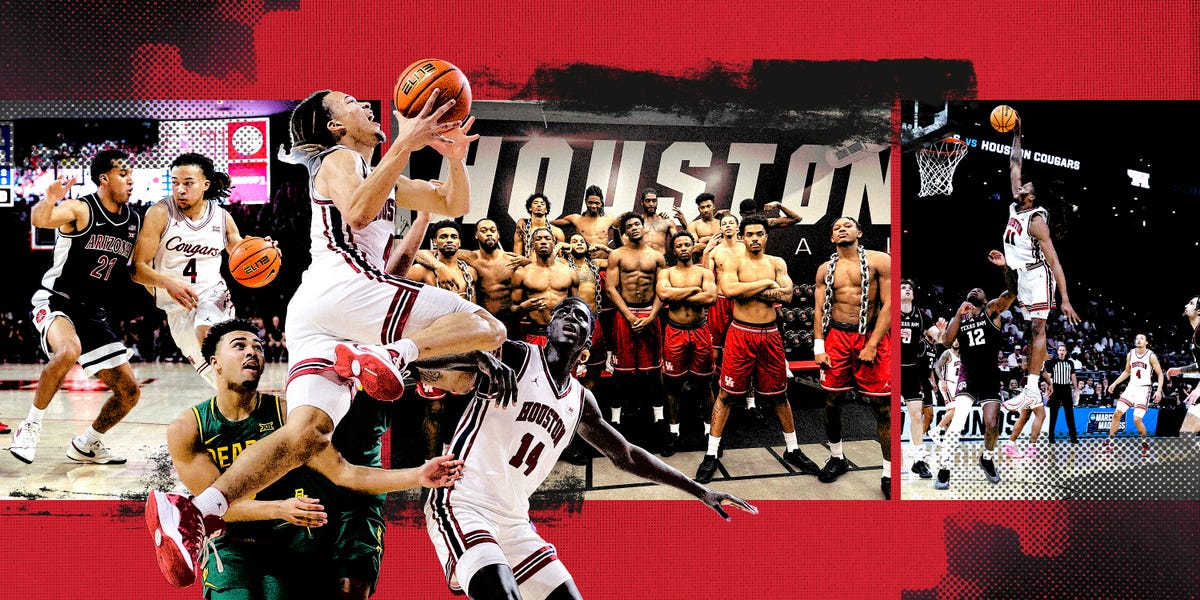
The viral photo of Houston’s very jacked 2024-25 squad that floated around last summer backs up that statement. College basketball fans may not think of building muscle as a key component of one of the top programs of the past few years, since basketball requires both explosiveness and endurance. But that focus feeds into Houston’s on-court identity—physical, tough, demanding—that they now carry into the Sweet Sixteen round of the 2026 NCAA tournament in pursuit of a national championship. Two-seed Houston will face three-seed Illinois on March 26.
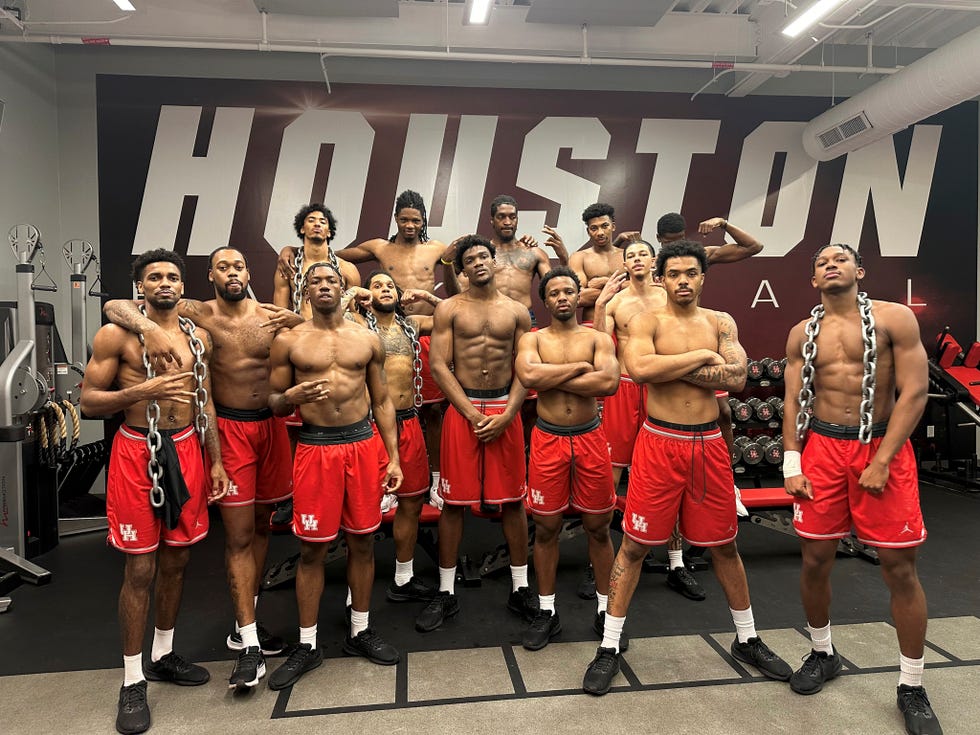 Houston Men’s Basketball
Players from the 2024-25 Houston squad flex (not the current 2025-26 team).
Bishop and the coaching staff are clear with recruits before they arrive: the program is demanding. The weight room, the off-season—players need to buy in before committing. “A lot of guys out there will run away from that,” Bishop says. “We get the kind of kids who run to that challenge.”
Bishop arrived in Houston in May 2017. A new practice facility had been built a year prior, with a new weight room and practice courts. He asked Sampson to invest in additional resources, including customized equipment specific for his training regimen.
Around seventy-five percent of Houston’s weight room equipment is custom-made, with gear sourced from all around the strength world. Bishop found a company in the UK, Watson, that customized the dumbbells to be thick handle revolving; Swedish weightlifting outfitter Eleiko made their barbells and bumper plates; a company from Canada, Atlantis, fabricated a hack squat machine long enough to fit an athlete over seven feet tell. Prime, a brand closer to home in Pennsylvania, custom built the hamstring pieces. “We’ve pinpointed the companies that would build things out exactly the way we want,” Bishop says. “If there’s a machine we need with a custom build, we go get it.”
Mobility, stability and skill are three of Bishop’s core tenets. “You must have mobility to get into positions, like a deep squat. You must build stability to add load,” Bishop says. “But a critical component often missed is you must develop the skill of training—developing and teaching guys what the mind-muscle connection feels like. You have to work at it [training], practice it, and do it with the intention to get better at it.”
Bishop pointed to examples of players who have gained nearly 40 pounds within his program. Offseason workouts run on a concurrent periodization model—concurrently driving up multiple physical attributes, whether it’s blocks of volume accumulation, hypertrophy, intensification, strength, or power. The realization block heading into the season is focused on peaking power output. Wednesdays are a one-hour session of mobility and recovery via the ELDOA method, a protocol Bishop prefers because of its emphasis on joints, tissue, and body work.
Bishop uses summer workouts to get the team outside the gym, with nontraditional drills including Danny ball (a version of beach volleyball with 12-pound medicine balls), strong man training, VersaClimbers, and running sessions that range from tempo runs and sprints up to a mile. All these off-court methods are meant to develop speed, power, and conditioning.
The next phase is preseason. Since practices have begun, the team shifts to three total-body training sessions a week. In-season, high-minute players strength train twice a week. Lower-minute players have extra conditioning and lifting. Redshirt and injured players (depending on the injury) will lift four to five days per week.
Team goals are central to Houston’s philosophy. One is for each player to have sub-10 percent body fat. “Fat don’t flex. Excess fat is a stressor,” Bishop says. “This is just necessary for how we play, the conditioning level required.”
That tenet is also upheld with Houston’s nutrition program, which is divided into three buckets. The first is the training table, i.e. full-fledged meals. Post-training breakfast buffets will include nutrient-dense foods like eggs, meats, nuts, fruits, berries, breakfast potatoes, oats (and grits, since Houston is in the South). Players return for a lunch buffet. In-season practices are late afternoon, so the post-practice dinner is a to-go box from a local restaurant waiting at their locker, “so they have to pick up the food to sit down,” Bishop says.
The second bucket is the fueling station: a 24/7 snack and hydration bar. Sports drinks with carbs are only consumed during practice and games. Otherwise, it’s water, Lemon Perfect, Quench, or Gold Standard Whey. The snack bar has a variety of fruits, pre-packaged meals, trail mixes and more.
The third bucket is supplements. “We try to address our nutrition from a standpoint of health driving performance,” Bishop says. “We’re looking at it from a micro-nutrient standpoint. Vitamin D, Omega-3 index, magnesium, zinc, multivitamins, etc. Anything that positively impacts your blood panel will drive your longevity.”
Sleep is another essential tenet. The basketball facility has eight custom-built sleeping pods designed to fit a 7-foot-plus athlete. The sleeping area is completely private. “You have to think of sleep as a meal, and naps as a supplement,” Bishop says. “Yes, we want our guys sleeping at night. And if we can get a nap during the day, it serves almost like a supplement to drive recovery.”
Much like advancing in March Madness, maintaining this level of commitment and focus is hard. But that’s also by design. “These guys want to have something that they need to struggle to overcome,” Bishop says. “Because if you go through that struggle, you go through the challenge and you overcome it. Now, you own it.”
Exercises for March Madness Strength
Bishop shared a few exercises that he uses with the Cougars to build strength and toughness to power their postseason runs. Here, he breaks down two standout exercises for the upper and lower body (and shares a few more).
Overhead Press
Also mentioned: Pullup/chinup, weighted dips
BISHOP: Long-term shoulder health is going to be much more predicated on vertical strength and mobility versus horizontal. When it comes to the overhead press, the greater you drive your overhead press, the more transfer there will be to the horizontal press. Meaning, don’t feel like your bench press is going to get really bad because you’re doing so much overhead pressing. Anybody who’s got a really good overhead press is typically going to have a really good bench press. But if all you do is focus on bench press, that doesn’t mean you’re going to have a good overhead press. Ultimately, driving your strength vertically will have way more transfer to driving your strength horizontally than the other way around.
Front Squat
Also mentioned: Glute-Hamstring Raise/Romanian Deadlift, Front Foot-Elevated Split Squat
BISHOP: Squat is the king of all exercises. I think the front squat is the exercise that has the most transfer for athletes. The example I like to use is this: You can go to gyms all over this country and you can find somebody who’s got a decent strike level. They can do a 315-pound back squat. But it doesn’t mean that they can do a full depth, 250-pound one. But if you go and find anybody that can full depth 250 on the front squat, they’re guaranteed they can do that 315 on the back. So, the front squat will drive up your back squat numbers.
A lot of times we’ll elevate our guys’ heel onto a 10-degree wedge, like a squat wedge or a slat board. Because when you have this super long wingspan, these really long legs, your torso is going to be a little bit short. Right? Somebody with a longer torso is typically a bit better at back squats. So, by elevating the heels, you can target leg strength a bit more versus that forward lean on the back squat, where it’s going to be a little bit more hip and low back dominant. There’s nothing wrong with that, but we need the quads to be strong. And that’s going to really help your vertical force production—vertical jump.

Anna Katherine Clemmons is an adjunct professor of Media Studies at the University of Virginia, and has written for numerous publications, including ESPN the Magazine and The New York Times.