Returnal was the sort of surprise I wish we had more of. On paper, it sounded audacious that Finnish studio Housemarque, known for incredibly tight arcade action with a story that was either poor or non-existent, had set out to tell a deep and compelling science-fiction story with thematic coherence. They even wanted to go fully 3D instead of the side-scrollers and top-down titles they’d made their name on. In fact, Returnal also started out as a top-down game in the style of Dead Nation and Alienation, founder and CEO Illari Kuittinen tells me over a beer the evening before the preview event to which Housemarque and PlayStation has invited the world’s gaming press. It’s Saros’s turn to bask in the limelight after five years of development and confidence is high. This is undoubtedly because that boldness paid off, as Returnal was one of 2021’s best games and proof that Housemarque could easily step into its new role.
Saros does not break new ground in the same way. It is, to a greater extent, “Super Returnal”, a spiritual sequel that builds on the ideas Returnal introduced, but in a new world. That much is clear after more than three hours with the game. However, this should not be seen as a criticism, as games take a long time to make, and Returnal laid such a strong foundation that it makes sense to build on it, and because Housemarque has once again succeeded in creating a universe and a story I’m incredibly curious to unravel, whilst refreshing the gameplay in exciting ways. Saros looks set to be another hit from the Finns.
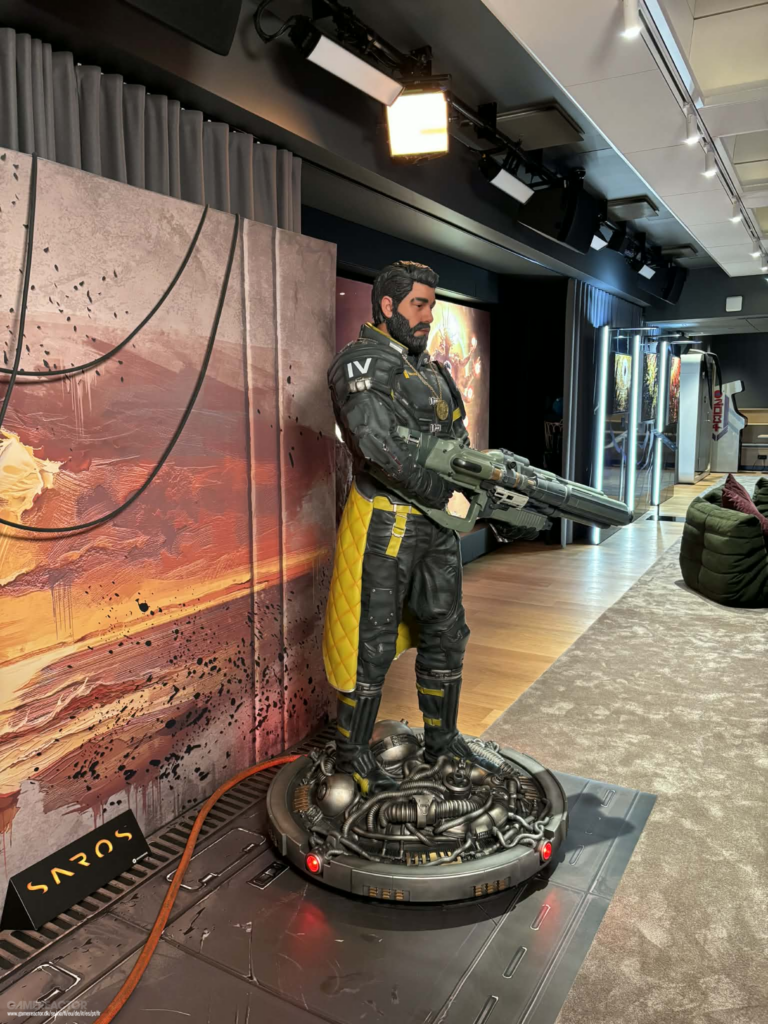
 Our protagonist, Arjun Devraj.
This is an ad:
But let’s rewind a little. One of the people who can rightly be credited with Housemarque’s tremendous development as storytellers is the Brit Gregory Louden, who, like several others at Housemarque, joined the studio from Remedy, and who, as narrative director, laid the groundwork for Returnal’s unique take on intergalactic sci-fi meets cosmic horror. At the time, Harry Kruger was the director, but having been involved in Saros’ early stages, he handed the reins to Louden, who opens the presentation that forms the basis of our time with Saros. “This is a dream project made by a dream team,” says Louden. A phrase that has been used right from the announcement. However, it doesn’t seem (just) like hot air. Over the two days I spend with Housemarque – both in the studio and in, shall we say, more informal surroundings – I speak to a good handful of different people from the team and the enthusiasm is unmistakable. Of course, they’re also happy to finally be able to really talk about what they’ve spent the last five years working on, but they also seem genuinely excited about what they have to share with us. This is evident when my table companion at the welcome dinner, VFX Lead Sharman Jagadeesan, enthusiastically snaps a photo of the Saros menu lying beside our plates, or when Kuittinen regales a small group of journalists with anecdotes about the studio’s convoluted history.
There is good reason for the enthusiasm. As mentioned, Saros builds on the formula introduced by Returnal. At its core, it’s a challenging action game, a “Ball Brawl”, as Housemarque cheekily calls it, where gameplay comes first, but the world and story aren’t far behind. There are clear roguelike and Metroidvania elements, but the former are less pronounced than in Returnal (more on that later).
 Housemarque has physically recreated parts of the Soltari colony in their studio.
Although Housemarque prioritises gameplay above all else, I’d like to switch things around and start by setting the scene narratively. You play as Arjun Devjrac; a soldier from the Soltari conglomerate, whose complete indifference to the value of human life brings to mind Weyland-Yutani. Arjun is part of a rescue mission tasked with finding out what has happened to the three waves of colonists that Soltari sent to the planet Carcosa to mine a valuable energy source. According to Louden, Arjun’s role in – and relationship with – Soltari represents the classic science-fiction side of the narrative coin, whilst Carcosa and its former civilisations embody the cosmic horror.
This is an ad:
Unlike Returnal, where you, as Selene, were completely alone, in Saros you have a handful of colleagues you can talk to in the starting area, which has been vastly expanded compared to Returnal. This makes sense structurally as a breather where you upgrade your abilities and chat with the others provides a much-needed break from the core gameplay, but I was worried that it would dilute the sense of helplessness that was so powerfully conveyed in Returnal. Fortunately, Housemarque pulls off a narrative masterstroke by having one of your colleagues attack you on your very first visit, thereby establishing that Carcosa has a terrible effect on people. The question quickly becomes who you can trust and who will be next, creating a paranoid atmosphere where you need each other but, at the same time, don’t really trust one another. When, for example, the mission’s gardener suddenly starts talking nonsense, alarm bells start ringing, but then he makes an excuse and makes you think that perhaps it’s just you who is paranoid.
Arjun, however, is no angel himself, for he is harbouring a secret. He is searching for someone, and he prioritises that search above all else, yet fails to share a single word about it with any of his colleagues. Why he keeps this search hidden is not yet known, but one suspects his motives lie in a grey area of sorts.
 Saros’ take on the classic shotgun.
“I love writing science-fiction stories,” Louden tells me enthusiastically, before I settle down to play. And it’s clear to see, because although many of the narrative elements are familiar to anyone reasonably well-versed in science-fiction and horror, it is, so far, a compelling cocktail that I can’t wait to drink every last drop of.
The same can be said of the incredibly tight core gameplay. For a third-person shooter, it’s fast-paced and arcade-style, just like Returnal, but it feels even more precise and impactful. The big change is the shield. In Returnal, it was mainly about dodging using Selene’s handy dash. That’s still the case here, but Arjun also has a shield which, as well as protecting him, can absorb bullets, converting them into energy that can be used to fire a powerful special attack. You activate the shield with R1, meaning both R1 and L1 are in constant use, as the shield isn’t effective against all projectiles. The standard blue ones are fine, but corrupted orange bullets will damage you. This brings to mind the developer’s brilliant 2011 title Outland, which also played with colour-coding in a similar way.
In its marketing of Saros, Housemarque has made a point of explaining how, with its permanent progression, it’s more accessible than Returnal, but the addition of the shield actually increases the complexity and requires you to approach the game differently by constantly assessing whether to seek out or avoid an attack.
All in all, Saros is a challenging game. The game’s first boss, Prophet, thrashed me a handful of times before I got the hang of it, and whenever I let my concentration slip, I was punished severely.
Prophet is, incidentally, a wonderful culmination of the first biome, Shattered Rise, which introduces Saros in the most beautiful way. The neoclassical architecture and spectacular vistas are a far cry from the overgrown ruins that introduced Returnal. In fact, they bring to mind FromSoftware’s decaying worlds, a comparison that becomes no less relevant when the game’s art director, Simone Silvestri, tells me that the tower looming on the horizon is a place we’ll be visiting.
“Violent beauty” is the mantra for the game’s art direction, and when Silvestri explains his process, the phrase makes perfect sense. “I like to start with the basics. History, mysticism, folklore. You take something relatable; something you can understand, and tear it apart. I love contrast and clashes, so I take another idea that’s very different, make them fight, and see what develops,” he says. The result is striking. It’s still dark and at times claustrophobic, but also opulent and grandiose.
Like Louden, Silvestri has also joined Housemarque from Remedy, Helsinki’s other major non-mobile developer. There seems to be great respect for colleagues in Espoo, but that doesn’t mean the approach to game development is the same in both places. “At Housemarque, there’s a different approach to collaboration between departments,” he explains, continuing with, “when you’re at Housemarque, you need to understand the gameplay second by second, minute by minute and hour by hour at a truly fundamental level, because we’re a gameplay-first developer.”
 Arjun’s armour is inspired by action heroes from the 80s and 90s.
Silvestri is an interesting person to talk to because his department has to bow to the sacred cow of gameplay, yet is still held in high regard. “First priority: improve the gameplay. Second priority: world-building. The priorities are very clear,” as he puts it. For example, when he started working on the art direction for the spheres that are so important in Housemarque’s games, he added a lot of effects such as lightning, after which the gameplay designers had to ask him to tone it down a bit, because it was almost impossible to see what was happening on the screen. Similarly, there is also a system for the layout of the screen, he reveals. “At the top of the level design is where you find all the details. The middle is simpler, because you need to be able to read it easily.”
It’s impressive how seamlessly the tight gameplay works with the captivating world in practice. Especially when, after defeating the aforementioned Prophet, I venture down into the second biome, Ancient Depths. Here, breathtaking vistas have been replaced by a twisted, metallic underground that feels like something out of Scorn or perhaps Aliens.
The comparison with Aliens seems particularly apt, as Silvestri explains that 80s action films were one of the major visual inspirations. Ancient Depths is also the biome that introduces choice in Saros. Whereas Shattered Rise is entirely linear, Ancient Depths has two core objectives that can be completed in any order. Combined with the markedly different visual style and the more claustrophobic combat, it feels completely different whilst fitting in brilliantly. “We want each biome to be its own thing,” says Silvestri, teasing even more striking changes later in the game. Housemarque won’t say exactly how many biomes there are, but judging by the menus, six is a reasonable guess.
Depending on the order you choose to complete your objectives, you’ll trigger a solar eclipse either early or late in the biome. The solar eclipse is another major difference from Returnal. Carcosa’s former civilisations attempted to use it to reach a higher plane. They shed their skin and endured pain, madness, and greed. They would do anything to attain the power the eclipse had the potential to grant. These are grim matters, which we are fortunately allowed to peel back layer-by-layer. Mechanically speaking, it makes most sense to think of the solar eclipse as a corrupted state, where the surroundings change, enemies become more aggressive, and the power-ups that normally only make you stronger also come with drawbacks.
It’s exciting stuff, partly because Silvestri explains that the eclipse varies from biome-to-biome, but also because the aforementioned drawbacks add a much-needed layer of risk/reward to the progression during each run. This aspect, in particular, is one of the few things I didn’t love about Saros. Usually, you’re simply handed an upgrade without having to make a choice, which diminishes the sense of building up your Arjun throughout that particular run. There are choices along the way and also a reward for being curious, but from what I’ve played, you don’t have nearly the same control as in, say, Hades. This also applies to the permanent progression, which, despite the choices, is still just about as linear as it gets. Initially, you upgrade either your health, your ability to quickly collect upgrade materials, or your shield. There’s nothing wrong with that, as it’s useful, but it’s not particularly exciting either. However, I did manage to unlock “Second Chance”, which, as the name suggests, revives you when death strikes.
I can only hope that Saros comes up with more game-changers like this.
But even if the roguelike elements end up being less prominent, it won’t spell the end for Saros, as it’s significantly less rogue than Returnal. I’ve already touched on the permanent progression, but perhaps even more significant is the fact that you can teleport directly to a biome once you’ve unlocked it. This means shorter runs, and for all of us who played Returnal at launch, it’s also welcome news that autosave during runs is included from the start.
 Housemarque is based in central Helsinki.
I hope the above makes it clear that I’m pretty excited about what I’ve played so far. As someone who absolutely adored Returnal, Saros is perhaps my most anticipated game of the year, but I was also a tad sceptical about whether it could recapture the magic. Based on what I’ve played, however, I can slowly start to put my concerns aside, because Saros is exactly as captivatingly bleak as I could have hoped; it plays like a dream, and it doesn’t really resemble any other AAA game on the market apart from, of course, Returnal and perhaps the three latest Doom games. This is primarily due to the fusion of dark science-fiction with narrative depth and arcade-inspired shooter gameplay, but also to Housemarque’s “almost engine” Graphite, which visually sets it apart from the sea of UE5 games with its “hypnotic sphere patterns”, as Silvestri likes to call them.
Before Returnal, Alienation, and funnily enough, Supreme Snowboarding were the biggest projects Housemarque had been working on. With Returnal and now Saros, they’ve moved up into a different league without losing that arcade spirit I’ve always admired them for. After the opening presentation, Kuittinen joked that Housemarque might combine snowboarding with bullet hell (sorry, ballet!), but then quipped that they’d probably be making third-person action games for the next 10 years. An innocent joke, were it not for the fact that, after a few beers the night before, he mentioned in a far more serious tone that ideally one should have a 10-year plan.
If the next decade is to be all about Returnal-style games, I’ll be the first to welcome it, as long as the Finns can continue to approach the task with the passion and craftsmanship they’ve put into Saros. Hopefully, the rest of the game lives up to those opening hours, because in a vulnerable industry, we need people like Kuittinen, Louden, Silvestri, Jagadeesan, and the rest of Housemarque.