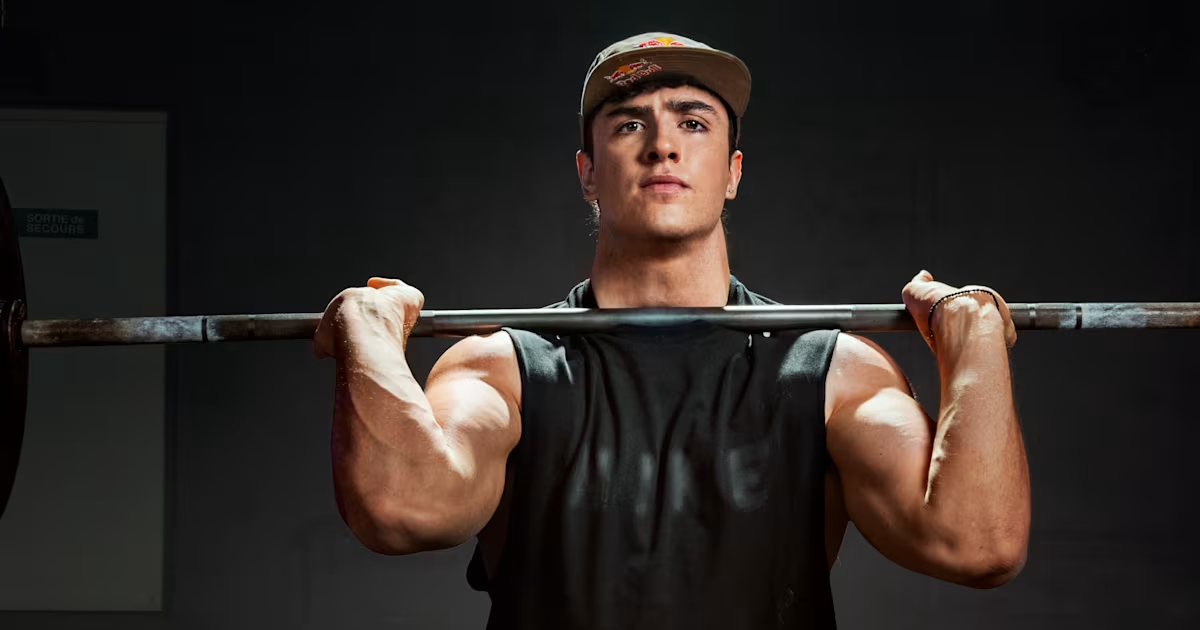
Six days a week, Victor Hoffer is in the gym – lifting weights, running, drilling movements and repeating them again and again. Gruelling and repetitive to some, but not to him. At 22, the French functional fitness athlete has a clear mission: push his limits and work towards becoming one of the best athletes in the world.Hoffer approaches training with the same commitment others reserve for their favourite TV show. Strength, endurance and technical skill all come together in his sessions, which he shares with a growing audience online. His message is simple: consistency, curiosity and mental resilience can take you much further than you think.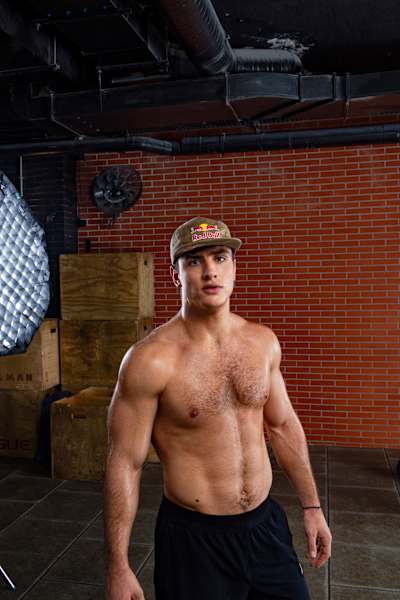
Sport has been part of Hoffer’s life from the beginning
© Carlos Suárez
Sport has been part of his life almost from the beginning. Born in Colmar in eastern France, Hoffer started gymnastics at the age of three, before eventually progressing to functional fitness, where the blend of strength, endurance and gymnastics immediately resonated with his background.
Today Hoffer trains more than 25 hours a week. His goal over the next few seasons is clear: steadily climb the global rankings and cement his place among the sport’s elite. For him, every competition and every session is another step towards that level. This year alone, he aims to enter the World Top 15, then into the Top 10, and also hopes to win a Workout of the Day at the Games.
The Red Bulletin sat down with Hoffer to find out more about his mindset, his goals and his training regime.
01
“Brick by brick” – building towards being the world’s best
Hoffer is taking a step-by-step approach to becoming the world’s best
© Carlos Suárez
Hello Victor. Could you sum up ‘Who is Victor Hoffer?’ for those who don’t know you so well?
 Victor Hoffer: I’m 22 years old and I’m from Colmar in eastern France. I started with gymnastics when I was three years old and later trained at a specialised centre near Lille. When I was 16 I moved back to Colmar and started functional fitness because my whole family was already doing it.
One of the phrases you use online is “brick by brick”. What does that mean for your ambitions?
It means progressing step by step. I’m improving physically but also mentally. Competition always brings situations you can’t fully prepare for. Every experience teaches you how to react better next time.
Right now I’m adding more running and more competitions to my schedule. The goal is to keep building experience so that when the big opportunities come, I’m ready.
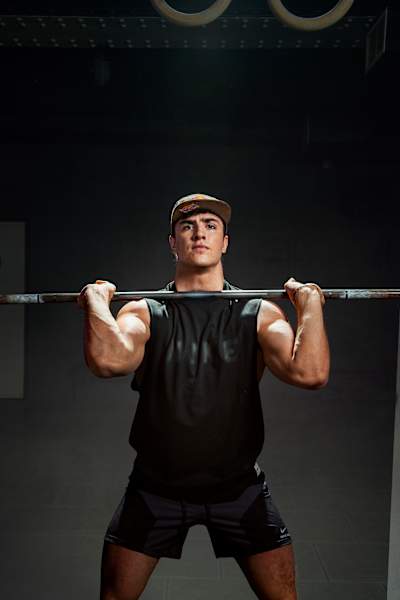
Hoffer often trains alone
© Carlos Suárez
You also use visualisation as part of your preparation. How does that work?
If I’m preparing for a lift, I’ll imagine the entire sequence – from walking up to the barbell to completing the movement. Weightlifting can be risky, so I picture every detail and possible scenario.
The aim is to create a kind of bubble around myself. When competition day comes, I can focus purely on execution without being distracted by everything happening around me.
Is weightlifting dangerous at this level?
It can be. Last year I partially tore a cruciate ligament while performing a shoulder press.
Weightlifting can be risky, so I picture every detail and possible scenarioWhat happened?
My feet were positioned incorrectly and my knee moved outwards during the lift. I was lifting 166kg at the time. With heavy weights, even a small technical mistake can lead to injury.
What has been your toughest injury so far?
A double stress fracture in two lumbar vertebrae. It developed gradually until the bones finally gave way. I had to wear a back brace for six weeks and couldn’t lift for almost four months. The back pain lasted for nearly two years.
03
Discipline as a form of freedom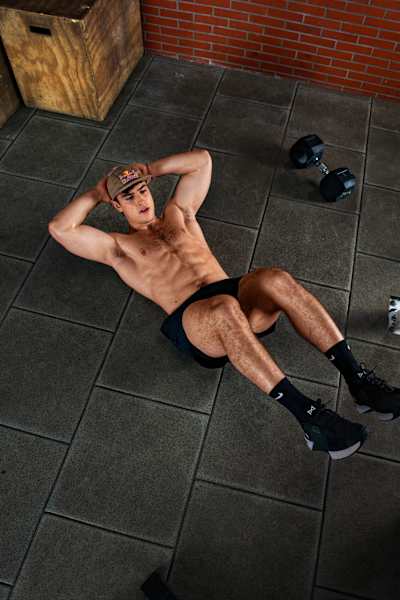
Hoffer spends up to 25 hours per week in the gym
© Carlos Suárez
How much time do you spend in the gym each week?
Usually between 20 and 25 hours, sometimes more. That includes warming up, setting up equipment and moving between sessions.
How many days do you train?
Six days a week. Monday to Saturday. Sunday is complete rest.
What motivates you to keep showing up?
Discipline. When I was younger in gymnastics, training wasn’t really a choice. Now it is – and that’s what makes it feel like freedom. I can decide to go to the gym and push myself.
Many people your age would define freedom very differently.
That’s true. If I compare my life to someone who goes clubbing every weekend, it’s completely different. I’ve had to give up some things, but over time I realised I actually enjoy this lifestyle.
04
Training alone – but not unsupported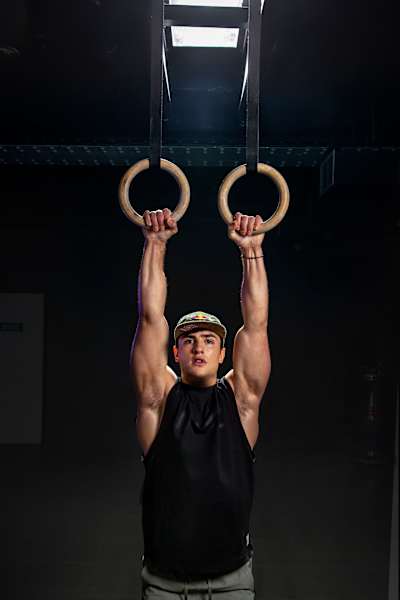
Hoffer has a background in gymnastics
© Carlos Suárez
How do you manage to train alone for so much of the time?
I often train alone, which I enjoy and it’s hard to find training partners at the same level, even though I do have some, of course. Beyond the training itself, I have a great team behind me, supporting me on this journey and helping me push myself.
I’m thinking in particular of my coach, who lives near Copenhagen and has a huge training facility where he often invites athletes. My coach plans my training every day, which is incredibly important.
I also have my manager, Lucile, who’s with us today. She helps me with projects like this interview and my developing relationship with Nike.
There’s also my girlfriend, Maja, who helps me a lot, and with whom I share the same passion. I’m also thinking of my parents who support me, especially by always having me at home.
Set realistic short-term goals – don’t try to go all-in at 150 percent from day one
05
Advice for athletes entering functional fitnessMany people have recently discovered fitness competitions such as HYROX. What advice would you give someone starting functional fitness training?
Start gradually and find a good training environment with experienced coaches. Ask questions and learn the movements properly.
Most importantly, set realistic short-term goals. Don’t try to go all-in at 150 percent from day one. Build things step by step – brick by brick.
Personally, I did the opposite at the beginning and went all out straight away. I wouldn’t necessarily recommend that.
06
Breaking down Victor Hoffer’s weekly training schedule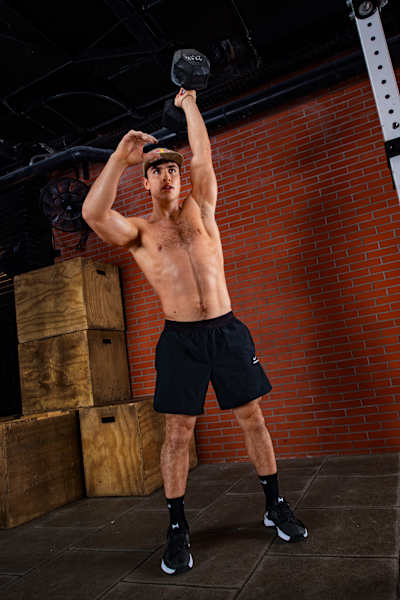
Hoffer works the hexagonal dumbbells
© Carlos Suárez
Victor Hoffer spends six days a week in the gym and follows a highly structured programme. His training combines heavy strength work, long endurance sessions and demanding gymnastics movements to build a complete athletic profile.
Here’s what a typical week looks like:
Endurance cardio machines
4 sessions per week
Up to 1h 30m per session
Equipment includes the bike, rowing machine and SkiErg – sometimes individually, sometimes combined.
Competition-style workouts
4 sessions per week
Two upper-body sessions and two lower-body sessions
Includes both Olympic-style lifts and traditional strength work such as bench press or military press.