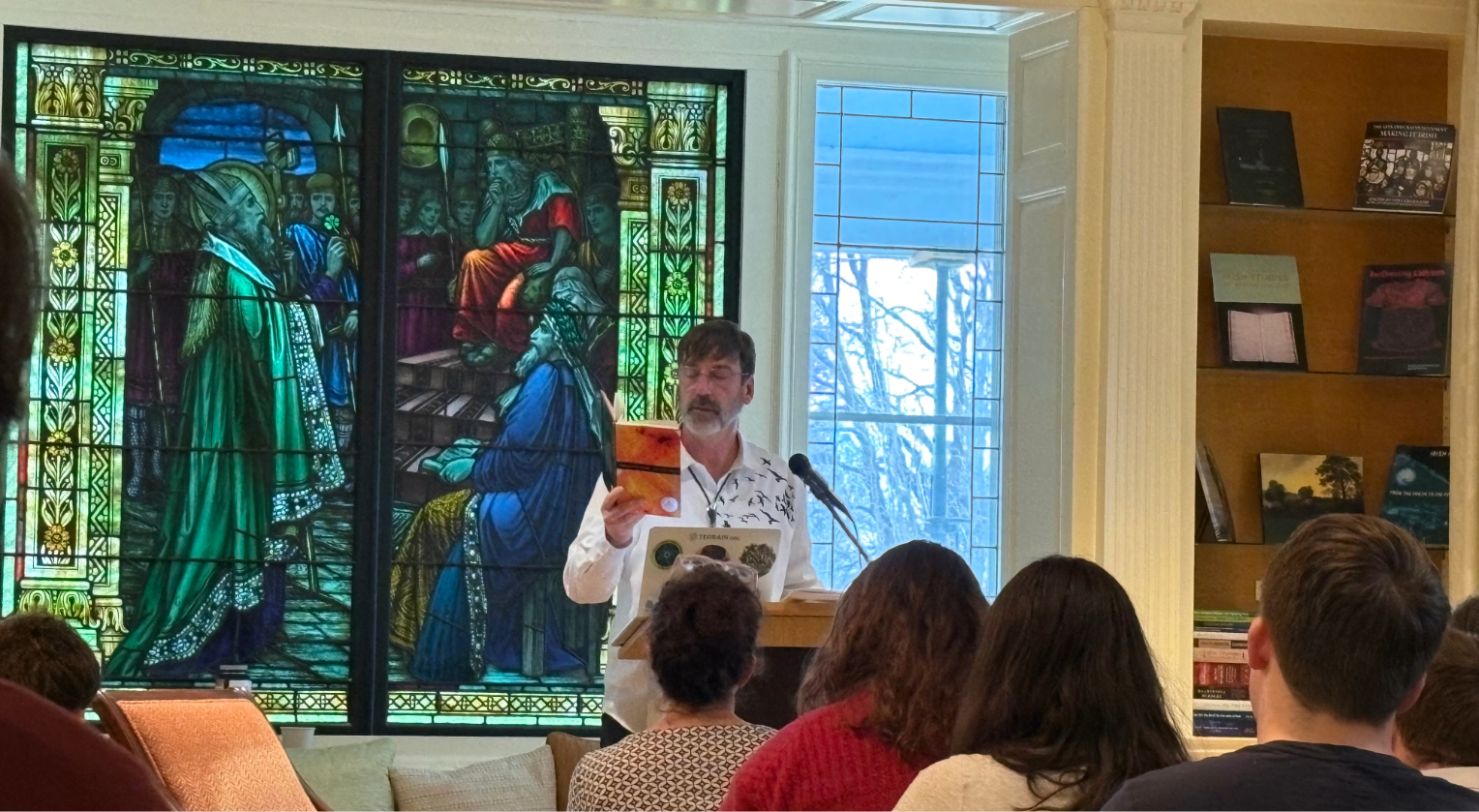
On Thursday evening, Washington State Poet Laureate Derek Sheffield spoke in the Connolly House to an intimate crowd of students and faculty. Sheffield, the author of two poetry books, co-editor of two anthologies, and recipient of several literary awards, presented an insightful and engaging reading of his work.
Boston College English professor Suzanne Matson introduced Sheffield with an anecdote from her time at the University of Washington, where she taught Sheffield. She recounted an assignment where students had to imitate a poet of their choosing, and Sheffield chose to mimic Mary Oliver, a decision which inspired his love of nature poetry.
“I take total credit,” Matson joked.
When Sheffield took the podium and greeted the audience, he immediately asked the crowd to take a selfie. The room filled with laughter and smiles as he stretched out his phone to take a picture of himself and the crowd of around 30 people.
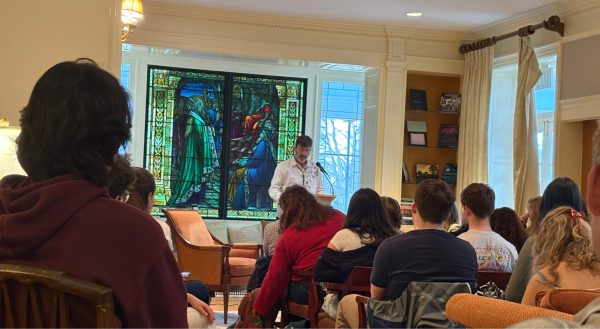 (Lillian Kelly / Heights Editor)
Sheffield then began to discuss how poetry has shaped his life. He explained that, as poet laureate of Washington state, he works to serve the art form of poetry and share it with others. Holding up his cup of tea to the audience, he used his teabag as a metaphor.
“My life has been steeped in poetry,” Sheffield said, pulling the bag from the mug for emphasis.
As he dove into his readings, the room filled with anticipatory silence. Despite his gentle demeanor, Sheffield’s command over the room was astounding.
His first reading was of “January Poem” by Suzanne Matson, an homage to his old professor. He dictated with a careful rhythm, taking time to pause between phrases and speaking with a gentle lilt. Afterwards, Sheffield expressed his desire to write shorter poems like Matson’s.
Matson responded by teasing him kindly and asking him to read something of his own. Sheffield obliged, reading “Bye-bye,” a poem of his about winter ending. His soft enunciation, in combination with the incredibly intimate space, had the audience listening with bated breath. The room was silent as they listened to Sheffield bid winter goodbye.
Afterwards, Sheffield read “Fish Like These,” which contemplates the sentience and suffering of a fish in captivity. Sheffield’s poem describes the complex experience of a rare fish in an aquarium, painting a powerful image of onlookers gawking at it.
Between poems, Sheffield engaged the audience with a playful wit. He cracked jokes and dropped pearls of wisdom, making the event feel akin to a gathering of friends, rather than a stodgy academic lecture.
After reading a poem by William Stafford—one of his inspirations—Sheffield read “Darwin’s Eyes.”
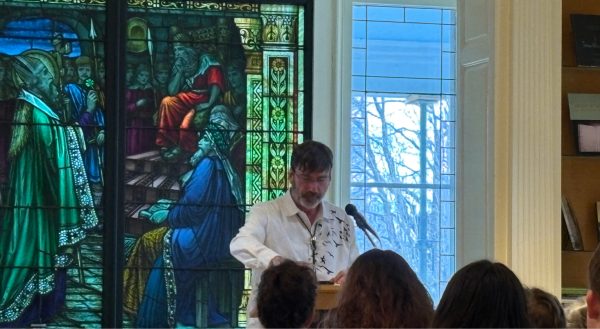 (Lillian Kelly / Heights Editor)
The poem enters the perspective of Charles Darwin studying evolution. Many of Sheffield’s poems incorporate his love of nature and biology, and “Darwin’s Eyes” is a clear example of Sheffield’s passion for ecological exploration. In a Q&A section afterwards, when asked why he has such an interest in combining ecology and poetry, Sheffield had a quick response.
“Love, man,” Sheffield said.
Sheffield explained how he discovered his love for the environment during his early teaching years in Seattle, Wash., where he lived in a cabin surrounded by nature. Expressions of nature’s vitality are ubiquitous in his work.
“Wonder is at the heart of both of them,” Sheffield said, when asked about the connection between biology and poetry.
Sheffield also expresses a different type of love in several of his poems. Two of the poems he read, “Her Calling” and “She Gathers Rocks,” are about his daughter. The poems were witty and heartwarming, often using childlike diction to convey a sense of youthful endearment.
To conclude, Sheffield read a new poem, also about his daughter, with the working title “All of it, and Zoey.” This piece was more contemplative than the previous ones, and, through his words, the audience became acutely aware of the love Sheffield has for his daughter.
Sheffield’s poetry reading was intimate, and, with his humble and knowing demeanor, Sheffield instilled feelings of hope and comfort in each audience member. The poems were both solacing and thought-provoking, and in combination with his warm personality, made for a memorable event.