Why Ulta Beauty Stock Is On Investors’ Radar
Ulta Beauty (ULTA) has drawn fresh attention after a sharp share price pullback over the past month. This has prompted investors to reassess how its current valuation lines up with its earnings and growth profile.
See our latest analysis for Ulta Beauty.
While the recent 30 day share price return of 24.01% decline has drawn attention, Ulta Beauty still has a 1 year total shareholder return of 40.85%, with longer term gains over 5 years but a small 3 year total shareholder return decline. This suggests momentum has recently faded despite earlier strength.
If Ulta’s pullback has you rethinking where growth might come from next, it could be worth scanning for other opportunities through the 20 top founder-led companies
With the share price pulling back over the past month, but Ulta Beauty still showing positive 1 year and 5 year total returns, is the market now underestimating the story or already fully pricing in future growth?
Most Popular Narrative: 22% Overvalued
Ulta Beauty’s most followed narrative pegs fair value at $427.41, which sits below the last close of $521.64, and that gap is central to the story according to n385903.
Ulta, the other company I was thinking of cutting, has a surprisingly favorable relative valuation in the beauty retail space. It has decent margins and actually is able to direct decent amounts of buybacks. Beauty products in particular make a lot of sense to be sold alongside salon services in a storefront so you can actually suss out the high-end products in person. They have numerous private label brands and partnerships that attract customers, providing a small buffer to their expanding loyalty program. They are at their lowest ever P/E ratio right now at only 13, but with a high P/S and book ratio of 7, which is odd to me. They have a strong Return on Capital Employed (ROCE) and are free from debt. However, being a pure-play storefront with little room to grow aside from the untested waters of abroad leaves this company with a likely case of declining margins and earnings before only being able to grow modestly in the future. It is certainly a giant that can grow bigger, but the execution risk amid growing competition from e-commerce and other legacy storefronts in the US may take away their market share in areas that are already saturated with stores. Perceived undervaluation is mostly tangible under assumed multiple expansion, which doesn’t leave a whole lot of room for an edge. Morningstar has the following to say: “We believe it carries more products and brands in the major beauty categories of makeup, hair care, skin care, fragrance, bath, and accessories than any other US specialty beauty retailer. According to the National Retail Federation, Ulta and wide-moat LVMH’s Sephora are the only two specialty beauty retailers among America’s 100 largest retail companies. Although Ulta faces significant and increasing competition, we believe it has a unique market position and loyal customers. As evidence of its competitive edge, its adjusted return on invested capital, including goodwill, has consistently been above our 9% estimated weighted average cost of capital. We estimate Ulta’s adjusted ROIC, including goodwill ROIC, will average 27% over the next decade… We view Ulta’s ability to thrive in a very crowded marketplace as evidence of a competitive edge…We view Ulta’s strong margins as evidence of its competitive edge…We think Ulta’s salon services with 8,000 stylists provide a competitive advantage. The $60 billion (IBISWorld estimate) US hair salon industry is very fragmented, as national chains (such as those franchised by Regis) have less than 10% share…We believe Ulta has opportunities for store growth despite its large base. The chain has expanded rapidly, having added about 1,000 locations since the end of 2008. As Ulta now has stores in all 50 states and all major metropolitan areas, we believe its store openings will slow. Unlike some competitors (including Sephora), Ulta has no stores outside the US. The firm had planned to enter Canada in 2021, but this expansion was put on indefinite hold. Instead, Ulta’s first international expansion will be into Mexico through a partnership with Grupo Axo… Due to the ease of launching products online and marketing them through platforms like Instagram, it has never been easier to launch new beauty products. Many of them fail, but some of them have found success. Ulta has been proactive in seeking new brands and offering them in its stores…We estimate Ulta will achieve 4% compound average sales growth over the next 10 years, well below its 16% average annual sales growth over the past decade. We forecast 4% yearly same-store sales growth in the long term.”
Curious how a business with high returns on capital, no debt, steady buybacks and moderated long term growth expectations still lands below today’s share price? The full narrative walks through how those profit assumptions, margin paths and future valuation multiples connect to that $427.41 fair value.
Result: Fair Value of $427.41 (OVERVALUED)
Have a read of the narrative in full and understand what’s behind the forecasts.
However, if competition in beauty retail or a weaker response to Ulta’s Mexico and international plans affects growth assumptions, that $427.41 fair value marker could shift quickly.
Find out about the key risks to this Ulta Beauty narrative.
Another View On Ulta’s Valuation
That 22% overvalued fair value of $427.41 relies on assumptions about margins and growth, but the simple P/E comparison tells a slightly different story. Ulta trades at 20.1x earnings, below peers at 32x but above the 18x fair ratio and the 18.8x US Specialty Retail average.
This mix of cheaper than peers, but richer than both the fair ratio and the broader industry, points to a valuation that could move either way if sentiment, growth, or margins shift. Which anchor matters more to you: the peer gap or the fair ratio signal for potential valuation risk.
See what the numbers say about this price — find out in our valuation breakdown.
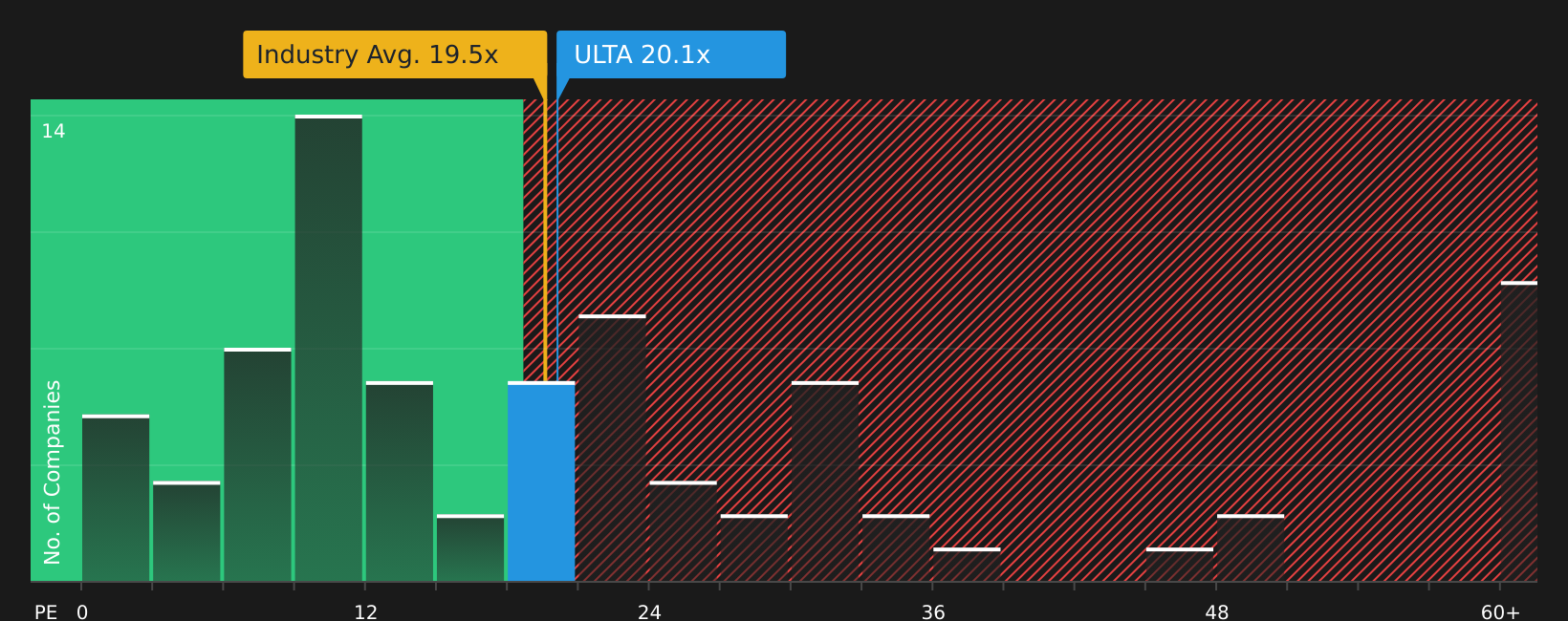 NasdaqGS:ULTA P/E Ratio as at Mar 2026Next Steps
With mixed views on whether Ulta still offers value after its recent pullback, it makes sense to look at the numbers yourself and move quickly to form a view. To understand what is driving optimism behind the company’s strengths, review the 2 key rewards
Looking for more investment ideas?
Ulta might be front of mind today, but your next opportunity could sit in a different corner of the market, so consider giving yourself options before prices move.
This article by Simply Wall St is general in nature. We provide commentary based on historical data
and analyst forecasts only using an unbiased methodology and our articles are not intended to be financial advice. It does not constitute a recommendation to buy or sell any stock, and does not take account of your objectives, or your
financial situation. We aim to bring you long-term focused analysis driven by fundamental data.
Note that our analysis may not factor in the latest price-sensitive company announcements or qualitative material.
Simply Wall St has no position in any stocks mentioned.
New: AI Stock Screener & Alerts
Our new AI Stock Screener scans the market every day to uncover opportunities.
• Dividend Powerhouses (3%+ Yield)
• Undervalued Small Caps with Insider Buying
• High growth Tech and AI Companies
Or build your own from over 50 metrics.
Have feedback on this article? Concerned about the content? Get in touch with us directly. Alternatively, email editorial-team@simplywallst.com