4
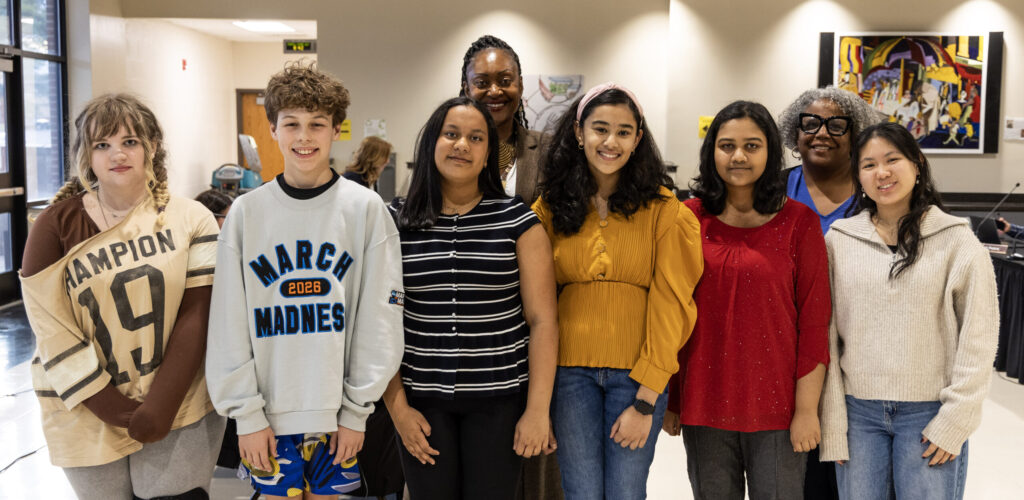
Students across the Hopewell Valley Regional School District were recognized Monday night for their work in a new digital wellness essay contest, part of a broader effort to address student well-being in an increasingly online world.
The recognition came during the March 23 Board of Education meeting, which also included discussion of new policies governing library materials and book challenges, along with updates on student programs, district initiatives, and upcoming plans.
Students honored for digital wellness essays
The essay contest, organized by the district’s Digital Wellness Committee in partnership with the Hopewell Valley Municipal Alliance, invited students to reflect on how technology impacts their lives and how to use it responsibly.
Corrine Rutt, the district’s supervisor of counseling, said the initiative was designed to encourage thoughtful and intentional use of devices.
“We received many thoughtful and impressive submissions, making it a challenge to select just a few students to recognize,” Rutt told the board.
Students recognized included:
Arini Tripathi (Timberlane Middle School) — Most impactful
Parker Berube (Timberlane Middle School) — Best research
Nitya Tiwari (Timberlane Middle School) — Honorable mention
Mikhailo DelMarco (Hopewell Valley Central High School) — Most impactful
Sara Zhao (HVCHS) — Best research
Amaris Linnea Andrew Sugan (HVCHS) — Honorable mention
District officials said the contest reflects a growing emphasis on digital wellness alongside traditional substance use prevention efforts.
Superintendent Dr. Rosetta Treece said the district has expanded its focus in recent years as new challenges have emerged.
“We’ve added digital wellness… because it just kept coming up that students were having a lot of mental health problems as a result of devices,” she said.
She added that concerns such as online gambling are also becoming more prevalent among students.
Student programs and supports highlighted
District officials also outlined a wide range of programs supporting student well-being.
Rutt highlighted initiatives including:
Social-emotional learning through the Character Strong curriculum
In-school counseling and mental health services
Partnerships with Rutgers Behavioral Health
Peer mentorship programs such as the Panda Club
The district has also trained more than 100 staff, parents, and community members in youth mental health first aid.
Board reviews new policy on library materials and book challenges
The board also reviewed a set of policies on first reading tied to New Jersey’s recently enacted “Freedom to Read Act,” which establishes formal procedures for how school districts handle requests to remove or restrict books.
Board Vice President Dr. Pamela Lilleston said the policies are intended to bring the district into compliance with the new law, which took effect in December 2025 and requires districts to adopt clear guidelines around library materials and challenges.
The proposed policy creates a structured process for reviewing materials, including who can file a complaint and how decisions are made.
Under the policy, requests to remove or restrict books can only be submitted by individuals with a direct connection to the district—such as students, parents, or staff—and must go through a formal review process.
Those requests would be evaluated by a committee that includes school staff, a parent, a board member, and, when appropriate, a student, before a recommendation is made to the board.
Superintendent Dr. Rosetta Treece said the law is designed to ensure that decisions about books are not made arbitrarily or without due process.
“This was passed to keep folks from challenging books on the shelves and taking them out of library without process,” she said.
Board member Dhruv Kapadia, who previously worked on the legislation, said the law was developed in response to a growing number of coordinated efforts to challenge books in school districts across the country.
“There were groups from out of state coming to New Jersey School districts and saying, ‘We don’t want your district teaching X, Y, and Z,’” Kapadia said.
He said the law creates a transparent process to ensure that decisions are made locally and with community input.
“What the bill does is create a very lengthy and detailed processs to make sure that the process is transparent,” he said.
Dr. Jacquie Genovesi raised concerns about implementation details, including timelines for responding to complaints and accessibility of materials.
She suggested extending response windows for parents and ensuring that digital materials are accessible to students who rely on screen readers.
“It is very frustrating for students… when your computer cannot read it to you,” Genovesi said.
The policies—including those governing library materials, public complaints, and instructional resources—were introduced on first reading and will return to the board for a second reading and potential adoption at a future meeting.
Additional updates: redistricting and planning
Treece also provided updates on district planning efforts.
A redistricting plan is expected to be released after spring break, with adjustments still being finalized.
The district is also exploring options that would allow some rising fifth-grade students to remain in their current schools, depending on transportation availability.
She also reminded families of calendar adjustments related to winter weather with school back in session on April 6 after spring break. Treece reminded parents that the district understands if families had travel plans already.
Acknowledging the war in Iran
Treece and Williams Galliano began the meeting acknowledging the war in Iran and the impact it has on everyone across the district.
“Our community is invisibly impacted by what’s going on internationally,” Treece said.