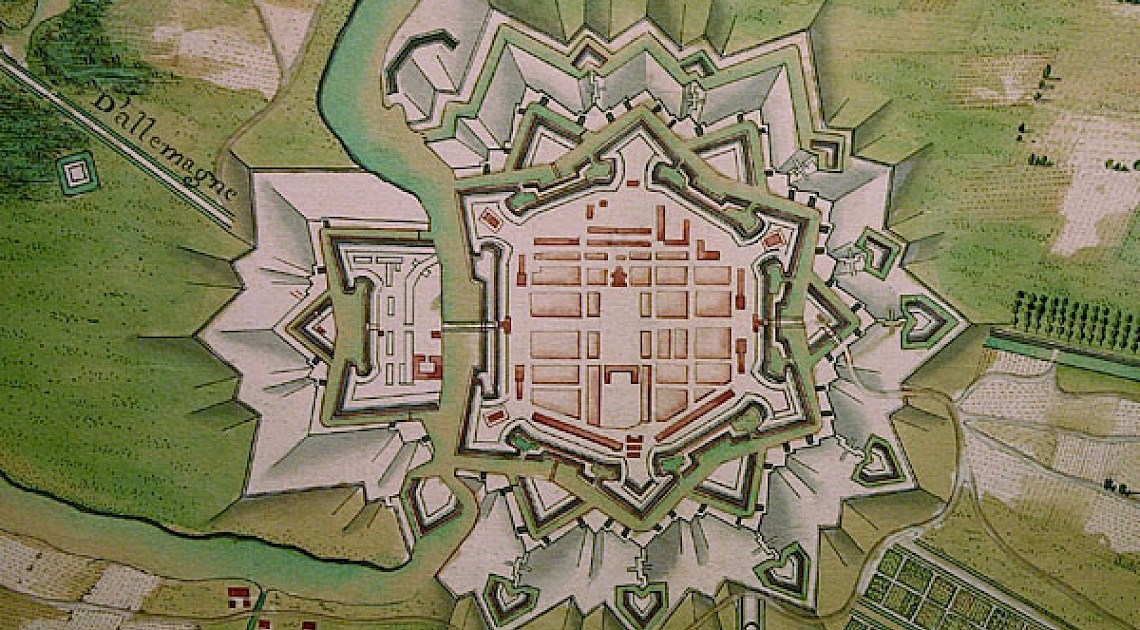
War is hell. But war is also geometry. And geometry can be quite beautiful. A prime example of that disturbing paradox is the so-called star forts that proliferated throughout Renaissance Europe.
Seen from above, these bastioned fortifications resemble elaborate ornamental diagrams, or perhaps even sacred mandalas. Yet their snowflake-like beauty was unintended. These were machines of war, developed from a mathematical attempt to solve a practical military problem: how to defend an army or a city from enemy artillery.
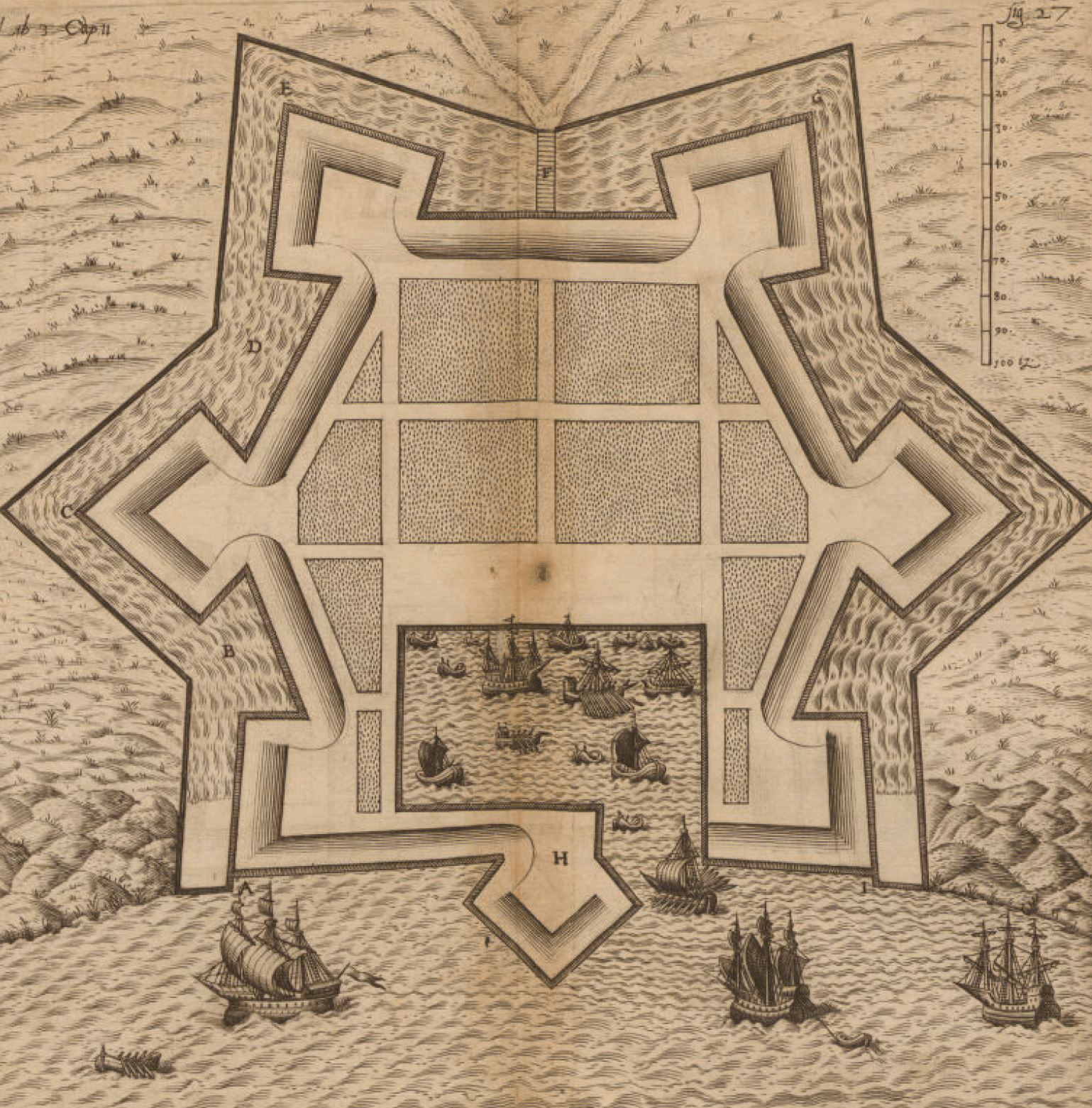 Typical star-shaped fortification from Jean Errard’s influential 1596 treatise. (Credit: Jean Errard, public domain)
Foundational to fortification theory was Jean Errard’s 1594 treatise La fortification réduicte en art et démonstrée, in which the French mathematician and engineer used geometry to formalize military architecture, helping to transform fort-building from a traditional craft into a discipline grounded in mathematics.
The resulting star forts (so called because of their multiple fortified extrusions) solved a technological crisis. Medieval fortresses, built to withstand ladders, catapults, and siege engines, were no match for gunpowder-powered artillery, the 15th century’s major military innovation. A cannon could easily take out vertical masonry walls that had stood unconquered for centuries.
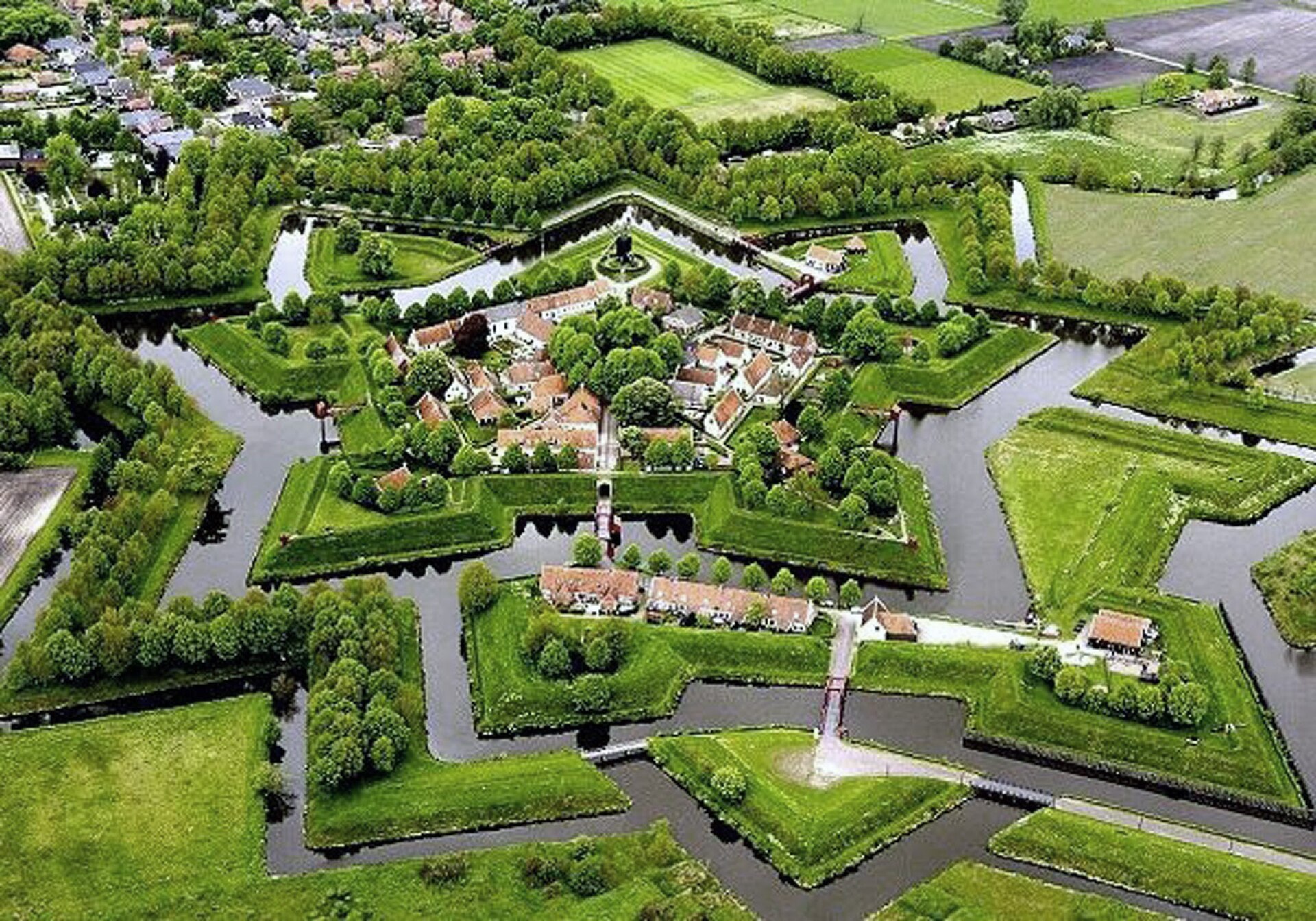 Fort Bourtange, a fortified village in the Dutch province of Groningen. (Credit: Wikimedia Commons, CC BY-SA 3.0)
Military engineers resorted to building lower, thicker ramparts, backed by earth, and sought to eliminate blind spots by building angular bastions — the aforementioned extrusions. Star fortifications started in Italy, were perfected in France (especially by the prolific Vauban), and dominated the European military scene for the entire 17th and 18th centuries, giving Europe’s strategic cities and landscapes a distinctive architectural look.
Despite their sophistication, star forts eventually became obsolete, undone by the very problem they once solved. Technological advances such as explosive shells and rifled cannon greatly increased the range and destructive power of artillery, rendering their ramparts increasingly ineffective. Additionally, military strategy shifted away from static defenses toward highly mobile field armies.
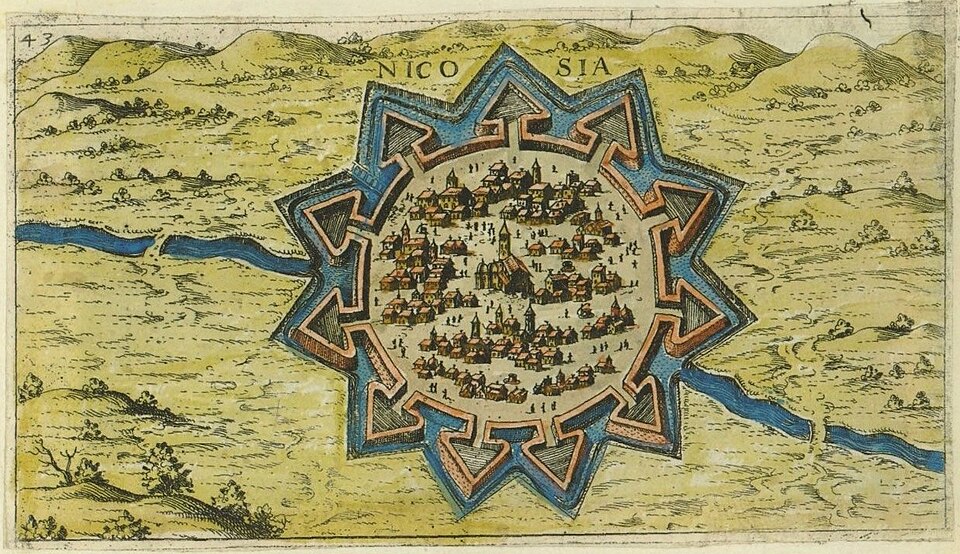 The city of Nicosia on Cyprus, as it appeared in the late 16th century. The battlements are still visible in today’s urban grid – but the circle is now split in two: a Turkish north, and a Greek south. (Credit: Giacomo Franco, CC BY 2.0)
By the 19th century, star forts had lost their military purpose. Many were dismantled to let the cities they once protected grow beyond their historic walls. Ironically, once relieved from their purely militaristic duties, star forts revealed their aesthetic value. That is why many of these geometric landscape features were eventually preserved as monuments or converted into parks.
While the star fort’s aesthetic appeal is immaterial to its (erstwhile) military purpose, its beauty is not mysterious or accidental: It arises precisely from its strict adherence to geometric logic. Symmetry, repetition, and radial balance are powerfully pleasing principles in human perception. When military engineers pursued these features for practical purposes, they inadvertently produced structures that resonate with the same mathematical harmony as other Renaissance art and architecture.
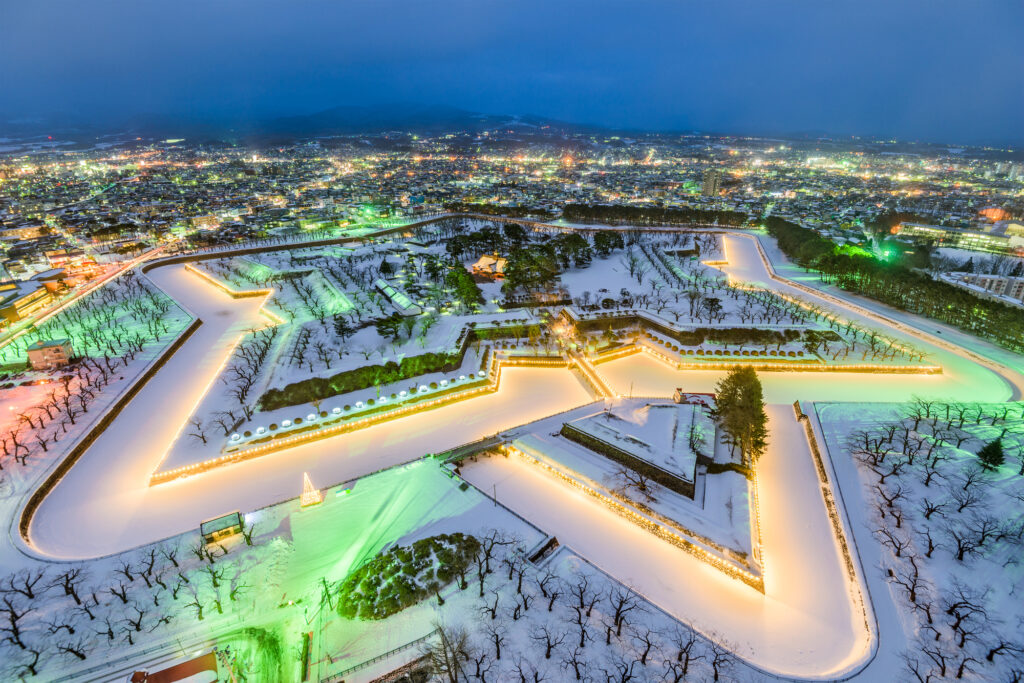
Hakodate, Japan, at Fort Goryokaku in winter.
Star fortifications were popular well beyond Europe. This is Fort Goryokaku, built in the mid-19th century in the northern Japanese city of Hakodate. Now a park, the fort is illuminated by thousands of lights from December to February. (Credit: Visit Hakodate)
We’re no longer designing star forts, but accidental beauty still emerges from rational design, be it airplanes, designed to be aerodynamic; bridges, engineered to last; and even digital networks, built for efficiency. When we optimize structures for functionality, the resulting forms often exhibit unexpected elegance.
Or, to summarize that in the fewest words possible: beauty is an emergent property of rational design. No-nonsense military builders like Errard and his ilk would no doubt have appreciated the pithiness of the phrase.
Built by the Venetians in the late 16th century, Palmanova has a double geometry: its interior consists of four nine-sided ring roads, following the idea in Thomas More’s Utopia that symmetry would help distribute knowledge and skills evenly throughout the city; and its exterior consists of two further encirclements, each with nine bastions. (Credit: European Space Imaging)
Strange Maps #1286
Got a strange map? Let me know at [email protected]