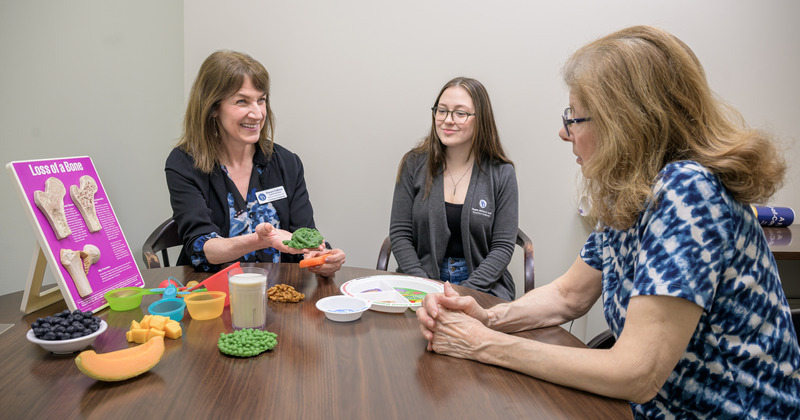
It’s not every day that registered dietitians hear they saved someone’s life. But Sharon Collison, a licensed registered dietitian at UD’s Nutrition Clinic, recently heard those words from a patient.
Belinda Pollinger, now 71, thought she was doing everything right. After retiring, she was exercising frequently and followed a mostly plant-based, dairy-, gluten- and sugar-free diet. She rapidly lost 30 pounds and developed severe gastrointestinal issues and worsening osteoporosis.
“I had a lot of food myths,” admitted Pollinger.
After several doctors failed to resolve her issues, Pollinger turned to the Nutrition Clinic, where Collison determined her diet was inadequate and deficient in many essential nutrients.
“Had I continued losing weight rapidly and not eating enough protein and calories, it could have been life-threatening, potentially leading to kidney or organ failure,” Pollinger said.
When Collison first met Pollinger, she was struck by her deeply rooted, unsupported food beliefs.
“She was so focused on eating healthy that it became unhealthy,” Collison said. “She was eating too many vegetables and lacked other essential food groups, which impacted her muscle mass and overall health.”
Collison worked with Pollinger to challenge her good-versus-bad food mindset and encouraged her to pause intense exercise and reintroduce protein, carbohydrates and dairy.
“She told me to stop eliminating foods from my diet without medical reasons and to stop my exercise classes before I hurt myself,” Pollinger said. “She told me I wasn’t eating enough calories or protein to sustain my activity levels, and I was breaking down everything I was trying to build up.”
With a more balanced diet, Pollinger regained weight and saw her gastrointestinal symptoms improve dramatically. She plans to return to the clinic to learn about nutrients that support bone density.
“It all starts with nutrition, and too many people with chronic disease aren’t informed,” Pollinger said. “Sharon changed my life. She was very invested in helping me and became a vital part of my healthcare team.”
For both women, the turning point wasn’t counting calories or a restrictive diet — it was discovering the power of nutrition.
“No medication, vitamins or supplements were going to improve Belinda’s gut function,” Collison said. “Food was her medicine, and her health improved by eating foods she was once fearful of.”
Through the Prevent T2 program, Cook learned she wasn’t eating enough and began incorporating new foods into her routine.
“I had always eaten healthy, but I’d get bored,” Cook said. “I’d never heard of chia seeds! I eat chia seed pudding and ground flax in my yogurt to pair protein and fiber with carbs. I learned to eat my starches last and never to sit down after I eat. I’m not depriving myself of anything. It’s all about balance.”
Both patients’ stories inspire Spitelle.
“Seeing that a registered dietitian can change someone’s life through evidence-based nutrition makes me want to soak up every bit of real-world experience and knowledge to excel in my career,” Spitelle said.