You push a shopping cart, pull your luggage across uneven sidewalks, push and pull furniture when cleaning, or when that sudden urge to redecorate comes on. So, why not tailor your workout to these common movements that you rarely go a day without executing?
A lot of people organize their workout splits by body part — upper body exercises one session, core the next, lower body another day or full-body workouts. It’s a solid approach, experts previously told TODAY.com, but you can also train to get stronger at common daily movements. This way, you’re ensuring that what you do in the gym will better translate into real life.
“Push–pull routines are widely used because they provide a simple and efficient way to organize resistance training,” Cedric X. Bryant, Ph.D., chief executive officer at the American Council on Exercise, tells TODAY.com.
By splitting up your workout sessions by these complementary muscle groups, you’ll give the opposing one time to rest and recover, which, Bryant says, can balance your strength routine and curb fatigue.
What Are Push-Pull Workouts?
Push-pull workouts are a type of resistance (or strength) training, says Alexander Rothstein, Ed.D., assistant professor of exercise science at New York Institute of Technology’s School of Health Professions.
“Push” exercises engages the muscles as you drive weight away from the body. This movement, Rothstein adds, could be horizontal or vertical. Pushing is typically achieved through “muscle actions like pressing or extending the arms or legs,” adds Bryant.
With “pull” exercises, you’re bringing the weight toward you in a horizontal or vertical direction. These movements call for drawing a load inward with flexing movements, explains Bryant.
Which Muscle Groups Do Push-Pull Workouts Target?
Upper body movements tend to be the focus of push-pull workouts, but they can include leg workouts too, the experts say.
Upper body push exercises target the pectoral muses in the chest, the deltoids in the shoulders and the triceps. Lower body push workouts, when you extend the hips and kinees to drive resistance away from the body, use the quadriceps in the thigh and the glutes exten, says Bryant.
Pull exercises, on the other hand, bring weight, resistance or a load closer to the body. These movements typically engage the latissimus dorsi, rhomboids, trapezius — all back muscles — and the biceps. Lower body pull exercises target the hamstrings and segments of the glute muscles, says Bryant.
Which Exercises Do Push Workouts Include?
Chances are you’re already familiar with most push workouts, even if you don’t recognize them as such. Common push workouts include:
Upper Body Bench pressesPush-upsOverhead shoulder pressesDipsTriceps extensionsChest flysLower BodyWhich Exercises Do Pull Workouts Include?
Engage your back, biceps, glutes and hamstrings with these pull movements:
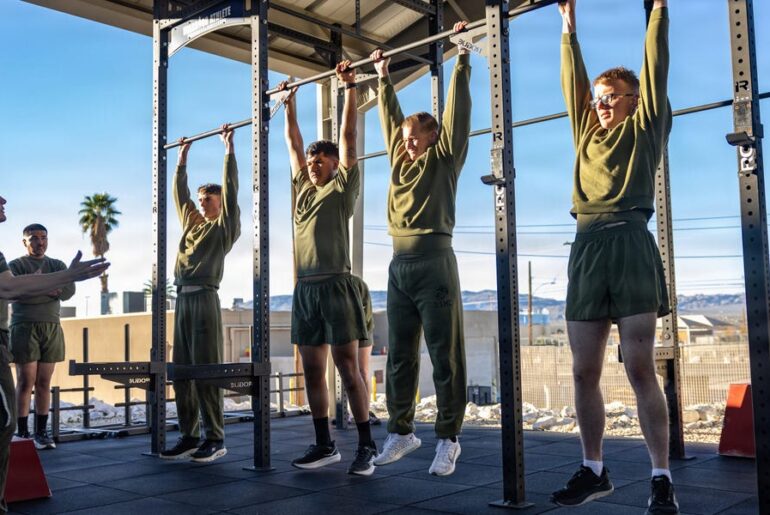
Upper Body Pull-upsLat pulldownsBent-over rowsSeated rowsBiceps curlsLower BodyDeadliftsRomanian deadliftsHamstring curlsGood morningsCable pull-throughsHow to Add Push-Pull Workouts to Your Routine
There are plenty of ways to work push and pull sessions into your current workout split, even if you don’t want to overhaul the routine you’ve already committed to.
“Many beginners benefit from combining push and pull exercises in a balanced full-body workout two or three times per week,” says Bryant. “More experienced exercisers often split push and pull workouts across different days to allow for higher training volume and recovery,”
The most important factor is making sure you’ve planned enough time for recovery in between workouts and plan to focus on each muscle group twice a week at a minimum, he adds.
Make One of Your Workouts a Push-Pull Session
Give one of your current upper body or lower body workouts a push-pull focus, Rothstein suggests, during which you’ll incorporate both push and pull movement.
He finds gym-goers typically prioritize push workouts more than pull workouts without realizing. Now, you can make the conscious effort to make sure you’re dedicating time to both. Then, continue the rest of your workout sessions as planned.
Alternate Push and Pull Sessions
If you don’t want to combine both push and pull work, which the experts assure is safe, dedicate one workout session to push work, and focus the rest of your sessions on lower body, upper body or full-body exercises as normal. Then, the following week, focus one session on pull workouts, says Rothstein.
Add One Push Day and One Pull Day to Your Workout
“Someone training three days per week might alternate push and pull sessions with a lower-body or full-body day,” says Bryant. “Others who train four or more days per week might separate push and pull workouts for both upper and lower body.”
Start With This 7-Day Push-Pull Workout Split
If you’d like to start a new workout split that prioritizes push and pull exercises, try the 4-2-1 method, Dr. Ian Smith, physician and author of “Eat Your Age,” previously recommended to TODAY.com.
The schedule features “four days of strength training, two days of cardio, and one day of mobility or active recovery,” Smith said. If that’s too intense, start with 2-1-1 training, featuring two days of push-pull strength training, one cardio day and one recovery day. Then, work your way up to 3-1-1 for three days of push-pull strength training.
Once you’re ready for four days of strength training and two cardio days, focus day one on push workouts for the chest, shoulders and triceps. Focus day two on pull exercises for the biceps and back. Dedicate day three to cardio, day four to legs, day six to either push or pull, plus core, and end the week off with recovery for day seven.