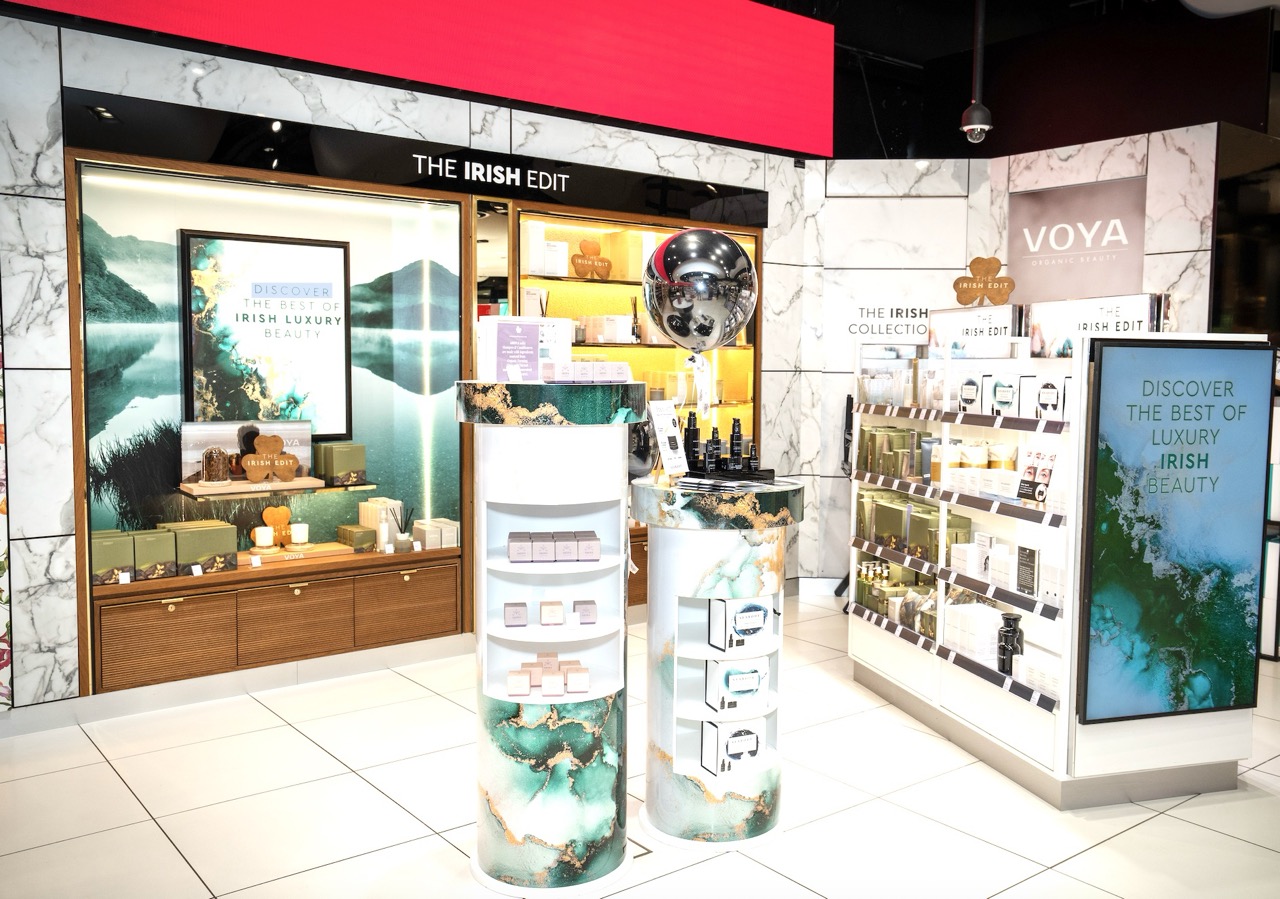
ARI Global Head of Beauty Deirdre Devaney and ARI Ireland Marketing Manager Anne Keane address how the travel retailer is leaning on the power of local brands to help drive growth in the fragrances & cosmetics category.
“Supporting local beauty brands is a fundamental part of our DNA, related to our strategic pillar to create a sense of place in the stores.”
So says ARI Global Head of Beauty Deirdre Devaney in assessing the increasing role that homegrown brands play in the P&C offer both in Ireland and at ARI’s overseas locations.
That strong presence of local brands is exemplified in ARI’s Irish estate, both at Dublin Airport Duty Free and Cork Airport Duty Free stores. Some 17 brands feature in the range, and some including Sculpted by Aimee, The Smooth Company, Max Benjamin or Poco Beauty have gained acclaim and a following well beyond Ireland.
Devaney adds, “There is a very direct link between creating that sense of place, partnering with local brands and driving commercial performance.
“In an age of globalisation where everything is so readily available online, having local brands with good storytelling and many with great heritage appeals to the shopper who wants to take something back home with them from their travels.”
But what makes a successful local brand stand out in the highly competitive beauty landscape? A great product that has a clear positioning and its own point of difference as a basic ‘hygiene factor’, and an ability to amplify awareness to travellers is crucial. Here, social media momentum plays a big part.
Devaney says: “You can have the best product in the world, but if nobody knows about it, it gets lost with so many beauty brands out there. Share of voice in a competitive market is vital.
“Influencer-led brands or makeup artist brands do this well. A great example is Sculpted by Aimee. Aimee Connolly started out as a makeup artist and then made an impact through influencing. If such brands had to pay for media spend to attain their popular status it would be very hard. Social media supports these brands’ rise greatly.”
ARI Ireland Marketing Manager Anne Keane adds: “Authenticity is something that the founder-led brands can really lean on because they are seen as experts in their field. People who are following Aimee Connolly or Pippa O’Connor (Poco Beauty) can see the passion of the founder, and that makes for authentic storytelling, which we can lean on.”
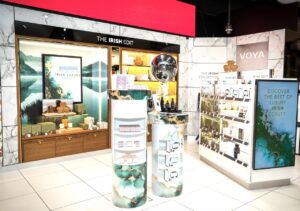
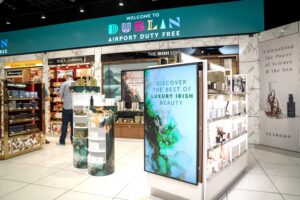 ‘The Irish Edit’: Brands are ranged not just by their origin but by brand type or the solution they offer, broadening their opportunity to appeal
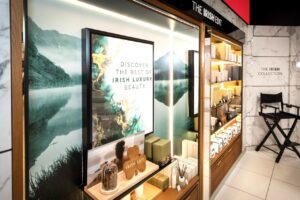
ARI leans on its local teams in each territory to identify and work with local, often small brands, to adapt to the airport channel.
Devaney says: “ARI dedicates substantial resources to research and insights across all teams and locations. We could develop the brand offering through store allocation and grading; however, this approach lacks the attention to detail that comes with ensuring local relevance in brand selection. Our buyers maintain direct relationships with the founders of these brands and meet with them regularly.”
Keane says, “The likes of Poco and Sculpted have evolved their SKU offering with the guidance of the team to adapt their formats and sizes, knowing that people top up their favourite products in travel retail.”
The offer can still evolve and improve, adds Devaney.
The search continues for an Irish fragrance brand to add to the portfolio. While ARI excels in skincare and makeup, there is a clear opportunity to grow the fragrance category, including within the Irish brand portfolio, notes Devaney.
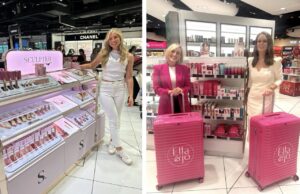 Extending brand reach through travel retail: Sculpted by Aimee (founded by make-up artist Aimee Connolly, left) and Ella & Jo (Founders Charlene Flanagan & Niamh Ryan pictured) are leaning on the visibility that the airport environment offers to embellish their reputations
“The opportunity across categories differs by location, and we tailor our approach accordingly. In Cyprus, we have a strong fragrance business, with opportunities to further develop skincare and makeup. Portugal is similar. In Canada, skincare used to dominate, but since COVID, the category has shifted more towards fragrance due to changes in passenger profile.”
In Ireland, one negative facing all brands in beauty or fashion is the inability to manufacture at scale in Ireland. “That is a real miss for me, and it would be good to have this as part of these brands’ stories but it is simply too costly,” says Devaney.
Going global with local
The ARI focus on homegrown extends to its other markets as noted above. In Canada local names such as Luc Vincent, Karine Joncas, Green Beaver and Watier resonate with shoppers in that market.
Cyprus Duty Free has even created its own fragrance, Chypre Parfum du Temps, which won a TREX Award in the Fragrance category from The Moodie Davitt Report in 2025.
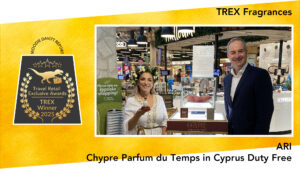
All elements of product and packaging are sourced locally.
In a related move, Cyprus Duty Free will soon launch a first in the ARI network – a concept that reimagines how emerging and local brands are presented and creates more agility in retail formats in the airport channel. More to follow soon.
More generally, scalability is another vital ingredient.
Devaney says: “There is a lot of work in developing these ranges and this is where our structure of local buying is really important. Airport retail is a challenging environment and can represent a high-cost base. You don’t get a discount because you’re dealing with local brands, which means they have to be commercially viable.
“We try to work within a framework that can bring scalability and accessibility. How can we use fixtures? How can we share Brand Ambassadors, work with local marketing teams, advise how they can get onto the relevant platforms and tap into the local influencers? We support all of that at ARI.”
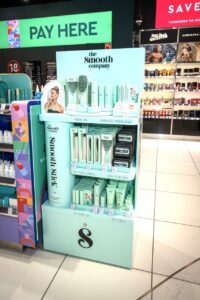
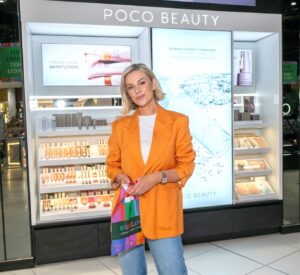 POCO Beauty, founded by Pippa O’Connor Ormond (above), and The Smooth Company (below right) are among the Irish brands going global via a strong social media identity along with the support of ARI in travel retail
 Ensuring the right positioning in-store is another factor.
Devaney explains: “We do not categorise Irish brands collectively, as this does not align with our customers’ shopping behaviour. Instead, certain brands offer specific solutions, so we position them accordingly – where shoppers are likely to seek those solutions – and allow each brand to highlight its unique advantages in service, product or price within that context.
“If you’re in an environment which is predominantly premium, prestige and luxury brands, which we have, you can lean on your advantage, whether it’s people, price service or value-added. But you also need an element of critical mass too.”
All of that helps to attract an audience that, for many hot, emerging, local brands is not a typical travel retail consumer.
Devaney explains, “We’re targeting social media-driven consumers who find duty-free environments unappealing or outdated.
“But it’s not only that. Sculpted by Aimee and Poco Beauty have an audience that might also be attracted to the international brands and vice versa and we provide that platform and environment to showcase these brands who complement one another.”
That also speaks to the high ambition that many of these brands have to go global.
The Smooth Company, which specialises in hair products, recently won the Guaranteed Irish Business Awards Beauty and Wellbeing category (sponsored by ARI).
Keane says: “They were founded at a kitchen table in County Wicklow and are now going global at pace. Sculped by Aimee is represented across the UK High Street market and in the big department stores, so it is great we can support those brands’ exposure at the airport.”
Devaney adds: “If you put something in front of 35 million people a year (at Dublin Airport) and it doesn’t work, then it’s not going to work. How these brands do in our stores is a very good gauge of how they will perform more widely.
“The brands are also learning. Because we are a global business we look at who is buying and where else those people are travelling. So for instance, we have a high British consumer uptake in Dublin, meaning there is no reason why you couldn’t create a business for that base potentially in Portugal or in Cyprus. That supports the reach of these brands potentially also.”
That brings us to performance and the need for new brands to prove themselves.
“We had a record year in beauty last year, with double-digit growth, on top of a record year in 2024. That was all built on driving newness,” says Devaney. “It was not exclusively driven by local, but these brands played a significant part in our success and in Ireland in particular the majority of growth was driven through Irish brands. Our performance would have been flat year-on-year if it wasn’t for newness.”
Ensuring a point of difference through local helps keep the offer fresh and will remain a core requirement in a fast-changing beauty market.
Devaney says, “The travel retail business model in beauty has been built on the brands investing significantly in capex, with the margin there to support a particular model built to support high concession fees.
“If brands are investing in margin and capex, of course they want to get an ROI traditionally over five years, but five years in beauty is an age these days. This is no longer the case with the successful retailers on the High Street where beauty has become very dynamic. I see a danger that travel retail slips back into offering things that have been only tried and tested on the high street.
“While the model we have historically may be hard to change we must challenge ourselves and look at how it can evolve to remain relevant and attract new customers.
“I challenge our teams in every single location to look at what is happening locally. Local brands can really fill the gap by coming in, changing up the space and making sure that what is relevant locally is actually being offered in the airports that you are travelling through. We should see newness in brands at the same pace as the customer experiences in their local area.” ✈