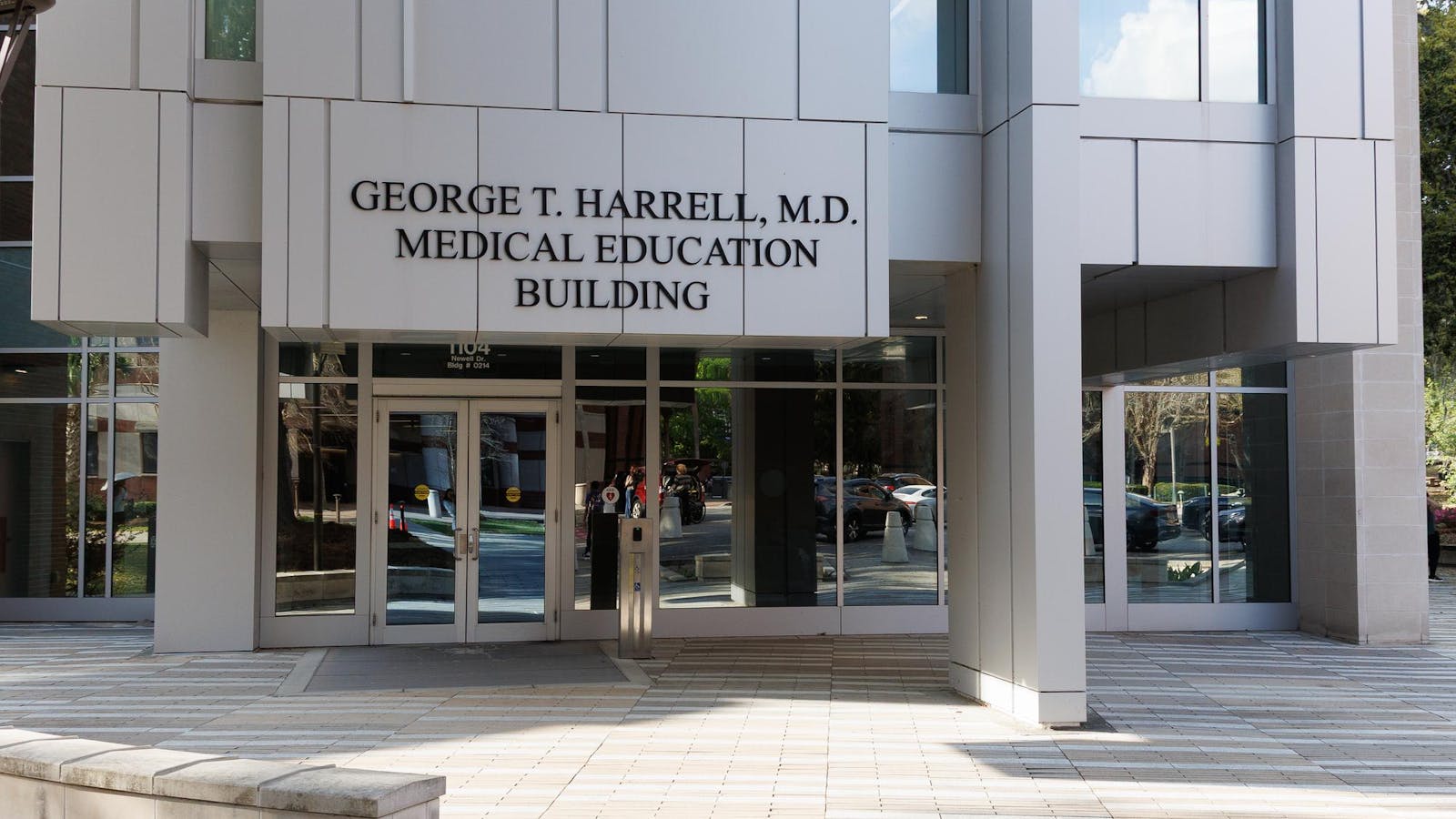
The UF College of Medicine is among 53 medical schools nationwide that have committed to a new nutrition education initiative.
Announced in early March, the initiative requires at least 40 hours of nutrition education — or an equivalent competency — for medical students starting in Fall 2026. It was announced by the U.S. Department of Health and Human Services and the U.S. Department of Education.
The curriculum change comes amid longstanding concerns about nutrition’s underrepresentation in medical training. Historically, less than 1% of lecture hours in U.S. medical schools have focused on nutrition, and many schools do not require clinical nutrition courses.
Nutrition education is gaining renewed attention in the wake of the Make America Healthy Again movement, led by Health and Human Services Secretary Robert F. Kennedy Jr.
Kennedy has targeted ultra-processed food consumption, seed oils and water fluoridation, in addition to promoting vaccine skepticism.
To support the effort, federal officials have pledged $5 million through a nutrition education challenge led by the National Institutes of Health to help institutions develop coursework, clinical training and research in nutrition science.
In a statement, the UF College of Medicine said it has long emphasized nutrition in its medical training and sees the initiative as an opportunity to strengthen that focus.
“Joining this important nutrition education initiative … is an exciting way for us to share how well we prepare our medical students,” a college spokesperson wrote in an email to The Alligator.
“The opportunity to collaborate with the UF Institute of Food and Agricultural Sciences and our clinical departments, as well as to develop an even richer assessment program to ensure our students are optimally prepared to deliver this important content during residency, helps us build an even healthier curriculum.”
Emma Beqaj, a 21-year-old UF nutritional sciences and microbiology and cell science senior, said she’s interested to see how the curriculum manifests and if there will be changes to learning. She said she believes many doctors don’t have enough knowledge about nutrition, following an algorithm rather than considering diet or lifestyle changes first.
“Food has been medicine since the beginning of time,” she said. “Everyone has to eat, so you might as well teach people how to eat for their benefit, so that medicine can be preventative and food can be preventative.”
Beqaj said emerging research shows additives and preservatives in food contribute to colon cancer and other inflammatory conditions, like diabetes or obesity, and these issues should be taught to future health professionals.
Enjoy what you’re reading? Get content from The Alligator delivered to your inbox
“Food is kind of the front lines of medicine entirely,” she said. “I mean, medicine came from people finding herbs around the world and being like, ‘Hey, this helps.’”
Mitchell Knutson, a UF food science and human nutrition professor who teaches both undergraduate and medical students, also said he is interested to see how nutrition education develops in the medical curriculum.
Knutson recalled a conversation with his own doctor, who told him about 85% of the health problems he sees in patients are related to nutrition, despite receiving zero nutrition education in medical school.
“We need to bridge that gap with training physicians [on] the importance of nutrition,” Knutson said.
He said the class he teaches at the medical school focuses on vitamins and minerals. He would like to see more screening for nutrient deficiencies in clinical practice.
For example, iron deficiency is common among young women, he said, but physicians often rely on general blood tests rather than specifically screening for iron deficiency.
In an ideal system, Knutson said, nutrition education would be integrated throughout medical school rather than concentrated in a short period.
“All I know is that they get a one-week intensive, and in my mind, that’s not enough, especially in the first year,” he said.
By the time students begin clinical work after four years, he said, many no longer remember much of what they learned earlier.
Eduardo Mejia, a 24-year-old UF medical student, took the one-week intensive nutrition block during his first year at the College of Medicine.
He said the weeklong intensive focused on foundational nutrition topics needed for board exams and general medical practice, including diet, managing blood pressure and diabetes. Vitamins were also a major focus, because they appear frequently on board exams and are important across multiple organ systems.
Mejia said increasing the focus on nutrition training is beneficial rather than solely focusing on board exam material.
“I feel like nutrition is probably one of the bigger things that patients will come to you to ask,” he said, “just because it’s pretty accessible.”
He said the first-year nutrition intensive helps provide a good basic understanding, but students may not fully understand the importance of vitamins because they have not learned how organ systems function yet.
Mejia also shared his perspective on federal influence over medical school curricula.
If the government were to mandate curriculum changes from the top down, Mejia said, UF might be less motivated to implement them enthusiastically, and “the quality might be a little worse.”
But because it’s the college’s own decision, he said, the school seems eager to make changes and focus on students’ learning and classroom experiences.
Mia Giannicchi is a contributing writer for The Alligator.
The Independent Florida Alligator has been independent of the university since 1971, your donation today could help #SaveStudentNewsrooms. Please consider giving today.