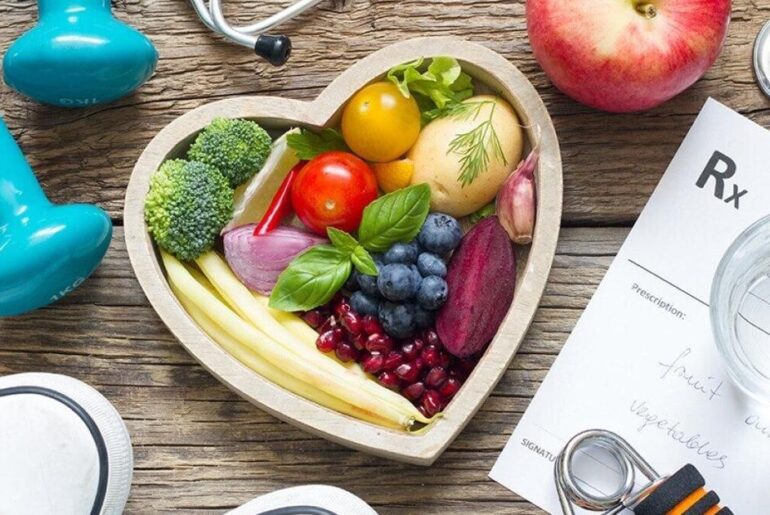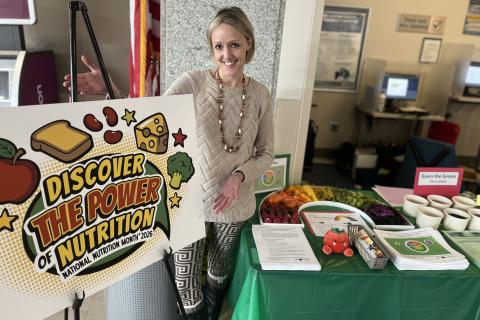
VA dietitians are food and nutrition experts trained to offer medical nutrition therapy and promote healthy lifestyle choices using a whole health approach.
This is exactly what registered dietitian Renae Briones does as a TeleMOVE! care coordinator at the Milwaukee VA.
“When people come into the program initially, I’ll do a nutrition consult with them,” Briones said. “I get to know them, their health, their background and medications that they’re on, and we get some good goals set.”
She spends a great deal of time working with Veterans, understanding where they want to go on their journey and coaching them along the way.
But Briones herself hasn’t been able to eat for over five years.
She is 100% Total Parenteral Nutrition (TPN) fed, with her nutrition and fluids entering her body through a central line.
“It’s basically an IV fluid bag, but it has protein, fat, carbs, electrolytes and vitamins in it too,” Briones said. “I hook up to that in the evening around 4 p.m. and then run it all night long. I’m able to detach from it during the day. It’s been keeping me alive.”
Adapting to a new lifestyle
Issues became more prevalent for Briones around 2010, but she said there were some elements dating back as long as she can remember.
She was diagnosed with several conditions, including gastroparesis, Ehlers-Danlos syndrome and postural orthostatic tachycardia syndrome.
“It’s this umbrella of autonomic nervous system dysfunction that they think causes my stomach and intestines to not work,” she said. “It affects other things, too. My heart rate, blood pressure, temperature regulation — all those things that should just be automatic — they’re all screwed up.”
Briones had to let go of doing things she enjoyed, such as rock climbing and whitewater rafting and other outdoor activities. Her experiences have taught her to focus on what she still can do.
“I’m finding different and new things,” Briones said. “I can still plunk my fishing pole in the river or the lake, and I enjoy that. I’m going to try taking a stab at rabbit or squirrel hunting this fall because I used to shoot archery. I don’t have the strength to do that anymore, but I could potentially shoot a gun.
“You’ve got to kind of reinvent yourself and figure out the things that you can do.”
Working at the Milwaukee VA
Briones has been with the Milwaukee VA for about 16 years. Before she got sick, she routinely worked with inpatient Veterans, including working with hematology and oncology patients who were tube- or TPN-fed.
“I ended up getting certified as a nutrition support specialist and helped on the nutrition support team for a while,” Briones said. “That was my absolute favorite. And that was before all this happened.”
While she was still in that role, she began to get treatment for her own medical conditions.
“It was really interesting to become the patient that I worked with, that I was providing services to,” Briones said. “It got flipped, and then I became that patient who had a feeding tube all of the sudden.
“It really opened my eyes to all the gaps and things that we could do better … like with providing education and just being more involved and hands-on with patients.”
Continued work with food
For many people, social gatherings often center on food.
“People really do struggle with not being able to eat, and everything revolving around food,” Briones said. “You still have people eating around you. … Everybody wants to go out to eat.”
However, she said she has learned to be content around food and is still very involved with food, especially in her work as a dietitian. She even cooks meals for her husband, who is a former chef and actively does meal planning and grocery shopping.
“If we’re having a family get-together, I’m going to make a ‘bomb’ hors d’oeuvre and bring it and share it because I still enjoy when other people are enjoying the food,” she said. “Even if I can’t have it, it’s OK.”
She is also able to try different foods without swallowing them. Her favorite food has always been peanuts.
“I’m still appreciative that I can smell and I can still taste. If I want to taste something, I can do that. And I’m OK with that. I’ve learned to be satisfied.”
Her current position at the VA focuses on helping Veterans try to get in a better balance and have a better relationship with food. She said it’s rewarding to see Veterans work toward their health and nutrition goals through the TeleMOVE! Program.
“These are people that were fit,” she said. “They were in great shape at one point when they were in service, so I know they have it in them. They have the discipline. They have all the tools. They’ve been there, and they know what it feels like to be healthy.
“It’s all the more reason to want to motivate and want to help them get back to that.”