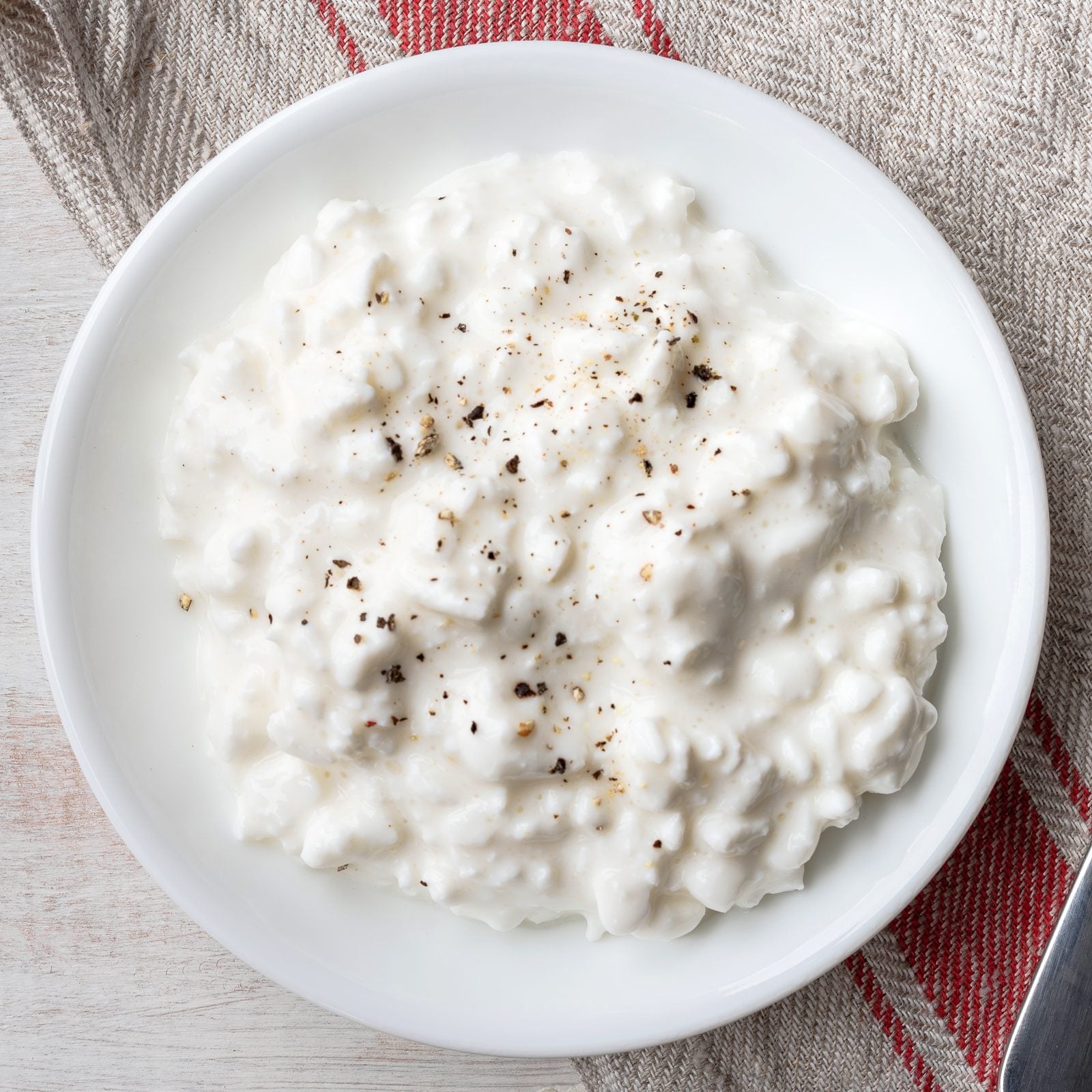
It went from your grandma’s favorite snack to one of the timeliest groceries on so many shopping lists—rising largely thanks to cottage cheese’s protein power and its versatility.
Americans have discovered that cottage cheese turns marinara sauce a creamy pink, folds right into scrambled eggs, and makes pancakes denser (there’s a reason lemon ricotta pancakes grace so many brunch menus). If you love the protein but don’t quite love the mouthfeel, Cleveland Clinic registered dietitian Kristin Kirkpatrick, RD, shouts out the growing trend of spooning some into the blender and hitting the button to whip it.
It can be worth playing around, Kirkpatrick says, for the nutrition benefits. She echoes the protein effect (for example, low-fat Trader Joe’s cottage cheese has 13 grams of protein per half-cup serving). While some brands are specifically promoting their probiotic content, Kirkpatrick says that comes with the territory: “We know that it has a lot of healthy bacteria that help with our microbiome.”
Kirkpatrick speaks to another draw: “It’s also something that many of my patients consider clean in the sense that it’s not ultra processed,” she says. (Though, always read your labels. Some brands do feature some sneaky odd ingredients, like “stabilizer” for texture, or carbon dioxide as a preservative.)
Of course, non-dairy eaters typically have to stay away (er, “a-whey”?). Thirty million to 50 million Americans experience lactose intolerance, while the Cleveland Clinic also specifically mentions a casein sensitivity. Casein is a protein in milk that can trigger an immune response in two to six percent of children, according to the Food Allergy Institute.
Some children outgrow a milk allergy, but lactose intolerance can also emerge in adulthood.
If you’re a cottage cheese fan, Kirkpatrick notes that products with higher fat or protein content are likely to make you feel fuller for longer.
Get The Healthy newsletter and follow The Healthy on Facebook and Instagram. Keep reading: