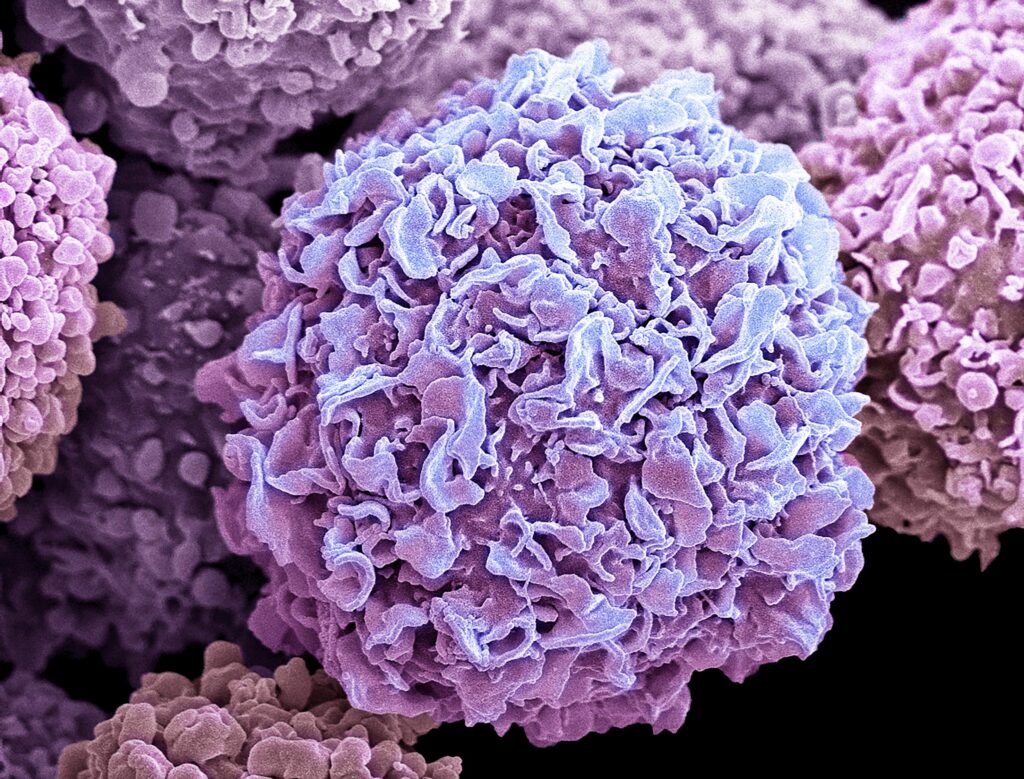
 Scanning electron micrograph of breast cancer cells. [Steve Gschmeissner/Science Photo Library, Getty Images]
Researchers headed by a team at Tel Aviv University have discovered that damaging variants in genes involved in a rapid immune response (innate immunity) are significantly linked to earlier breast cancer (BC) onset in carriers of the harmful BRCA1 genetic mutation. The team carried out whole exome sequencing (WES) of hundreds of Ashkenazi Jewish women with the BRCA1 risk variant, and found that the strongest association with earlier BC onset was for genes involved in the activation of natural killer (NK) cells, which serve as the body’s rapid first line defense against viruses and cancer.
The findings prompt the researchers to suggest that more refined, personalized risk prediction models may be needed for carriers of the mutant BRCA1 gene, as although this mutation strongly boosts their risk of breast cancer, age at diagnosis varies considerably.
The team reported on the findings in Journal of Medical Genetics, in a paper titled “Damaging missense variants in innate immunity genes are associated with earlier age of breast cancer onset in BRCA1 185delAG carriers,” in which they concluded “To the best of our knowledge, our study is the first large-scale WES analysis aimed at identifying genetic modifiers of BC risk in BRCA1 PV carriers … Our findings highlight a novel role for innate immune pathways as potential modifiers of BC risk in BRCA1 carriers.”
BRCA1 is one of two prominent breast cancer susceptibility genes, the authors explained. “Women harboring a pathogenic variant (PV) in BRCA1 have an estimated 60–80% lifetime risk of developing BC, along with a substantially elevated risk (30–40%) of ovarian cancer.”
Surgical removal of the breasts, fallopian tubes, and ovaries mitigates the risk, but because the age at which breast cancer develops in carriers is highly variable, even amongst those with the same genetic BRAC1 mutation, it’s difficult to know when this life changing procedure should be carried out, they commented. “Although penetrance for BC in BRCA1 carriers is high, it is incomplete, and age at BC diagnosis among BRCA1 carriers varies widely, even among carriers of identical PV in the same families.”
This variation in disease onset suggests that other modifying factors might be influential, including impaired immunity, because of the pivotal role the immune system has in the development and surveillance of cancer, the team suggested. They hypothesized that “… impaired immune function may also modify BC risk among BRCA1 PV carriers.”
To explore this further, the team studied whole exome sequencing information from 321 Ashkenazi Jewish women, among whom the prevalence of BRCA1 mutations is around five to six times higher than it is among other ethnic groups worldwide. The women were all carrying the same BRCA1 mutation (185delAG) and 98 of them had been diagnosed with breast cancer. Their average age at diagnosis was 41.5 years, but ranged from 26 to 75 years. “Leveraging a large whole-exome sequencing (WES) cohort of Israeli women carrying the BRCA1 185delAG AJ founder PV, we examined whether carrying additional putatively damaging variants in genes involved in distinct arms of the immune system was associated with age at BC diagnosis,” they commented.
Whole exome sequencing reads the most crucial 1–2% of a person’s DNA—the exome— which contains around 85% of mutations known to cause specific medical conditions. The researchers’ whole exome sequencing data revealed that additional likely damaging mutations (missense variants) in genes involved in innate immunity were significantly associated with earlier onset of breast cancer.
Mutations in the genes involved in natural killer cell activation were most strongly associated with earlier disease onset, conferring a risk more than 3.5 times greater. “We found that the presence of additional putatively damaging missense variants in genes involved in innate immunity was significantly associated with earlier BC diagnosis,” they stated. “This effect was noted for several overlapping gene sets; the strongest one was for the genes annotated as involved in the activation of NK cells.” They pointed out that the risk-modifying effect they round was specific to genes involved in innate immunity. There was no significant association identified for genes related to the adaptive immune system.
“In summary, our findings in the Israeli cohort of identical BRCA1 PV carriers highlight a potential role for innate immune pathways as modifiers of BRCA1 penetrance and may support the development of more refined, personalized BC risk prediction models for BRCA1 PV carriers,” the investigators wrote. However, they cautioned, “It remains to be determined whether these preliminary findings can be replicated in independent, ethnically diverse, larger cohorts of carriers of heterogeneous PVs in BRCA1.”