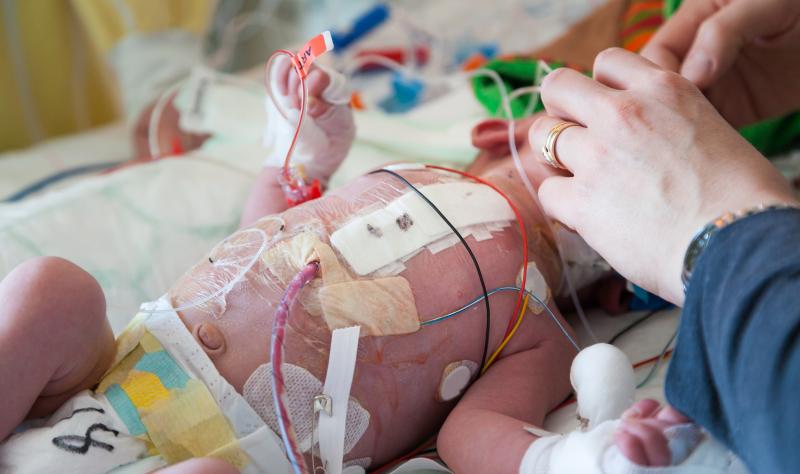
The baby began life as a healthy newborn.
But just a few weeks after birth, the child became irritable and appeared to be bleeding under the skin, a condition that can cause bruises or small red spots.
When doctors performed a blood test, they found the baby had low levels of several critical proteins that help blood to clot. The body needs vitamin K to make certain proteins, called clotting factors, which are critical for controlling bleeding.
Babies have low levels of vitamin K when they’re born, leaving them vulnerable to life-threatening bleeding under the skin and from the umbilical cord, nose, mouth, digestive tract, and brain. Bleeding in the brain can lead to strokes that leave babies with devastating and even fatal injuries.
Doctors treated the baby with vitamin K, which can bring clotting factors up to normal levels within four hours. Although they used other treatments to try to stop the bleeding, the infant bled too much and for too long and died, said Allison Wheeler, MD, MSCI, co-author of a paper that tells the infant’s story, published today in Pediatrics.
‘Unfortunately all too common’
The baby’s death could likely have been prevented with an injection of vitamin K at birth, said Wheeler, an associate professor of pediatric hematology and oncology at the University of Washington School of Medicine.
“This is not a unique scenario,” Wheeler said. “This is unfortunately all too common.”
A growing number of parents are rejecting vitamin K shots. The proportion of newborns who didn’t receive the vitamin K shot increased from 2.92% in 2017 to 5.18% in 2024, according to a national analysis of electronic health records published in JAMA in January. Infants who do not receive vitamin K injections are about 81 times more likely than other babies to develop vitamin K deficiency bleeding between one week and six months of life.
Wheeler said she fears that she other doctors will be treating more babies with vitamin Kdeficiency bleeding. .
“It’s heartbreaking,” she said.
A shot at life
Before doctors began routinely providing vitamin K shots to newborns in 1961, up to one in 60 developed vitamin K deficiency bleeding in the first week of life.
One shot at birth protects babies until they are four to six months old, when they can get vitamin K from solid food, and normal intestinal bacteria begin making it. Although breastmilk is the best first food for newborns, it contains relatively little vitamin K.
Vitamin shots are not vaccines and, until recently, weren’t controversial.
Since the COVID-19 pandemic, however, the number of people who question vaccine safety and other health measures has grown. Refusing vitamin K shots used to be “something that just never happened,” said David Hill, MD, a Seattle pediatrician and spokesperson for the American Academy of Pediatrics who was not involved in the new report. “Now, I breathe a small sigh of relief every time I review the medications for a newborn and see that the vitamin K was given.”
More parents are refusing other life-saving interventions for newborns, including antibiotic ointments that protect a child’s vision, and the birth dose of the hepatitis B vaccine, Hill said.
I breathe a small sigh of relief every time I review the medications for a newborn and see that the vitamin K was given.
Sustained attacks on vaccines and other safe interventions, from the the active ingredient in Tylenol to folic acid supplements in early pregnancy to prevent birth defects, have undermined the public’s trust in proven treatments, the study authors wrote.
The baby’s death “occurred within an increasingly politicized public health climate, where long-settled pediatric prevention is increasingly being framed as optional or discretionary rather than standard of care,” authors wrote in the paper. “Regardless of one’s position on any single vaccine policy, repeated high-visibility reframing of pediatric prevention that has demonstrated long-standing efficacy and safety has spillover effects because it can normalize the idea that established prophylaxis is optional and that ‘doing nothing’ is a medically equivalent choice.”
Many pediatricians who work in intensive care units now have experience treating babies with life-threatening bleeding, Hill said.
Last year, Hill took care of a toddler who was born healthy but suffered a stroke on his second day of life due to vitamin K deficiency bleeding. The toddler suffered from seizures and had severe developmental delays.
Counseling parents
Hill said he talks to parents who refuse vitamin K injections for their babies. He can persuade about one in four to agree to the injection. In many cases, parents simply don’t know much about the injections.
Before launching into anything controversial, Hill said he tries to establish a relationship with parents to create trust. He tries to put parents at ease and avoid confrontation.
“The first thing we always need to do is bond over this child,” said Hill, who works in hospitals. “Before we’re going to talk about vitamin K, they need to know that I am here because I’m excited to help them with this new baby. Then I can say, ‘I noticed that this baby has not yet gotten the vitamin K, which we give to all of our babies to keep them healthy. Do you mind sharing with me your thoughts about why?’”
Parents who reject vitamin K shots aren’t necessarily opposed to vaccines, Hill said. Some parents don’t like needles or want to spare their newborns the pain of an injection.
When talking to parents, Hill said, “I hear mistrust of pharmaceuticals, of traditional medicine, about concerns that somehow there is something in the vitamin K injection that is going to harm this child more than it will help them. I also hear the appeal to nature, the idea that it is better than anything that is unnatural.”
Warning signs of grave consequences
When Hill can’t persuade parents to agree to vitamin K shots, he warns them about potential warning signs of dangerous bleeding. He instructs parents to tell health care providers that their baby wasn’t given vitamin K at birth, because that information can help clinicians make a diagnosis, as well as make it more difficult to decide whether to perform procedures that involve needles.
“One of the things I always include in my education for parents who make this choice is to make sure they’re aware of the signs of a stroke or of a brain bleed in their babies,” which can include irregular movements that look like a seizure, Hill said.
“If their baby is unresponsive or stops eating, or won’t move one side of their body, or doesn’t move one side of their face, they’re having a medical emergency and have a very limited amount of time to respond.”