EAST COBB — The Cobb County Police Department is preparing for the global spotlight — and potential security challenges — that will come with the 2026 FIFA World Cup.
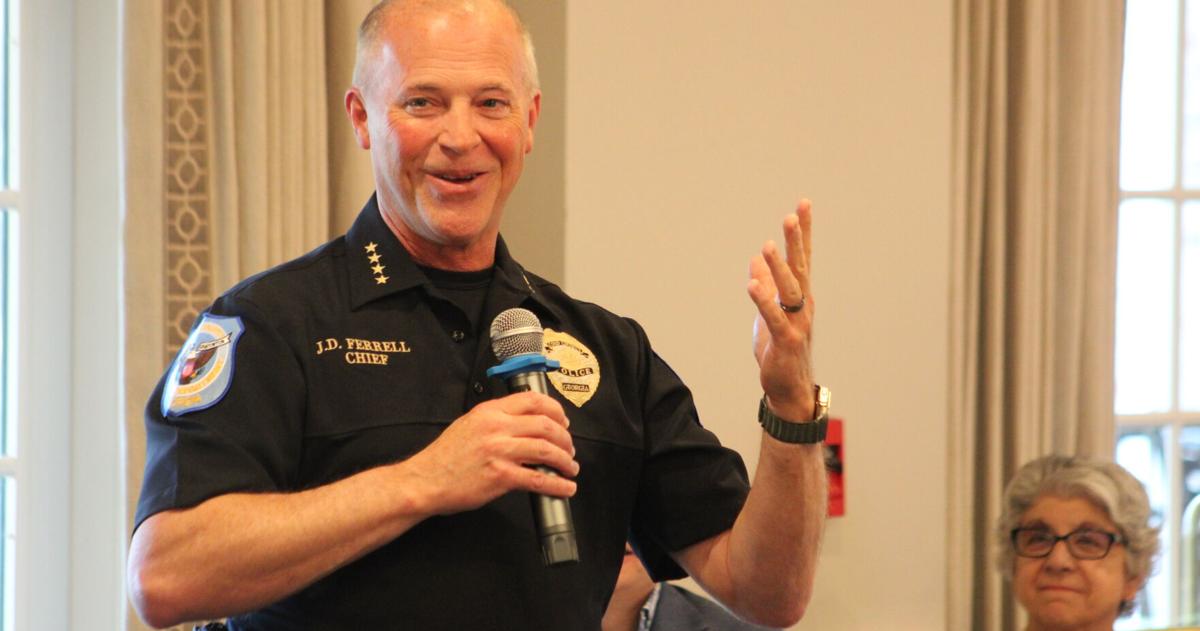
Cobb Police Chief James “Dan” Ferrell spoke to the East Cobb Area Council Thursday about his priorities, which include expanding technology, strengthening community engagement and enhancing officer wellness, while also outlining how his department is gearing up for one of the world’s largest sporting events.
Ferrell, who was named chief last October, said he is already beginning to see parts of his long-term strategy take shape.
‘Age of technology’
A major theme of Ferrell’s remarks was what he described as policing’s “age of technology,” a shift he said is transforming how departments operate.
When Ferrell entered law enforcement in the 90s, resources and technology were limited.
“We had a radio and a car, and that’s pretty much it,” he said. “…We policed by stopping and talking to a lot of people.”
Over time, he said, that evolved into a renewed focus on community policing in the 2010s. Now, the next phase is being driven by rapid technological advancement.
Cobb County has leaned heavily into that shift in recent years. Ferrell noted that crime in the county is down nearly 40% over the past five years, a trend he partly attributes to improved technology that allows officers to quickly identify where crime is occurring.
At the center of that effort is the department’s real-time crime center. The system integrates tools like license plate reader cameras and live video feeds to give officers immediate situational awareness.
Ferrell said the department is working to expand partnerships with local businesses, allowing them to connect security cameras directly to the crime center during emergencies.
Through the system, businesses can opt in to automatically share live camera feeds with police when a 911 call is placed, giving responding officers a real-time view of what’s happening inside.
“Soon as the 911 call closes out, everything turns off and goes away,” Ferrell said. “So it’s there when you need it. It’s not there when you don’t need it.”
The department is also exploring artificial intelligence systems that can monitor business properties after hours, detect unusual activity and alert police in real time.
At the same time, Ferrell emphasized the need to balance innovation with civil liberties.
“How do I make sure that we’re not stepping on the constitutional rights of people that we’re here to protect, where technology gets overly invasive,” he said. “But we’re putting technology in in a responsible way, where technology actually does good things.”
County drone program
Another key initiative is the department’s expanding drone program.
Cobb Police have been piloting “drone as a first responder” technology for about three months now, Ferrell said. When certain 911 calls come in, a drone can be automatically deployed, arriving on scene in about 72 seconds and streaming live video back to officers and the crime center.
Ferrell shared a recent example in which a drone located a missing elderly man with dementia in the woods in less than five minutes — a search that would have previously taken dozens of officers hours to complete.
The department is now preparing to purchase six additional drones designed to support large-scale events and enhance aerial response capabilities, thanks to a recent $10.7 million grant from the U.S. Department of Homeland Security tied to World Cup preparations.
“We’re going to be able to do something in our county that nobody else can really do in the state of Georgia,” Ferrell said.
Preparing for FIFA
With Atlanta set to host multiple matches and related events during the 2026 FIFA World Cup, Ferrell said Cobb County — home to Truist Park and two base camps — is preparing for a major influx of international visitors.
That includes fans staying in local hotels and short-term rentals, as well as increased activity in entertainment hubs like The Battery Atlanta.
One of the biggest concerns, he said, is the growing threat posed by drones. He said drones were relatively easy to weaponize, pointing to recent global conflicts in Ukraine and Iran where they have been used in attacks.
Currently, local law enforcement can detect drones and identify their operators but has limited authority to stop them.
“And we know that, matter of fact, we had a breach during the Major League Baseball All-Star Game,” Ferrell said. “We had a drone make it into the stadium over home plate while they were playing the game.”
While the operator — who simply wanted footage of the game — was caught, Ferrell said, “There was nothing we could do to stop it.”
That will change with new mitigation technology funded through the federal grant. The equipment will allow trained personnel — operating under federal authority through a United States Marshals Service task force — to take control of potentially hostile drones and safely land them.
Antennas placed across the county will be able to detect drone signals, override their frequency and guide them to the ground, significantly improving security at major events, including future Braves games, Kennesaw State University football games and other large gatherings.
Beyond security threats, Ferrell said the World Cup will bring other challenges, including language barriers and large, shifting crowds.
To address communication issues, the department plans to activate real-time translation features in officer body cameras, allowing conversations to be translated instantly between multiple languages.
The department is also preparing for crime trends typically associated with major events, particularly fraud.
Scams involving counterfeit tickets are expected to be common, Ferrell warned, urging residents and visitors to purchase tickets only from reputable vendors.
Property crimes, such as vehicle break-ins, may also increase in high-traffic areas. The department plans to increase patrols and launch public awareness campaigns ahead of the event.
Officials are also coordinating with regional partners to combat human trafficking, which often spikes during large-scale events.
Immigration enforcement
After the meeting, the Journal asked Ferrell about other federal partnerships, specifically whether the department had one with U.S. Immigration and Customs Enforcement.
Back in February, the Marietta Police Department signed an agreement with ICE allowing police to function as immigration officers, a move officials said was done in order to comply with state law.
“I know the city of Marietta made a decision to have a liaison, I believe, and I’m not sure if anybody else in the county has yet or not,” Ferrell said. “But I can tell you, the county police department does not have that.”
While Cobb police work with federal partners like Homeland Security on issues such as narcotics investigations, immigration enforcement is not part of the department’s mission, he said.
Ferrell added the department hasn’t “been approached and asked about it.
“It’s not something that we’ve engaged in, and quite honestly, it really is not part of what our mission is as a local police department,” he said. “Our mission is public safety. Immigration enforcement we’ll try to leave to those experts that want to deal with that side of it.”
Reorganization, officer wellness
Internally, Ferrell said the department is undergoing significant restructuring.
Leadership has been reorganized, and new divisions focused on strategic technology and community outreach have been created to better align resources with priorities.
A major focus is officer wellness. Ferrell highlighted the high levels of stress in law enforcement and noted that many officers face serious health issues after retirement.
In fact, he said police officers often have a shorter life expectancy after retirement, with some dying from a heart attack just a few years after exiting the force.
Ferrell noted therapy was not historically encouraged in law enforcement and men, who make up a large portion of the department, are, in general, more likely to ignore health issues.
Through a recent $200,000 grant, the department is expanding access to mental health services, including annual sessions with licensed therapists and additional resiliency training in partnership with Kennesaw State University.
“We had it as a pilot program for about the last four years now in our really high risk units like our crimes against children and our active investigators and our homicide investigators, … and it’s been very effective,” Ferrell said. “People are finding that they were more stressed than they thought they were, and they’re finding avenues now where they can relieve that stress.”
Leadership development is also being emphasized across all ranks, with Ferrell stressing that officers on the street play a critical role as community leaders.
Community engagement
Ferrell said reconnecting with the community — especially young people — is another priority.
He pointed to growing challenges such as 24/7 social media-driven bullying and youth mental health issues, which he said require earlier intervention and stronger partnerships with schools and families.
“Suicide rates with our kids are at an all-time high, and you don’t hear about them, … because it’s not something that we release publicly,” Ferrell said.
The department plans to expand its Police Athletic League program to be “full time” and increase outreach efforts aimed at helping students manage conflict and pressure.
Traffic enforcement is also expected to ramp up, as the department works to rebuild its special operations unit and increase its presence on local roads.
“Over the years, with loss of employees and shrinking staff, that’s the units that had actually taken the brunt of the hit and had gotten kind of decimated over the years,” Ferrell said. “So we’re trying to build that back and make that what it was before, so they can be a little bit more aggressive and a little bit more seen in our community.”
Ultimately, Ferrell said his goal is to combine new technology with traditional policing values while maintaining strong community ties.
By attending meetings like the East Cobb Area Council, he hopes to build trust and open lines of communication with residents.
“You can’t talk to enough people,” Ferrell said. “There’s 800,000 people in Cobb County… so we’re trying to find ways where we can get the most contact with the people possible.”
Attendee Kurt Von Borries told the Journal he enjoyed the chief’s speech, saying he liked that Ferrell was “engaging everybody.”
Von Borries joked he was going to tell Commissioner JoAnn Birrell, who was in attendance, to give Ferrell and the department “a lot more money.
“They do a great job for us, but they always need funding.”