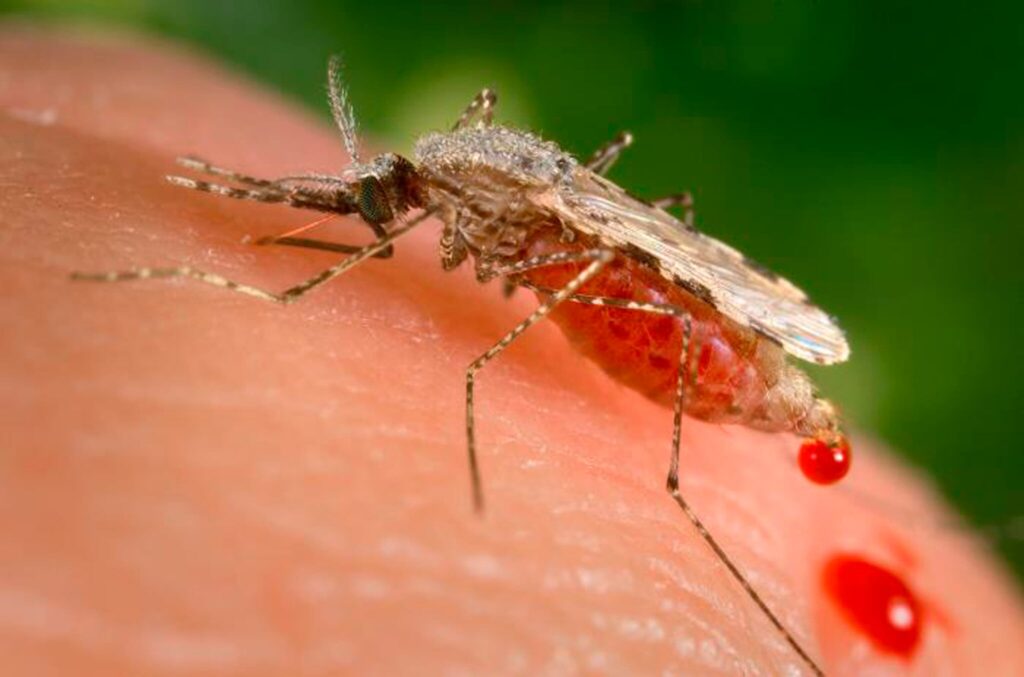
Israeli researchers say they have discovered how malaria parasites trick their way into surviving in the human body, opening up hopes for new therapies that can battle the deadly disease.
Spread by mosquitoes, malaria is estimated to affect 1,000 children a day and kill 500,000 per year, largely in South America and sub-Saharan Africa.
In ground-breaking research published in the journal Cell Reports earlier this year, the team from the Weizmann Institute of Science in Rehovot found that malaria parasites send packages of their own messenger RNA to hack into a cell’s nucleus and hijack its splicing activity to shut down any immune response before it gets started.
The key to the study, which was among several projects set back by an Iranian missile attack in June that destroyed several labs connected to the Biomolecular Sciences Department, was the identification of the parasitic RNA inside the cell’s inner sanctum, where it had no business being.
“Nobody detected this low level of the parasite’s messenger RNA (mRNA) in the nucleus of immune cells using a microscope before,” Prof. Neta Regev-Rudzki, one of the lead researchers, told The Times of Israel. “It was completely new.”
Get The Times of Israel’s Daily Edition
by email and never miss our top stories
By signing up, you agree to the terms
The findings point to a potential new target for antimalarial drugs, said Regev-Rudzki, specifically therapies designed to prevent malarial RNAs from taking over the host’s splicing system.
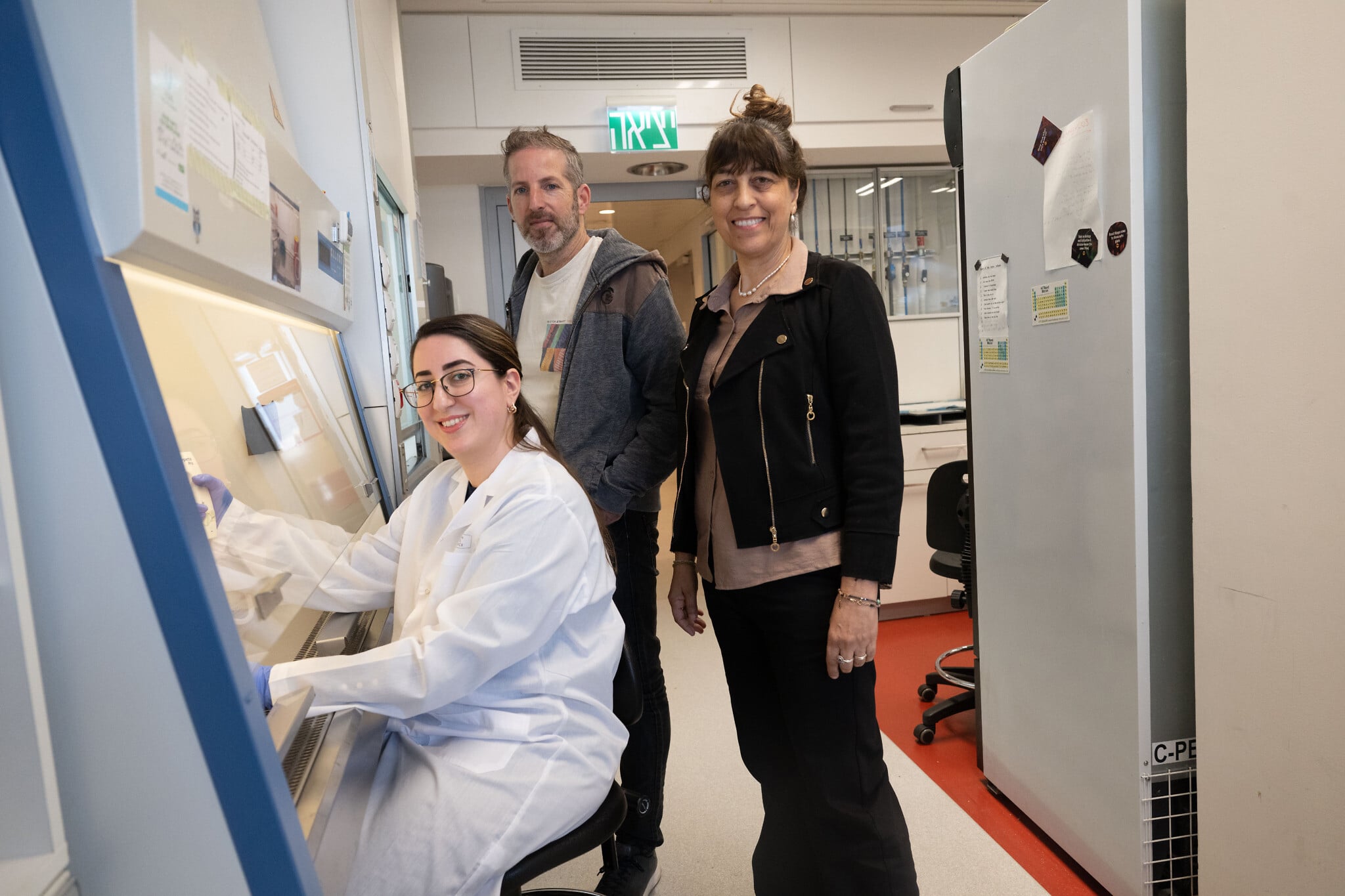
Standing, right, Dr. Neta Regev-Rudzki, of Weizmann Institute of Science, Dr. Zeev Malamed of Hebrew University of Jerusalem, and Paula Abou Karam, a PhD student at Weizmann Institute. (Courtesy)
Amy Buck, a University of Edinburgh professor of RNA & Infection Biology, said the research could have applications beyond malaria as well. She was not involved in the study.
“It is exciting not only because it offers new insights into how malaria can evade host immunity,” Buck said, adding that it “expands the context for how and where imported RNAs can function, with potential relevance to many other human diseases.”
Mission against malaria
Malaria is caused by parasites carried by female mosquitoes that pick up the parasite by biting someone who already has the disease.
Worldwide, millions of people are infected with malaria each year. Most cases are in sub-Saharan Africa and South America. More than 500,000 people die each year from the disease, though antimalarial drugs can treat the malady, especially if caught before complications begin. However, those drugs lose their efficacy as the parasites build resistance.
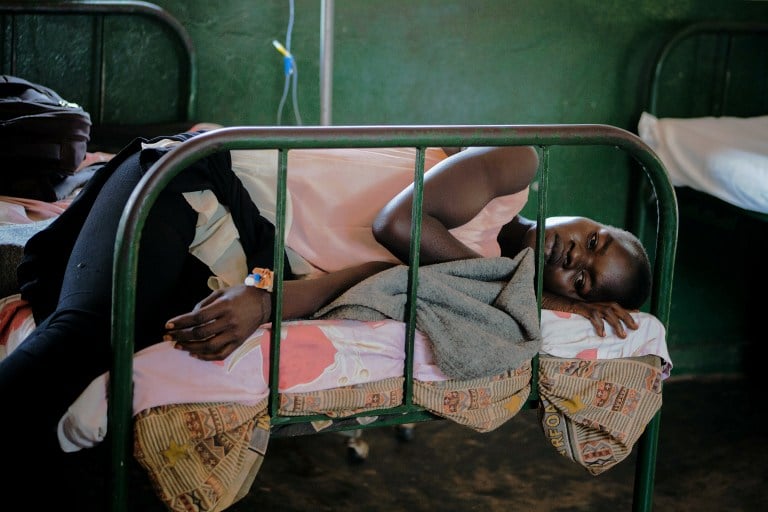
A patient rests on a bed after being discharged from the malaria ward at Panyadoli Health Center III in Kiryandongo refugee settlement, northwestern Uganda, on April 11, 2017. (AFP PHOTO / Esther MABABZI)
“We have to somehow find the way to block this disease and all this suffering,” Regev-Rudzki said, noting that there is no effective vaccine yet against malaria parasites. “For me, I feel like it’s a mission.”
Early symptoms include cycles of chills and then fever. Untreated malaria causes rapid destruction of red blood cells and then multi-organ failure, and cerebral damage. The parasite could lead to fatal complications, including respiratory failure, within a very short time.
More than a decade ago, Regev-Rudzki discovered that the malaria parasite Plasmodium falciparum invaded human red blood cells while sending out vesicles — tiny membrane-bound sacs filled with RNA — to communicate with fellow parasites inside other red blood cells.
“The research broke the dogma that the parasites competed with each other,” she said. “We discovered that they don’t necessarily compete. In some stages, they actually coordinate actions and work together as a team.”
“This parasite is sort of a genius, because it’s only one cell,” she said.
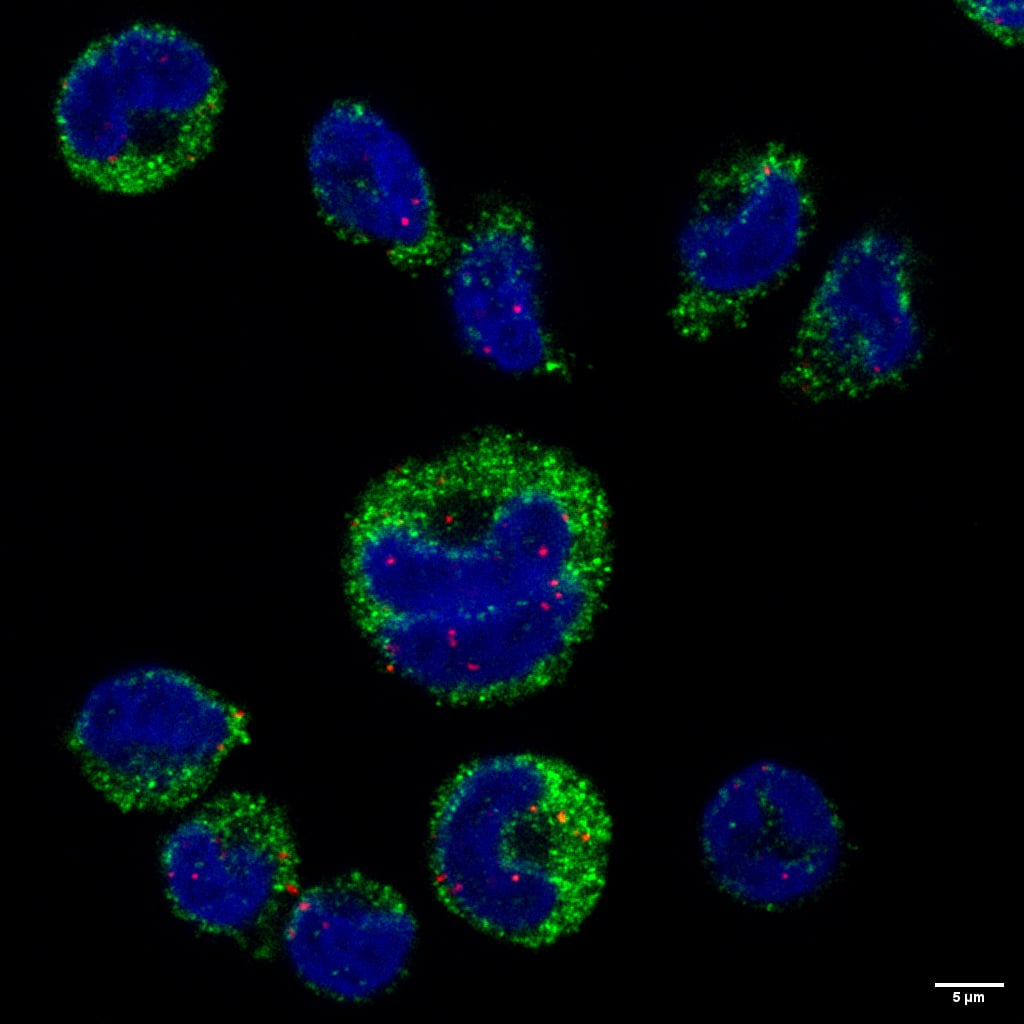
Red alert, red herrings: Malarial RNA molecules (red dots) observed inside the nuclei (blue) of monocytes, a type of immune cell (green), using fluorescence confocal microscopy. (Courtesy/Weizmann Institute)
The new study, led by Dr. Paula Abou Karam, set out to determine what other tools the parasites use to survive in the human body. Also contributing to the research were scientists from the Hebrew University of Jerusalem, Technion-Israel Institute of Technology, and Tel Aviv University.
“We discovered that the parasites use these vesicles not just to talk among themselves but also to manipulate the human immune cells by delivering misleading messages,” Regev-Rudzki said.
The researcher said that her team was surprised to find that the RNA molecules had made their way into the highly protected nucleus of the immune cells.
“The nucleus is very protected,” she explained. “It’s like the brain of the cell, so there are lots of gatekeepers. It was hard to believe that the parasitic RNAs were inside the human immune nucleus. We had to be convinced.”
Hunting for RNA
At first, the task seemed nearly impossible because the parasitic RNA levels were so low, making them difficult to detect.
Abou Karam, then a PhD student, refused to give up and continued to look for markers of the parasitic mRNA within a type of immune cell called a monocyte.
“Paula had to keep changing different microscopy methods,” Regev-Rudzki said. “She insisted and kept trying for more than a year and a half until she could detect the RNA molecules.”
Abou Karam told The Times of Israel that she met the “very challenging” task of detecting the mRNA by designing a fluorescent probe, like a highlighter for a microscope, which was then used with fluorescent dye.
“Each time a single malaria mRNA molecule successfully crossed into the nucleus, it made a red dot,” she said. “Then we had to take images with a special focal microscope and do the analysis.”
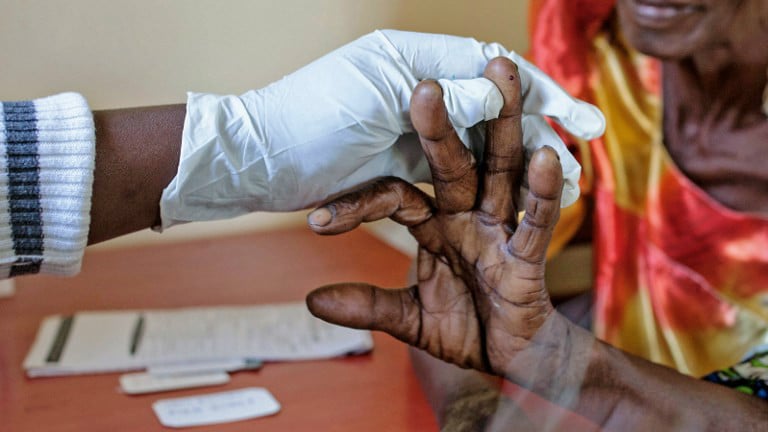
An elderly woman gets tested for malaria at FIMRC Health Center III in Bududa district, eastern Uganda, on April 7, 2017. (Esther MABABZI / AFP)
The scientists still did not understand how the foreign RNAs entered human cells, so they joined forces with Dr. Zeev Melamed of the Hebrew University of Jerusalem, a leading expert in RNA and splicing.
With Melamed’s help, the team discovered that once the parasite’s mRNA reached the nucleus, it latched onto two specific human proteins, ACIN1 and PNN.
These proteins are meant to splice messages into instructions that activate the immune system and fight off infections. But the parasites’ mRNA hijacks the immune system’s communication network and turns those spliced messages into gibberish.
The confusion does eventually trigger a defensive response, the researchers found, but it sends immune cells to the monocytes rather than to the red blood cells where the parasites were multiplying all along.
Abou Karam said that soon after the researchers completed the study, they submitted the manuscript for publication and had plans for revisions involving other experiments. Then a devastating Iranian ballistic missile struck the Weizmann Institute last June.

A building of the Weizmann Institute of Science in Rehovot after it suffered a direct hit from an Iranian missile on June 15, 2025. (Courtesy/Prof. Eldad Tzahor of Weizmann)
While the team’s lab was left intact, equipment from other labs that it had been using was destroyed.
“A lot of the facilities at the institute were destroyed, and we couldn’t do our research in the same way anymore,” she said.
Abou Karam is no stranger to conflict and upheaval. Born in Lebanon, her father was a member of the Israel-backed South Lebanon Army, which fought against Hezbollah and other terror groups before the IDF’s withdrawal from Lebanon in 2000. Her family was one of dozens to flee to Israel, where they were granted residency, following the pullout. She was 8 at the time.
“It was quite rough, but slowly we had to adjust,” Abou Karam recalled.

Two militiamen of the Israeli-backed South Lebanon Army direct a convoy of armored vehicles in southern Lebanon, June 3, 1999. (Butros Wanna/AP)
The same adaptiveness was put to work after the missile attack.
“We had to think on our feet and get really creative,” she said.
Regev-Rudzki said the team felt it had to press forward, to ensure that those who targeted the institute did not succeed in thwarting potentially life-saving science.
“All we knew was that we had to continue, because otherwise, they won,” she said. “We have to stick to the science. We keep saying that in science, there are no boundaries. Science is a bridge, and we have to keep working in our lab and our research, and we won’t let them stop us.”