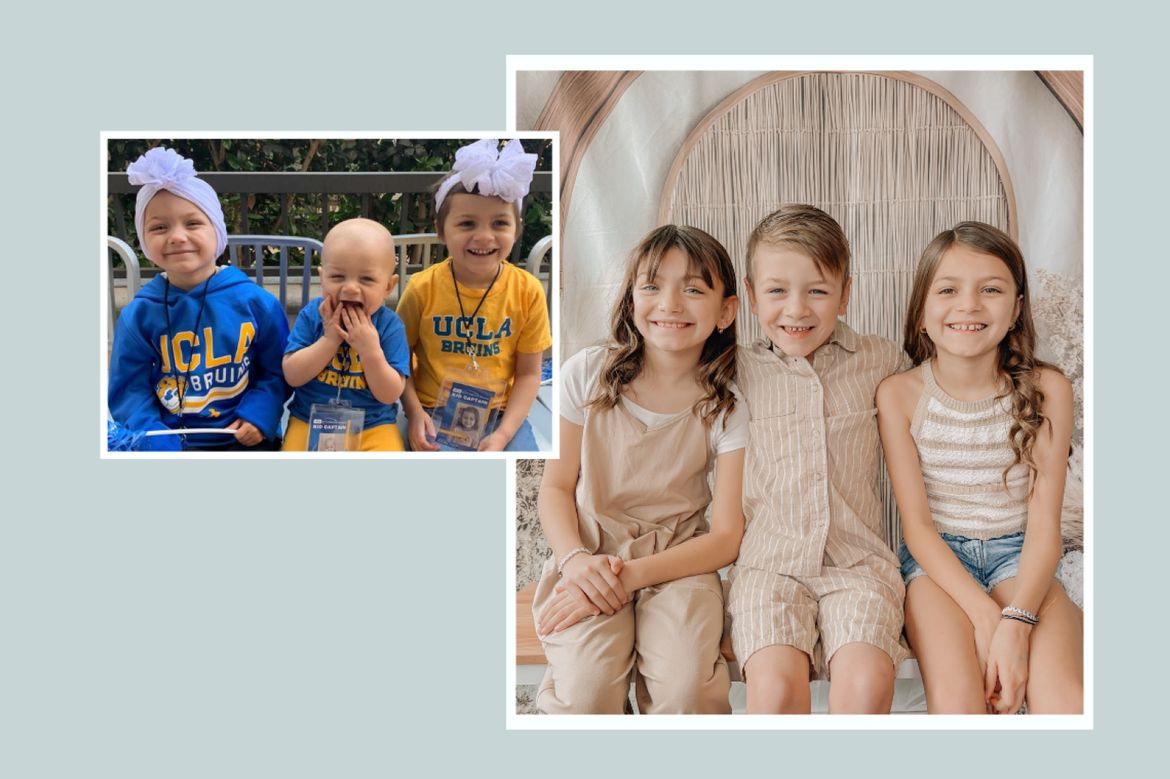
Seven years ago, Jon and Alicia Langenhop learned that all three of their children suffered from the same devastating, one-in-a-million genetic disorder. The constant, life-threatening infections and rashes that began weeks after each child’s birth, emergency room visits and hospital stays — accompanied by exorbitant bills — now had an explanation: severe leukocyte adhesion deficiency-I. But it wasn’t until they found an investigational gene therapy trial at UCLA that they had any hope their young family could beat the deadly odds of the disease.
Ava, 10, Olivia, 8, and Landon, 6, have been in good health since receiving the therapy in 2020. They adventure outdoors, play softball and dream of jobs as veterinarians and magicians.
“It’s like night and day,” Alicia said from the family’s home in Canton, Ohio. “Before they were treated, it was just doctor visit after doctor visit, hospital stays nonstop. Now they’re normal, happy kids who were even able to start going to public school on time.”
The Langenhops aren’t the only family who spent years grappling with the consequences of this rare disease. Marley Gaskins, now 16, spent so much of her early life in and out of doctors’ offices that her mom, Tamara Hogue, quit her job to provide her daughter with round-the-clock care. Marley, who has grown up in Live Oak, Florida, battled near-constant infections and followed a strict regimen of medicines at precise hours to stave off the effects of her condition.
Marley is now an active member of the Girl Scouts, a lover of all things arts and crafts, and as Tamara said with a grin, a typical teenager who sleeps in late and spends too much time on her phone. These activities — even the wonderfully mundane — are possible because she received treatment in the same UCLA clinical trial. Marley’s trial participation, along with Ava, Olivia and Landon’s, helped enable the U.S. Food and Drug Administration to grant accelerated approval for the therapy that changed their lives.
Marley Gaskins, the first patient to enroll in the LAD-I clinical trial. Courtesy of Tamara Hogue
Commercially known as Kresladi, the therapy targets the defective gene that causes LAD-l, which affects approximately one in one million children worldwide. The genetic defect prevents white blood cells from functioning normally, impairing the body’s ability to fight infections and heal wounds.
The one-time therapy inserts a healthy copy of the affected gene into a patient’s own blood stem cells, which are then returned to the child’s body. These blood stem cells can produce the functional immune cells necessary to fight infection and keep the body healthy.
The therapy represents a different treatment approach from stem cell transplants, which have historically been the definitive treatment option for some patients with severe LAD-I.
Clinical trials for the therapy were led by Dr. Donald Kohn, a physician-scientist and member of the Eli and Edythe Broad Center of Regenerative Medicine and Stem Cell Research at UCLA, and sponsored by Rocket Pharmaceuticals, which licensed and developed the therapy, as well as the California Institute for Regenerative Medicine, a California state agency that funds stem cell and gene therapy research.
“Clinical trial participation is absolutely critical to making medical advances — it’s how we learn what works and doesn’t work,” said Kohn, who is also a distinguished professor of microbiology, immunology and molecular genetics in the UCLA College and of pediatrics and molecular and medical pharmacology at the David Geffen School of Medicine at UCLA. “For these patients to be some of the very first to receive this treatment, it’s very courageous.”