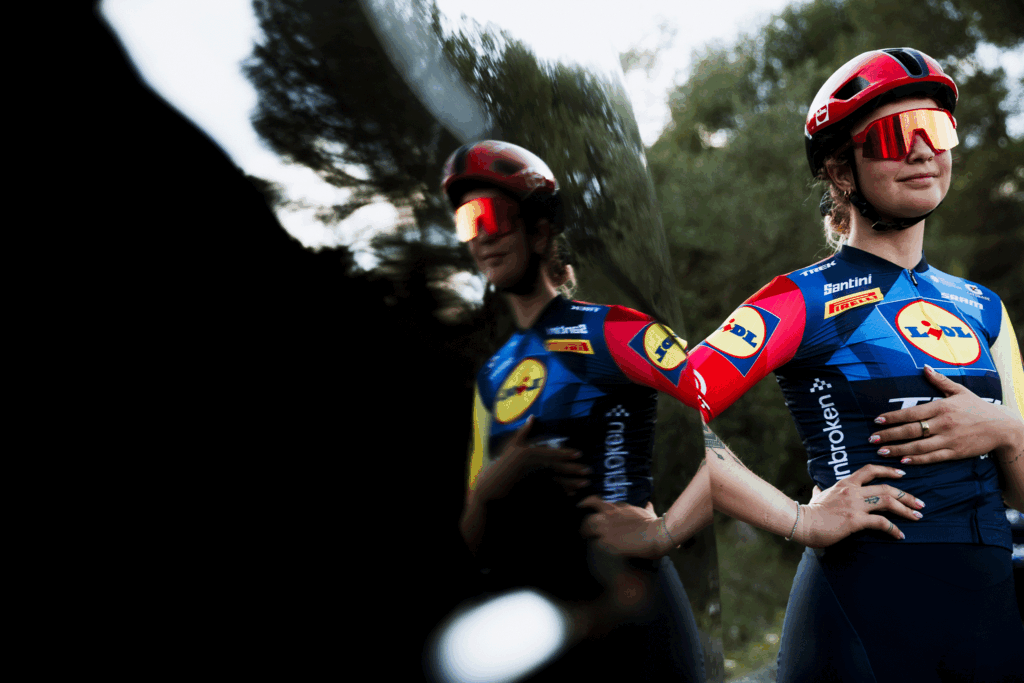
The body and mind are inextricably linked – sports nutrition is about far more than just numbers. In the first of our ‘Food for Thought’ series, Emma Norsgaard and her nutritionist, Jolien Vandemoortele, discuss how to balance the scales to achieve both health and happiness
Above everything, Emma Norsgaard and Jolien Vandemoortele are friends. Rider and nutritionist might be their professional titles, but this is a relationship which spans more than that. Exchanges between the pair are not made up by a barrage of data or macros, but by compassionate conversations that focus on feeling as much as they do fueling. It’s this, Vandemoortele says, which is the very ethos of her approach to nutrition.
“Every nutritionist on this team works with their individual group of riders and we divide them based on who has the best connection with each rider,” she explains. “Apart from nutrition, me and Emma talk about a lot of different topics – it’s not just numbers or physiology but also the mental side that comes with that, which is what helps a rider reach their full potential. Everyone values the human side of things and looks further than the numbers, weight and data.”
Double Grand Tour stage winner Norsgaard is open about the fact she has faced her own struggles when it comes to her weight during her career. The 26-year-old stresses the importance of having Vandemoortele as someone she can confide in, especially when she feels at risk of falling into a comparison trap with her colleagues.
“I can be completely honest with her about how I feel. Sometimes I look at other riders and think: ‘how do they look? What is she eating?’ There is a lot of emotion involved in it too, and it’s nice that she gets it. She never judges me and I see her as a friend helping me to be better.”
Having a relationship with her nutritionist which is built on trust and honesty is especially important for the Danish rider as she navigates complex topics such as fueling through the menstrual cycle when hormones are fluctuating. Both Vandemoortele and Norsgaard explain that research around how periods link with sporting performance is sparse, but that this is steadily improving as women’s sport develops.
“We celebrate the menstrual cycle in this team and are so happy when riders have a regular cycle. The science is really limited so we need to try and find good studies and make protocols around how to eat in different phases of the menstrual cycle,” Vandemoortele explains.
“You can say that in the first phase of the cycle you might need less energy, then around ovulation you need more because the burn is a little bit higher. But also again, it’s so personal. Some people can’t do big training around ovulation while others feel amazing. It might be that scientifically when you’re on your period you’re supposed to perform better but if you are cramping and in pain, it isn’t going to work. It’s so individual and you have to take so much into account.”
Relative Energy Deficiency in Sport (RED-S) is a common occurrence among the women’s peloton – it causes missed or irregular periods (amenorrhea), because the body lacks sufficient energy to support both daily functions and high-level exercise, leading to the shutdown of non-essential systems like reproduction. Norsgaard is working hard to ensure she maintains a regular cycle even when she is deep in preparation for key parts of her season.
“My priority is to become strong and healthy, seeing food as a friend. It’s easier to say than it is to do, but rather than Jolien telling me to cut carbs or calories, she encourages me to be healthy and crack my period, really be good to myself. People are becoming more open and more girls are talking about periods and when they get their cycles. Before, it was almost like if you got your period you were not skinny or fit enough, this has changed and we’re moving towards a more positive mindset” she states.
“With Jolien, I talked a lot with her about how to eat during my cycle as I feel really big changes in my cravings and how hungry I am at different times. We are so used to checking everything in our body – I can gain two or three kilos in water during my period. That can be hard to deal with because the Tour of Flanders is not going to change the date because I have my period. It’s something I try to work with but also try to be more gentle with myself.”
The main target of Norsgaard’s season will come in the spring Classics on the bergs and cobbles of Belgium. A puncheur with a fast finish, the Danish rider is focusing on being at the sharp end of the hardest races this year. With this in mind, Norsgaard admits she is focusing more on her nutrition ahead of her Classics campaign but is prioritizing taking care of her body at the same time.
“I follow a program, so I know I am getting enough while losing what I want to lose,” she explains. “When the race starts, it’s important to have enough of everything like fat, protein, carbs and Jolien is key for this. It’s nice because I just want to focus on doing my thing on the bike, so she takes care of the rest. I turn my brain off and just think about performing, it’s different to how I am in my normal life when I am freestyling more – in this period before and during big races, I try to track everything.”
Vandemoortele’s aim is, of course, to support Norsgaard in her lofty ambitions, but she is also there to check that any weight loss is being monitored carefully.
“We really must make sure she keeps fueling whatever she’s doing. I’m not saying she can eat whatever she always wants, we must keep working on our healthy habits so we can eat good quality, whole foods without artificial sweeteners. But, if she is craving a piece of chocolate then I always say she should just get on with it and have the bloody piece of chocolate,” the Belgian laughs.
“I think she is doing a lot of mental work to believe that she doesn’t need to be in a small body, but a strong body that can sprint for the win. If she just keeps believing in and fueling that skill, staying calm and confident in herself, she can have a nice season.”
Getting every ingredient right in the recipe for success is no easy task, but both Norsgaard and Vandemoortele say that a holistic approach to performance is key. Nutrition is as much about the mind as it is the body, so psychologists and coaches being involved with conversations about fueling is imperative to finding the right balance. Opening up to her teammates is also something that Norsgaard finds helpful when she is struggling with sensitive topics like body image.
“I do my best to talk about it with my teammates, like at races and on my podcast. I’m trying to be open with my feelings and say if I feel out of place somewhere or if I’m looking and thinking everyone else is skinnier than me. Immediately when I say it out loud, I feel better. It’s easy to think everyone is looking at you but it’s never true.”
Vandemoortele also notices that group conversations are a positive way for riders to share concerns and relate to each other’s worries.
“I’m happy they speak about it around the table and bring up these topics. Working together with psychologists to challenge the thought process of ‘my body is not good enough’ is important. Mostly, if you look back to when a rider lost weight and was very lean and you ask if they were happy, or if they felt strong, the answer is no, not at all. Or they got injured afterwards and had to recover. Most of the time they realize being in a slightly bigger body makes them strong enough to do all the racing and travelling,” she says.
“I love to sit together with coaches, doctors and psychologists to have discussions as every single department links together. That’s what is fun about cycling, you have that ability to really work together as one team.”
Above all, both Vandemoortele and Norsgaard understand that the human must always come before the athlete. This is what Norsgaard believes will help her sprint to success when the Classics roll round – with a body that has been fueled correctly to make the most of her talents, rather than lessen them.
“You can have the perfect numbers but if the mental side is not there, you might as well just put those numbers in the toilet,” she says. “It all has to work together and in modern cycling, this team understands that. Riders need to be happy before anything else.”