At 68, I’m often asked what I take to stay healthy. Perhaps it’s because I’m active and engaged, I move quickly, and I seem to enjoy life. The assumption is that there must be something behind the scenes, a regimen, a set of supplements quietly doing the work. The truth is much less dramatic.
Sure, I take vitamin D in winter. I’ve tried collagen and creatine at different points. I might take a multivitamin for a few days and then forget about it entirely. But there’s no system, no daily ritual, no sense that my health depends on what I swallow each morning.
Which is why a recent study on centenarians caught my attention. Researchers analysing blood samples found that people who live into their hundreds don’t necessarily have more antioxidant protection than the rest of us. In fact, they often have less, not because they’re lacking anything, but because their bodies are under less strain in the first place. They don’t need to mount the same level of defence.
It’s a subtle shift, but an important one. Ageing well may be less about adding things in, and more about reducing what wears us down.
New FeatureIn ShortQuick Stories. Same trusted journalism.
This connected to a recent experience that changed how I think about health – not as something to optimise, but as something to attend to.
Last November, I had precancerous cells removed from my face. More significantly, 18 months ago, a bad fall while out walking with a heavy rucksack left me with a serious concussion. The recovery was slow, and it required proper medical attention: scans, monitoring, time. What it also gave me was a much sharper understanding of what my body actually needs, and what it means to slow down rather than push through.
When I look at my own life, a few things seem to have mattered far more than any supplement ever could.
Strength training
The first is strength. I’ve been doing strength training for over 20 years, starting in my late forties. Not because I was worried about ageing, but because it felt like a sensible long-term decision. I didn’t want to lose muscle, and I knew that staying physically capable mattered.
What I didn’t fully appreciate at the time was just how important that decision would become, especially after my concussion, which made me acutely aware of balance and how quickly physical confidence can be disrupted.
I began to research through reading academic papers, not just articles in magazines and online. There’s now strong evidence that strength is one of the most reliable predictors of how well we function as we get older. It affects balance, mobility, metabolic health and resilience after illness or injury. The concussion also taught me something I hadn’t known before: as we age, the neural signal between brain and body slows by a fraction of a second. It sounds tiny, but it’s a significant factor in why older people are more likely to fall. Strength training and balance work aren’t vanity, they’re how we stay safe.
More recently, I’ve shifted away from goal-focused training towards something more functional. Less about lifting heavier weights, more about maintaining the kind of strength that supports everyday life, getting up from the floor, carrying things with ease, moving confidently. I can walk up three flights of stairs to my flat without holding on and want to continue till I’m at least 80.
Functional fitness isn’t glamorous, but it underpins everything else.
Listening to my body
The second is how I respond to discomfort. The concussion forced me to learn this properly. Recovery meant genuinely slowing down, paying attention to what my body was telling me and resisting the urge to override it. I used relaxation and breath rather than reaching for painkillers. I rested when I needed to rest.
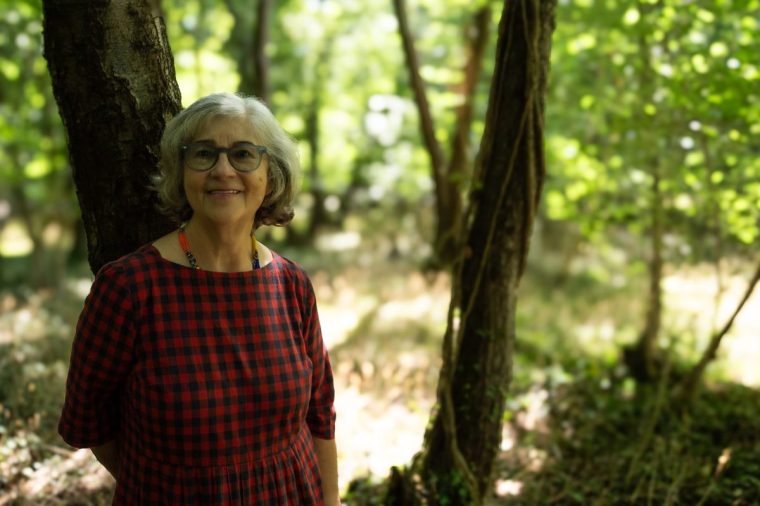 Denise Taylor used relaxation and breath rather than reaching for painkillers after a fall (Photo: Ilona Gierach)
That experience reinforced something I’d long believed but hadn’t always practised: the body often knows more than we give it credit for, and our job is to listen rather than override.
I don’t see every ache or pain as a sign that I’m getting older. My starting point is that there’s usually a reason, and that things can improve. If my back hurts, often from “sleeping funny”, I slow down and pay attention. There’s good evidence that how we think about pain influences how we experience it – stress and anticipation can amplify it – while calm attention can reduce it.
This isn’t about avoiding medical care. Some medication is genuinely necessary for many people, and I’m not questioning that. What I’m questioning is the reflex to reach for something, anything, as the first response to every sensation.
Restoring energy
The third is how I manage my energy. There’s a strong emphasis in conversations about ageing on staying active and socially engaged, and those things do matter. But what’s often overlooked is that not all activity restores us.
I lean strongly towards introversion. I enjoy people and value connection, but too much social stimulation is draining. What restores me is quiet; time alone, space to think and write and notice. I spend time at my woodland in Gloucestershire, walking or simply sitting. I write regularly. I allow for days that aren’t overly structured.
This isn’t withdrawal. It’s paying attention to what I actually need.
Chronic stress is one of the clearest contributors to poorer health as we age, affecting sleep, inflammation, immune function and overall resilience. But stress doesn’t only come from obvious pressures. It can come from overcommitment, from constant stimulation, from never quite stopping. Learning what restores your energy, and protecting space for it, is one of the most practical things you can do.
Staying interested in life
Running through all of this is something quieter, but just as important. I’ve stayed interested in my life. I’m still curious, still want to learn, still find myself thinking about how people make sense of later life.
There’s good evidence that psychological factors matter as much as physical ones when it comes to ageing well. A sense of purpose and curiosity are linked to better health outcomes and longer life. But beyond the research, it simply changes how life feels. Later life isn’t something I’m enduring. It’s something I’m living.
None of this makes me immune to illness or the realities of ageing. Bodies change. Things happen. There are no guarantees. And I’m not suggesting supplements have no place. For some people, in some circumstances, they’re genuinely useful. Vitamin D in winter is a reasonable example. But the idea that they’re foundational to good health feels misplaced.
What sits at the centre, in my experience and in much of the evidence, is more ordinary – and harder to package. Move in ways that maintain strength and capability. Respond to discomfort with attention rather than alarm. Pay attention to what drains you and what restores you. Stay interested in your own life.
No industry is built around doing these things quietly and consistently over time. But when I look at my own health at 68, and at what the research increasingly tells us about people who age well, it all points in the same direction. Not towards more inputs, but towards fewer underlying strains. Not towards quick fixes, but towards long-term habits.
There’s a simplicity to it that can feel almost disappointing. But it may also be why it works.