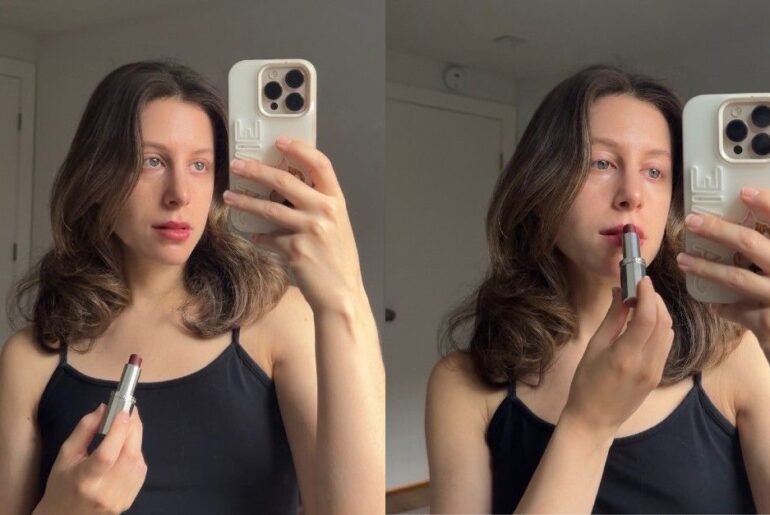
Ever since artificial intelligence spread like wildfire, you’ve probably read countless articles on different topics describing the phenomenon with the unmistakable phrase “it’s just like in Black Mirror.” Still, I can’t help but talk to you about the mirror—and how it’s changing today. Some time ago, I told you about the origins of this object and its portable version designed for smartphones. Now, its evolution has taken a step further. For years we’ve dreamed of a meeting point between the beauty world and the tech universe, just think of Cher Horowitz’s magical computer in Clueless or the make-up machine by Chanel used by Leeloo in The Fifth Element. What if I told you that you can open your eyes and actually experience it? On social media, the first reviews of AI mirrors are starting to appear. These are smart mirrors powered by AI that promise to revolutionize our daily makeup and skincare routines. But how? Let’s take a closer look at one of the most talked-about innovations of the moment: the mirror by Swan Beauty.
The Swan mirror marks a turning point in AI-powered beauty mirrors
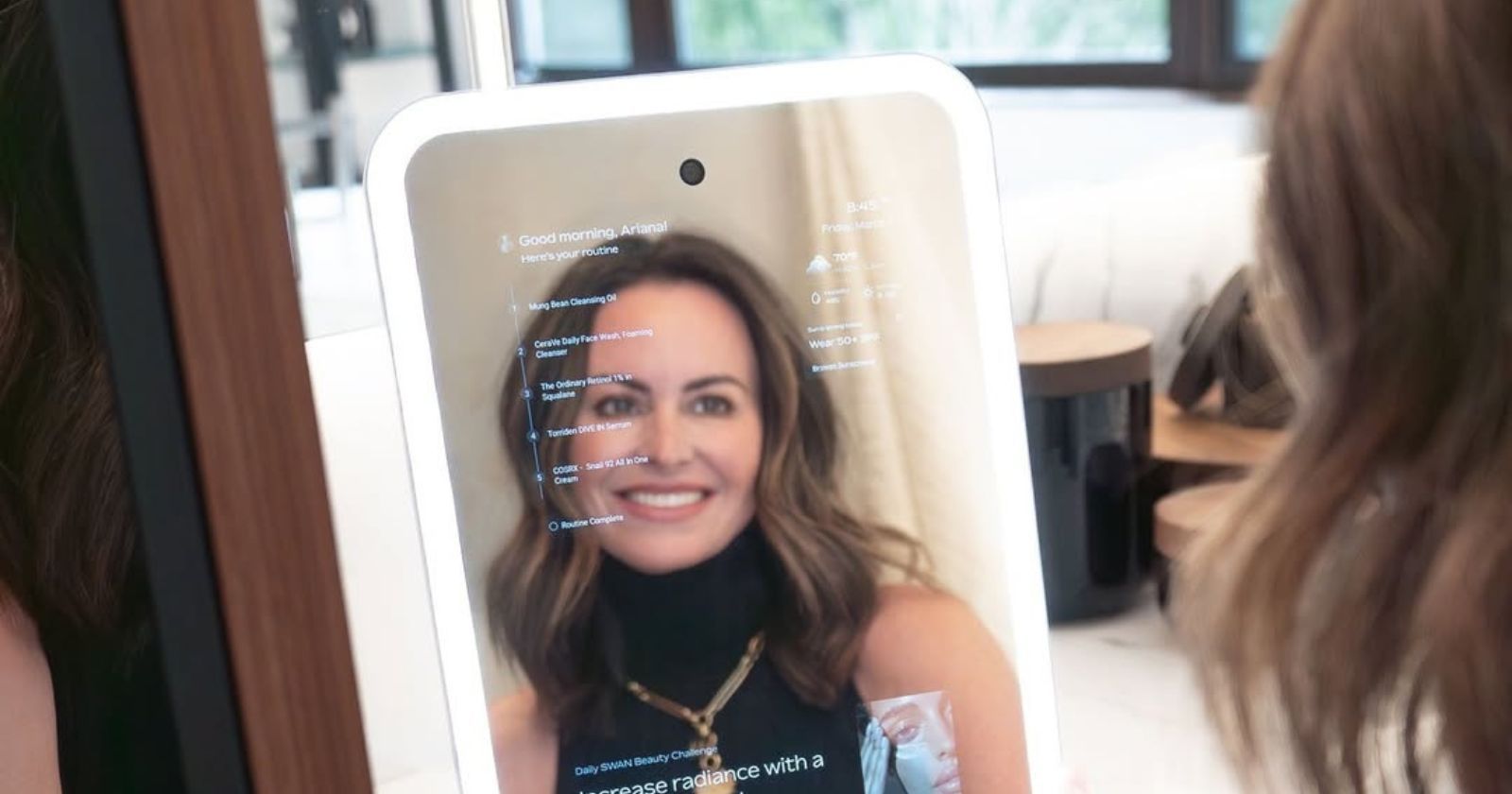
On January 14, 2026, CEO Colby Mitchell announced the launch of the first smart mirror by the startup Swan. Available on the website for $795, it is described as “a hub that integrates artificial intelligence and shopping into a single hardware device.” Supporting the project is the Mitchell Family Office, which acquired Cos Bar (a historic high-end retailer) in 2025. This step is key to understanding the brand’s positioning: the mirror analyzes your skin and suggests tutorials, while the Cos Bar marketplace allows users to instantly purchase top products featured on the platform.
From a technical standpoint, the mirror features a 15-inch display, a 4K resolution camera, and adjustable LED lighting with three color temperatures. Particularly useful for recording your GRWM are the built-in microphones, which offer crystal-clear voice capture and immersive high-quality audio. As mentioned earlier, users can access the Swan Beauty community and view content both on the device and through the app on their smartphone. In short, a full-fledged social network, just like Instagram or TikTok.
A monthly subscription to unlock full functionality
However, it’s important to clarify which features are available upon purchasing the Swan Mirror and which require a monthly subscription. In short, to access AI and AR (augmented reality) tools, users need to subscribe to a membership costing around $10 per month. The unlocked features include:
– Skin analyzer: a dermatological scan that evaluates 7 skin parameters and assigns a health score even without a subscription. However, this is a one-time scan to check the current condition of your skin and is quite limited. Without a subscription, the mirror does not remember your skin over time, so it cannot tell whether a serum is actually working. With tracking, you can build a personalized routine, log the products you already own, receive suggestions on how and when to use them consistently, and discover new ones based on your skin’s needs.
– SmARt Makeup Artist: without a subscription, users can access basic tutorials, record videos, and watch content from others. However, they cannot use the AR overlay (a facial mapping system that digitally guides makeup application) or access advice from celebrity makeup artists involved in the project, such as Carolina Gonzalez, Allan Avendano, and Fiona Stiles.
From ethics to future implications
Can we trust it? Colby Mitchell revealed that the feature was developed with dermatologists who analyzed “thousands of faces,” evaluating them case by case across the seven parameters mentioned earlier (wrinkles, pigmentation, texture, oiliness, redness, acne, UV spots), “to make the machine as intelligent as possible.” In practice, recognition algorithms are used to compare a face with a database of dermatologist-validated cases in order to classify and measure skin concerns. In other words, the machine doesn’t invent anything, it relies on human expertise to function effectively.
Does optimizing our routine turn us into our own worst critics? The nuances of AI today
Could we do without a dermatologist or a personal trainer thanks to these new tools? The short answer is no, but there’s another angle to consider. AI can simulate the expertise of a dermatologist, but it lacks the intuition that comes from lived experience. However, if a device constantly observes us (whether we’re working out or looking in the mirror) and pushes us to optimize ourselves, we might risk becoming our own harshest critics. Perhaps AI doesn’t free us from work or complex routines, but instead imposes something else: the constant maintenance of our image and health according to algorithmic standards. Still, there are positive aspects to consider. According to many experts, AI will not replace humans but could act as an assistant, helping with complex tasks and paradoxically giving us back some of our “free time.” The nuances are many, all worth observing closely and considering carefully. What do you think?