Spring approaches — slowly this year — ignoring the calendar and human expectations.
Sharp, pointy green shoots reaching for light, struggle through cracks in the earth and promise that soon crocuses and daffodils will emerge. Hopefully, near some granite steps that lead from a driveway a purple hyacinth — given to my daughter years ago by a friend at an Easter service in upstate New York — will again reappear.
Ramadan, the Muslim month of fasting, self-reflection and spiritual renewal ended two weeks ago.
Nowruz, the Persian New Year, was celebrated on March 20.
Palm Sunday was celebrated a week ago.
Pesach / Passover began before sundown on Wednesday.
Good Friday has passed.
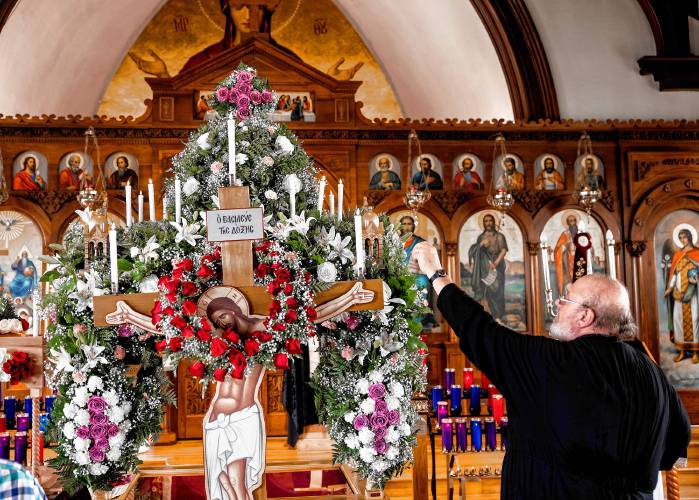
Easter is now.
It is a season of love, of scents, memories, promise, deliverance and liberation. Most importantly, it’s a season that reminds us that we can’t forget the lessons of Moses and Jesus and Muhammad, or of Gandhi, Nelson Mandela, Malcolm X, Dr. Martin Luther King, Jr. — the “others” of their day — who rose against authority and helped to deliver the oppressed, the marginalized, the disenfranchised, into the light.
There were probably no daffodils and crocuses in Egypt over 3,000 years ago “… in the month of (the) spring” when scribes recorded humanity’s first successful slave rebellion and wrote of how the Israelites — with God’s help — were freed from slavery, and how Moses led the Exodus of the Israelites out of Egypt and across the Red Sea to Mount Sinai, where he received the Ten Commandments.
The story of overcoming pharaoh, of triumphing over the powerlessness and hopelessness that tyrants and rulers try to instill in their subjects, the story of the liberation — as narrated by the scribes — forever inspires humankind with its promise of freedom from oppression.
The beauty of the Easter story, of an olive-skinned Jew from Nazareth named Jesus — carpenter, radical preacher, social justice activist — born of the Virgin Mary and, according to Christian tradition, crucified, died, buried and raised from the dead, is no less inspiring.
In challenging authority, in chasing the moneylenders from the temple, in embracing the dispossessed and giving them promise of salvation, we learn, through the story of his sacrifice, that redemption is of the spirit.
Out of the shadows, into the light.
New life seeking light and promise through cracks in the earth.
“No one today is purely one thing,” my friend Edward Said wrote. “Labels like Indian, or woman, or Muslim, or American are not more than starting-points, which if followed into actual experience for only a moment are quickly left behind. … Yet just as human beings make their own history, they also make their cultures and ethnic identities. No one can deny the persisting continuities of long traditions, sustained habitations, national languages, and cultural geographies, but there seems no reason except fear and prejudice to keep insisting on their separation and distinctiveness, as if that was all human life was about.”
Today, understanding that I have been writing about genocide, ethnic cleansing, terrorism, famine and dispossession for far too many months — all with urgency and justification — I want to share a different kind of story today.
Today, I want to reflect on some personal moments of beauty and light that I renew each spring — memories of family and faith.
It’s Palm Sunday a long time ago and after church, many families have come together at our house.
The women gathered, weathered, stout, some stooped, bent from years working in fields, mills, factories. All present. Sitto (grandmother). Aunts. Cousins. Mummy and her sisters. Most wearing their Sunday best, all wrapped with large aprons, starched, crisp.
The men gathered as well. They always sat in the living room weaving, with calloused hands, fresh palm fronds — which they had brought home after attending mass at Our Lady of the Cedars Church — into traditional delicate designs that would hang over doors for the coming year, smoking cigars, playing cards and drinking coffee made by Mummy, who had to keep tearing herself away from making ma’amoul, Arab Easter cookies, to keep them happy.
Palm Sunday. Sitto had prepared the dough in advance.
Ready.
Walnuts had been ground, mixed with sugar and flavored with rose water. Dates had been carefully pitted, then ground through a meat grinder clamped to a sturdy wooden kitchen table. Then reground.
I still have that grinder, attached, for sentimental reasons, to a table in my kitchen.
Card tables were set up and covered with white sheets. Extra chairs had been borrowed.
Everyone had a place.
Everyone was ready.
It was an annual tradition. Women rolling out little discs of dough, others filling them with dates or nuts and folding over the top, forming puffy semi-circles, others carefully crimping the edges and decorating the tops with pierced patterns made with small tin tools Daddy made in his basement workshop.
I still have one of those tools.
Late that night, after the ma’amoul had set a while, Sitto baked them (she wouldn’t trust anyone else to do it) in our aged green Garland wood-stove, deftly sliding cookies in and out on a wood peel so old and worn I think she might have brought it with her when she emigrated from Syria at the turn of the 20th century.
All emerged perfectly baked.
No timer. Just instinct.
Differences in piercing designs distinguish the date cookies from the nuts.
On Monday the cookies, having cooled, after having been sprinkled with generous amounts of powdered sugar and carefully packed in tins that had been saved over the past year, would be hand-delivered to each family that had joined us in making them, each getting their share.
I favored the ones with walnuts — the taste lingers still.
In the early 1990s, perhaps — well after I had embraced Islam — I remember being in Cairo and Damascus suqs (markets) during a springtime when Easter and Ramadan overlapped. The bazaars were full. Christian shopkeepers welcomed Muslims, Muslim shopkeepers served Christians and richly-decorated church candles and Ramadan lanterns competed for space in shop windows.
I am flooded today with memories of such salvific stories and so thankful to you all for giving me the opportunity to share them, to reaffirm my belief in the unity that sustains us all. Achieving social justice for all is a challenge but the examples of the prophets inspire us, and compel us to action.
Logos in an Easter cookie. Logos in a cup of coffee, a Torah, a Vigil, a Resistance.
Logos.
Alleluia.
Alhamdulillah.
Robert Azzi is a photographer and writer who lives in Exeter. He can be followed at robertazzitheother.substack.com.