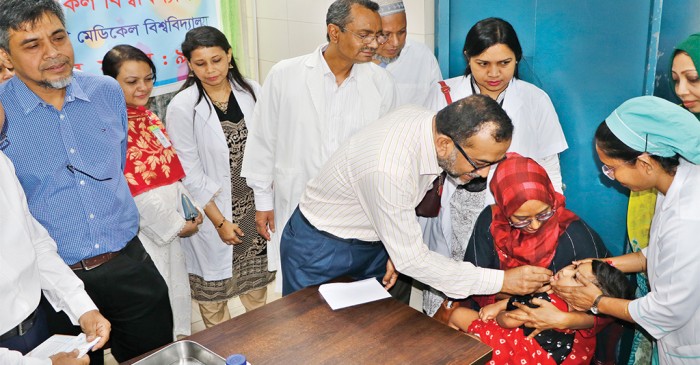
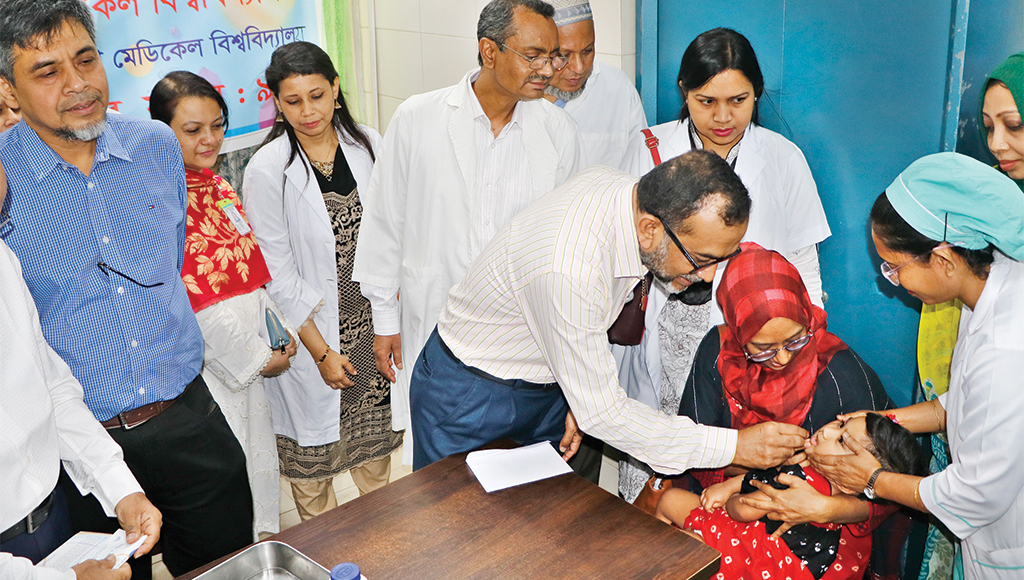
Representational image.
Disruptions in the country’s regular Vitamin A supplementation campaigns over the past few years have left millions of children vulnerable to infectious diseases, with public health experts linking the micronutrient deficiency to the severity of the ongoing measles outbreak.
Nutritionists and physicians said that Vitamin A plays an important role in strengthening immunity and reducing complications from measles, warning that gaps in the national supplementation programme could increase infection risks and mortality among children.
Dhaka University’s Institute of Nutrition and Food Science director Professor Md Saidul Arefin said that Vitamin A deficiency not only weakens resistance to measles but also exposes children to pneumonia, diarrhoea and other infectious diseases.
Though Vitamin A campaigns are usually conducted once every six months but the authorities, for the last time, failed to conduct any in more than one year due to capsule shortage.
The Vitamin A supplementation deficiency was exposed as more than 100 children died with symptoms of measles, and more than 7,000 cases were detected across the country over the past three weeks.
‘Vitamin A strengthens the immune system and helps children fight infections. If supplementation is disrupted, children become more vulnerable to measles and other diseases,’ Professor Saidul explained.
According to the Institute of Public Health Nutrition, the latest National Vitamin A Plus Campaign was held on March 12, 2025, while the previous round took place on June 1, 2024, despite the government’s long-standing strategy of conducting the campaign twice a year at six-month intervals.
Health officials said that the campaign was disrupted following the discontinuation of Operational Plans under the Health, Population and Nutrition Sector Programme in June 2024, which also affected routine vaccination, logistics, procurement of medicines and disease surveillance.
For decades, Bangladesh successfully implemented biannual Vitamin A campaigns alongside immunisation programmes, reaching more than 22 million children aged between 6 and 59 months every year and earning global recognition for reducing child mortality and preventing blindness.
However, the programme had already faced setbacks during the Covid-19 pandemic in 2020–2021, and the closure of Operational Plans further weakened procurement and supply systems, leading to shortages of Vitamin A capsules.
Officials said that capsules were previously purchased through Operational Plan funds, but procurement slowed after the funding mechanism was halted.
Institute of Public Health Nutrition director Mohammed Eunus Ali said that Vitamin A capsules were now limited and were being used mainly for children infected with or suspected of having measles.
‘We are now providing Vitamin A capsules to measles-infected or suspected children. We have around 60 lakh capsules left from the previous campaign,’ he said, adding that a proposal for new procurement had been sent to the ministry for approval.
The National Vitamin A Plus Campaign, supported by UNICEF, distributes blue capsules for children aged 6–11 months and red capsules for those aged 12–59 months through immunisation centres and community clinics.
Presently, the government has only 10 lakh blue capsules and 50 lakh red capsules against the demand for more than two crore capsules for a national campaign.
The government on Sunday launched emergency measles vaccination in 30 upazilas of 18 districts to control the outbreak, while health minister Sardar Md Sakhawat Husain said that Vitamin A would be provided to infected children as part of treatment support.
Public health experts, however, stressed that Vitamin A supplementation should not be limited to infected children alone, urging the authorities to resume nationwide campaigns to reduce infection risks.
According to World Health Organization guidelines and Bangladesh’s Integrated Management of Childhood Illness protocol, all children diagnosed with measles should receive Vitamin A supplements because the disease rapidly depletes Vitamin A levels and increases the risk of severe complications and death.
Physicians and nutritionists warned that children with Vitamin A deficiency were more likely to suffer severe measles complications, including blindness, pneumonia and malnutrition, and suspected that the high infection and casualty rates in the current outbreak could be partly linked to disrupted supplementation.
During the last campaign in March 2025, more than 2.26 crore children were targeted for the supplementation.
The authorities purchase the capsules from local market and supply them free of cost for the children, aged between six to 59 months.
Experts said that restoring regular bi-annual campaigns was essential to rebuild immunity among children and prevent future outbreaks.
‘Vitamin A is not just a supplement; it is a life-saving intervention that reduces child mortality and strengthens immunity. Regular campaigns must resume without delay,’ Mohammad Mushtuq Hussain, former adviser to the IEDCR and a public health expert said.
Vitamin A is a crucial micronutrient required for vision, immune function, growth and protection against infections, and its deficiency remains a major public health concern in developing countries like Bangladesh.