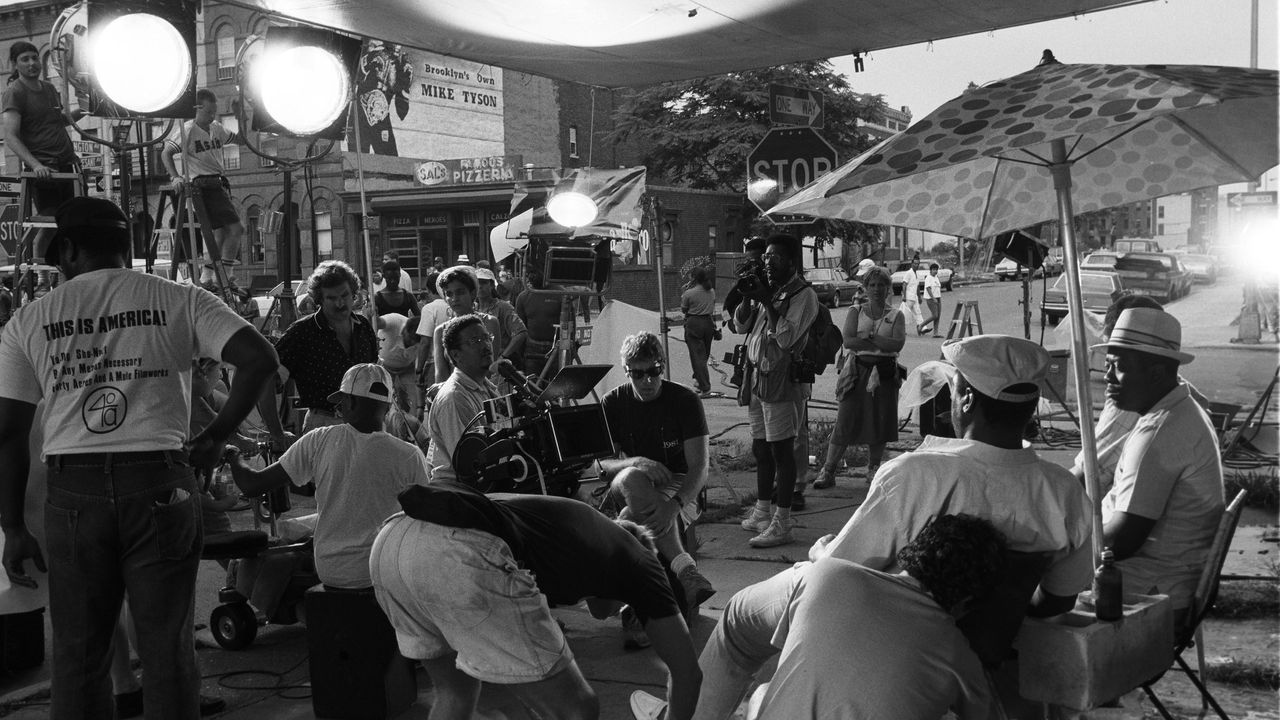
Directing movies is also a matter of production—of the interpersonal, the administrative, and the technical practicalities that go into creating the images and sounds that end up on the screen. The vast implications of that casual notion unfold in fascinating, appalling, comedic, and nearly tragic detail in “Cinematic Immunity” (Feral House), Michael Lee Nirenberg’s oral history of filmmaking in New York City from 1954 to 9/11. Subtitled “An Oral History of New York Filmmaking as Told by the Crews That Got the Shot,” it’s a workers’-eye view of Hollywood on the Hudson, looking behind the scenes of films that were made, wholly or in part, on location in and around New York City (plus a few shot out of town but with New York-based crews). The book is manifestly a labor of love (and a love of labor) because the world it portrays is the one in which Nirenberg, a scenic artist based in New York, has made his career. In a hundred and fifty interviews, nearly four hundred pages, he hears from crew members, current and former, who worked on films including “On the Waterfront,” “Midnight Cowboy,” “The French Connection,” “The Taking of Pelham One Two Three,” “Do the Right Thing,” and “Goodfellas,” as well as TV shows (“The Sopranos”) and commercials.
As a cornucopia of anecdotes, sassy portraits, and revealing asides, the book is unputdownably engaging; it’s futile to resist the temptation to quote it at length. But the stakes involved, both artistic and social, make these recollections far more than mere yarns. First, movies are workplaces, and Nirenberg’s interviewees reveal the stressful negotiations involved in the daily life of filmmaking—not only with executives and producers but also with directors, who, though employed by those very same businesspeople, are also the immediate bosses of the crew. Thus this is intrinsically a story of class differences, involving labor unions and labor relations in general. At the same time, because directorial control is the very definition of the art of cinema, this is also a story of how that art happens, of the kinds of relationships on which the very ability to function as an artist depends, and of the process of communication (sometimes mysterious, sometimes strikingly literal) by which a plan becomes a reality. In the era that Nirenberg covers, that reality is starkly physical and often impossible to control and, therefore, dangerous. These stories make plain the bodily harm that crew members have routinely risked, and how these workers—whose enthusiasm for their work and for cinema itself is palpable—consider a profession whose hazards are not only physical but also psychological, professional, and familial.
The first movie discussed is “On the Waterfront” (1954), Elia Kazan’s bruising drama of union corruption and resistance among longshoremen, starring Marlon Brando. Ironically enough, union policies played a significant role in shaping the film. Kazan, struggling to find a local cinematographer whose work appealed to him, lucked into hiring a living legend. Kazan heard from a cameraman named Boris Kaufman, who said that he’d shot a waterfront movie before. That movie was Jean Vigo’s “L’Atalante” (1934), a mighty classic of visual poetry and emotional power, and Kaufman—Russian-born and the young brother of the famous Soviet directors Dziga Vertov and Mikhail Kaufman—had had a distinguished career in France, before the Nazi Occupation forced him to emigrate. Despite his long and illustrious experience, union strictures prevented him from working as a cinematographer in Hollywood, which is why he remained in New York, working mainly on short films and documentaries—and why he was keen to work on Kazan’s film. Amazingly, although he won an Oscar for his cinematography in “On the Waterfront,” Kaufman still wasn’t able to shoot studio pictures in Hollywood; union requirements would have forced him to start as an assistant and work his way up. Instead, he stayed put and became a go-to cinematographer for New York productions such as “12 Angry Men” and “Splendor in the Grass,” while also becoming a prime mentor for a new generation of New York-based camera crews. (One of his camera operators for “On the Waterfront,” Gayne Rescher, went on to be the director of photography on such classic New York movies as Elaine May’s “A New Leaf” and Otto Preminger’s “Such Good Friends.”) Hollywood’s loss was indeed New York’s gain.