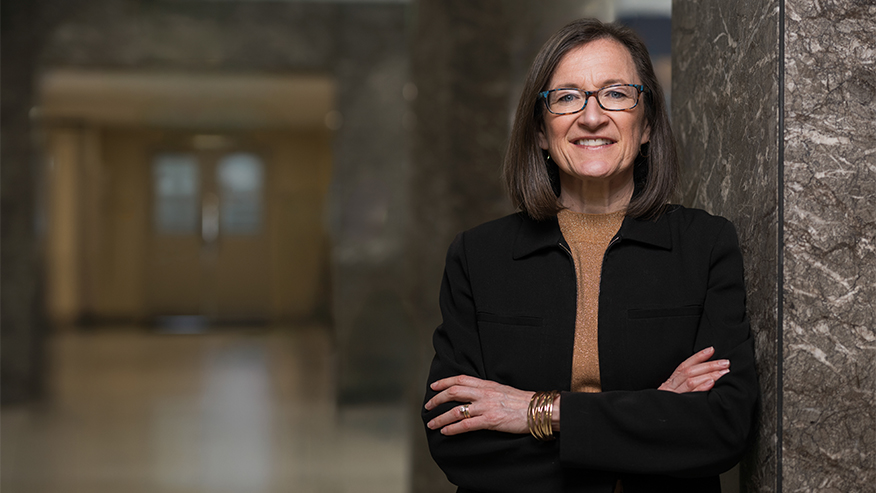
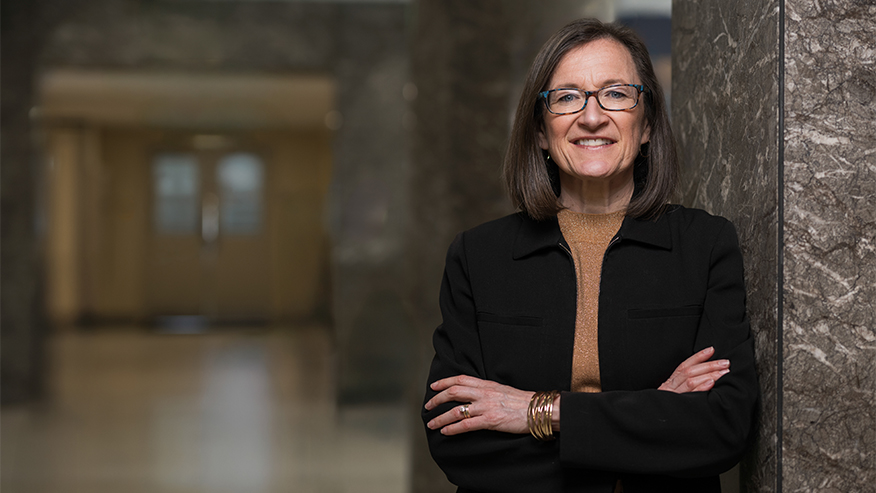
Laura Murray-Kolb has been chosen for the 2025 Lu Ann Aday Award, which recognizes outstanding research that has significantly contributed to the health and well-being of society. (Purdue University photo/Becky Robiños)
WEST LAFAYETTE, Ind. — Laura Murray-Kolb has been selected to receive the 2025 Lu Ann Aday Award, a recognition given annually to a Purdue University faculty member who has made a major impact in their field within the humanities and social sciences.
Murray-Kolb, professor and head of the Department of Nutrition Science in the College of Health and Human Sciences, studies the neurophysiological and neuropsychological consequences of iron deficiency with the aim of informing the development of policies designed to improve maternal and child health worldwide.
“I am humbled by this recognition and grateful for the opportunity to work alongside dedicated colleagues, students and communities,” Murray-Kolb said. “Together, we strive to advance nutrition and health for women and children worldwide. I am indebted to my former mentors for exceptional training and hope this award inspires continued efforts to improve lives globally.”
As the leading micronutrient deficiency worldwide, iron deficiency undermines both physical health and cognitive function, often before symptoms are visible. Its most severe form, anemia, affects an estimated 40% of children aged 6 months to 5 years, 37% of pregnant women and 30% of women aged 15-49 years, placing millions at risk during critical stages of development.
By integrating nutrition, psychology and development, Murray-Kolb’s research has advanced understanding of the consequences of iron deficiency, identified critical windows for intervention, and informed evidence-based recommendations and policies to prevent its most damaging effects. Her work has contributed to shaping World Health Organization guidance to use serum ferritin, a pre-anemic biomarker, as a screening tool to better protect the developing brain.
Her research has secured more than $50 million in funding, including support from the National Institutes of Health, U.S. Department of Agriculture and the Gates Foundation, and she has published 116 peer-reviewed articles and 12 review papers.
Murray-Kolb’s contributions have earned national and international recognition, including the Norman Kretchmer Memorial Award in Nutrition and Development in 2016 and the Nevin Scrimshaw Mid-Career Award in Global Nutrition in 2019, both from the American Society for Nutrition (ASN). She was inducted as an Excellence in Nutrition fellow by ASN in 2025 and named among the top 2% of most-cited researchers worldwide in 2024 by Stanford University in partnership with Elsevier. From 2024-25 she served as chair of ASN’s Academic Nutrition Departments and Programs and currently serves as secretary on its board of directors. She also serves on the Journal of Nutrition’s editorial board and has contributed her expertise to major international and federal efforts, including task forces convened by the International Union of Nutritional Sciences, the Micronutrient Forum and the National Institutes of Health, helping to guide iron supplementation policy, particularly in malaria-endemic areas.
The Lu Ann Aday Award is one of Purdue’s most distinguished faculty honors. Established through a gift from alumna Lu Ann Aday, the award recognizes outstanding research that has significantly contributed to the health and well-being of society.
Murray-Kolb will speak at the Excellence in Research Award Lectures event from 9-11:30 a.m. May 6 at the East/West Faculty lounges in the Purdue Memorial Union. Registration is requested here.
About Purdue University
Purdue University is a public research university leading with excellence at scale. Ranked among top 10 public universities in the United States, Purdue discovers, disseminates and deploys knowledge with a quality and at a scale second to none. More than 106,000 students study at Purdue across multiple campuses, locations and modalities, including more than 57,000 at our main campus locations in West Lafayette and Indianapolis. Committed to affordability and accessibility, Purdue’s main campus has frozen tuition 14 years in a row. See how Purdue never stops in the persistent pursuit of the next giant leap — including its integrated, comprehensive Indianapolis urban expansion; the Mitch Daniels School of Business; Purdue Computes; and the One Health initiative — at https://www.purdue.edu/president/strategic-initiatives.