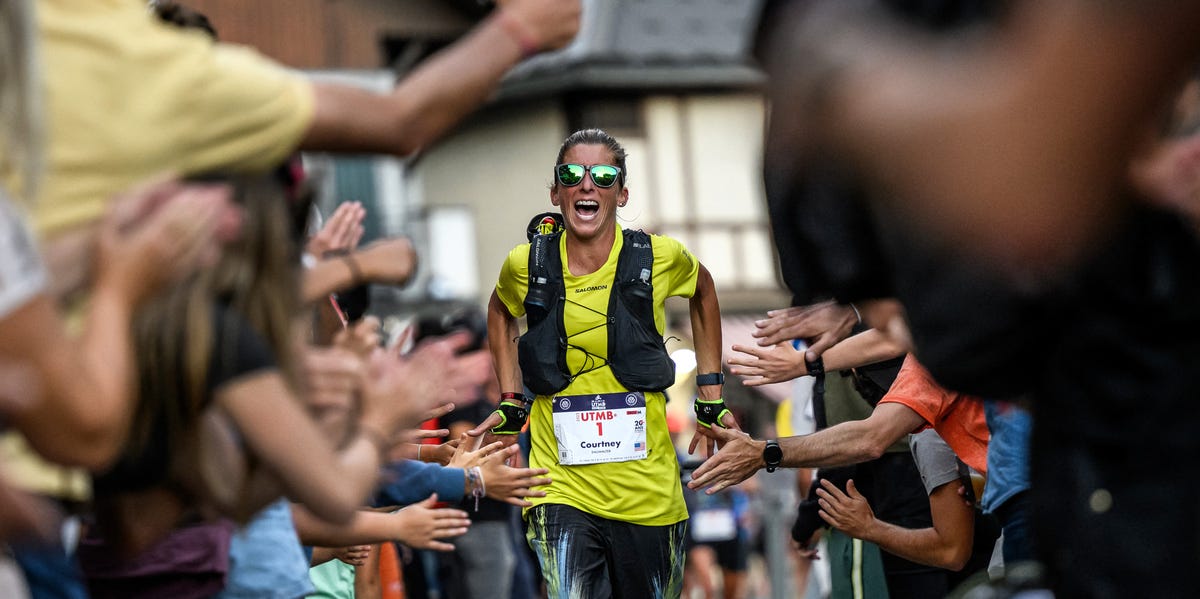
When high school science teacher turned elite ultrarunner Courtney Dauwalter first started running 50- and 100-milers in the mountains back in 2011, her approach to fueling resembled her previous gig: lots of experiments. For years, she tested out whatever food she found at aid station tables or items she saw other people eating, seeing how it would settle while she ran the course.
“When I would arrive at an aid station, I would just copy the person in front of me, exactly what they would eat,” she tells Runner’s World. “If they were grabbing pickles and Doritos, then that’s what I was having. Or if they were drinking Coca-Cola and a handful of gummy bears, that’s what I would try. I really had no idea what I was doing for fueling ever.”
Dauwalter’s “follow-the-leader” method lasted about six years before she realized something had to change. The turning point happened sometime around 2017, when she was racing a 50-miler and orbiting the same competitor for hours. As the two approached the final aid station (around mile 40), she watched him “slam” a shot of 5-Hour Energy and speed off. “I didn’t see him the rest of the time. In my head, I was like, ‘oh my gosh, a 5-Hour Energy… I should copycat that at my next race,’” Dauwalter says.
Related Story
So during her next 100-miler, around mile 30, Dauwalter took a shot of 5-Hour Energy. “I had been expecting booster jets,” she says. “I thought it was going to make me fly, but I didn’t feel any effects from it.” So she took another.
Within a few miles of that second high dose of caffeine, she ended up lying on the side of the trail, throwing up for hours. “It had triggered this whole terrible reaction, and then I was like, ‘okay, you actually need to start paying attention to what works for you and maybe start having more of a plan and not just [consuming] random things every single race,” she says.
Since then, Dauwalter has taken her typical approach to fueling and refined it just enough to carry her through long distances with fewer stomachaches and more strategy.
Nearly a decade of nailing down her fuel strategy has paid off as the 41-year-old. She recently won the women’s division of the Ultra Trail Chianti Castles 120K, which secured her spot at both Western States and UTMB this summer, two competitive 100-milers she’s won several times in recent years.
Now, Dauwalter is translating that success into new race distances. She recently made her road marathon debut at Twin Cities in October 2025, following that up with an 11-minute PR (2:38:54) at California International Marathon (CIM) just two months later.
While Dauwalter is just beginning to tap into her marathon fueling strategy, her approach to race nutrition still comes down to intuition, fun, and accessibility. Take these pieces of wisdom from the downfalls and triumphs of the multi-record-holding ultrarunner herself so you, too, can stay energized for miles—maybe even 100 of them.
Related StoryShe Brings Her Own Fuel to Eliminate Overwhelm
Unlike road marathons, ultramarathons typically offer buffets of different food and drink choices at aid stations: hot, cold, sweet, savory, chocolatey, fruity. “It’s a lot of options, which is amazing, but for me, I just needed to streamline the process,” Dauwalter says.
Now, she fills her pack up with fuel she loves, like waffles, chews, and Naak boost gels (one of her sponsors). She also uses aid stations to refill her bottles with water, combined with powders from Tailwind (another sponsor) that she carries in her pack.
Keeping a more limited selection of all her favorites helps Dauwalter maintain her excitement to eat (because you need to look forward to fueling up during long races!), but also “helps eliminate the thinking and choice involved in those aid station stops,” she says.
When Dauwalter runs really long, as in more than two days (she won the 2017 Moab 240-miler in 58 hours), she also opts for french fries, cheeseburgers, and “legit things.” “I find that the longer the races, the better my stomach is at taking in real solids,” she says. For races 24 hours or shorter, she sticks to chews, gels, and waffles.
In general, Dauwalter’s approach to nutrition is to keep it simple and convenient, making sure her fuel tank stays full of things she genuinely enjoys eating and drinking, and taking it in as early and often as possible. “I have no science to it. It’s really just trying to get in those calories every hour,” she says.
Related StoryShe’s More Strategic Now
While Dauwalter doesn’t have fueling down to a perfect science, she does rely on predetermined intervals for when to take in fuel during a marathon. She typically has Tailwind drink mixes and Naak gels waiting for her every few miles at the water stops during road marathons, estimating about four gels and four Tailwind single-serve packets to get her to the finish line (for a total of about 1,200 calories and 300 grams of carbs).
Over the last few years, Dauwalter has also tapped into advice from a friend with a background in nutrition about consuming more calories and carbs per hour, which she didn’t have a gauge on before. “We realized that my numbers were just really low for what a person could be taking in during 20 hours of running,” she says.
Together, they’ve laid out A, B, and C fueling plans, and “a whole alphabet of options” to get the same result if her “A” plan falls through. For example: “If I’m trying to hit a thousand calories or whatever, here are the versions of a thousand calories that work for my body,” she says. That might look like a combination of three Tailwind single-serve drink packets and four Naak gels, or three Naak gels, three Naak waffles, and two Tailwind packets.
Dauwalter’s husband, “a big spreadsheet guy,” also helps her plan out general sections of a race, how long it might take her to complete it, and then what she’ll fuel with for each section.
For really rocky or technical terrain, Dauwalter sticks to liquids to avoid the hassle of opening a package. Before long sections where she travels uphill or has poles in hand, she’ll plan to take a gel, even if she’s not feeling up to it yet.
Dauwalter has learned the difference between fueling to finish and fueling to feel her best. “You could actually be feeling really strong through the whole [race] if your fuel tank stays full instead of sputtering at the end with last gasps of fuel left,” she says.
Related StoryShe Never Fueled Her Training Runs… Until Recently
You might assume that with the variety of Dauwalter’s fuel options, she would take every opportunity to practice. But she actually didn’t start fueling on training runs until a few years ago. “I would just leave the house with nothing, stay out for as many hours as I wanted, and come back and be dying of thirst and starving,” she says. “In those first years, I wasn’t never bringing something [to fuel with], but my go-to was just get out the door and run because that was training. The eating part I didn’t associate with the word ‘training’ at that point.”
What changed for Dauwalter was the simple realization that figuring out fueling is just as important as racking up miles. “I didn’t think of the training that happens with carrying a vest, utilizing all the pockets to hold your gear and your nutrition, and then practicing eating the nutrition while you’re running or staying hydrated,” she says.
Related StoryShe Lets Travel Guide Her Tastes
Dauwalter often travels for big races, so she and her husband take a convenience-based approach to fueling before race day. “Nothing is must-have. We don’t travel with a rice cooker. We don’t plan ahead our meals or anything,” she says. She often ends up getting pizza before her races because it’s typically “universally the same,” keeps things “a little bit predictable,” and because the ease “makes it taste extra delicious,” she says.
Otherwise, Dauwalter describes herself as “a huge snacker,” and often keeps her eye out for candy stores wherever she travels. “I’m going to be going in the candy aisle of any new place that I go to and see what sorts of different candies we can try while we’re there,” she says. She typically stocks up on salty crackers or chips, too.
Related StoryShe Recovers With “Real Food,” or Whatever She’s Craving
No matter the distance, Dauwalter’s run recovery fuel looks fairly similar. “It’s a lot based on cravings because usually it means it’s something that your body might need in those moments,” she says.
For example, she prioritizes protein right after her races and big training runs, leaning on Tailwind protein drink mixes and cheeseburgers. “Sometimes it’s craving something that’s totally the opposite end of the spectrum from race nutrition,” she says, noting salads and “real foods” often sound good to her. “I love candy, but I think post-race, I’m never like, ‘ooh, give me a bag of candy.’ I’m like, ‘give me something crunchy and salty, probably some melted cheese in there. Something hot,” she says.
Dauwalter’s view on fueling is grounded in the belief that eating well and often allows her to “do the cool stuff,” a.k.a. race her strongest for miles and miles. “Fuel makes the thing that we get to do with it even more fun because you get to run feeling stronger for longer,” she says. “Associating those things [eating and running performance] a little bit more has probably been my biggest [point of] growth in the nutrition world.”

Kristine Kearns, a writer and avid runner, joined Runner’s World and Bicycling in July 2024. She previously coached high school girls cross country and currently competes in seasonal races, with more than six years of distance training and an affinity for weightlifting. You can find her wearing purple, baking cupcakes, and visiting her local farmers market.
![[National Cancer Center]](https://www.vitaminrush.com/wp-content/uploads/2026/04/1775630735_news-p.v1.20260408.3a934993e5d245aaa6944c90f88b1a24_P1.png "The National Cancer Center announced on the 8th that it will expand its nutrition support program “C..")