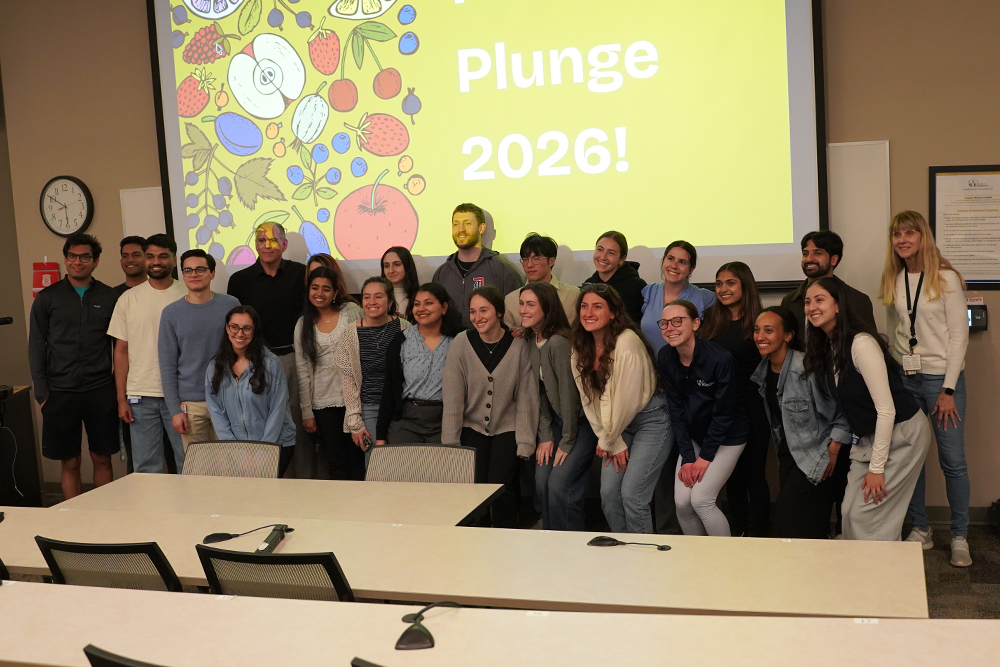
Oakland University William Beaumont School of Medicine students recently took a deep dive into the benefits of plant-based eating, thanks to a collaboration with a local nonprofit.
The Lifestyle Medicine Interest Group (LMIG) worked with Chickpea and Bean on this year’s Plant Plunge.
Held Tuesday, March 10, the event introduced students to the role nutrition can play in preventing and managing chronic illnesses such as diabetes. This year’s session featured a presentation from Roxanne “Roxy” Becker, MBChB, DipIBLM, medical editor and educator at the Physicians Committee for Responsible Medicine, followed by Marc and Kim Ramirez, co-founders of Chickpea and Bean.
It makes sense for LMIG to lead the way for the initiative because the group promotes awareness of lifestyle and integrative medicine at OUWB while encouraging preventive medicine, healthier eating, and medical student wellness, said Sruthi Shriram, M2, president of the group. This year’s Plant Plunge included faculty, staff, and physicians and featured a wider variety of plant-based meals from local restaurants.
Together, the speakers encouraged students to view food as a form of medicine and a tool that can influence patients’ long-term health.
“Diet is the most underestimated tool that you have in your toolbox as future physicians. Your patients deserve to have this knowledge,” said Becker. “Nutrition can be so powerful for preventing disease or even reversing disease, and you can make such a difference in your patients’ lives.”
Becker noted that many of the leading causes of death in the United States, including cancer, diabetes, stroke, and Alzheimer’s disease, are strongly related to diet. Yet she said that nutrition is often neglected in medical education. She encouraged students to view a plant-based diet as a way to address the root cause of disease and prevent chronic illness before it develops.
The event emphasized the role nutrition can play in preventive care and future patient counseling.
“This event is important … the opportunity to learn about the role of diet in preventing, treating and even reversing chronic conditions is really exciting for me,” said Julia Barto, M2, vice president of LMIG.
Shriram said the event reflected the collaborative work of LMIG members and partners to introduce future physicians to nutrition as a tool for preventing and managing chronic disease.
Rather than relying on highly processed vegan or vegetarian foods, a healthy plant-based diet centered on whole foods like fruits, vegetables, grains, legumes, nuts, and seeds is the foundation. Kim and Marc Ramirez shared practical, whole-food, plant-based recipes found on their website.
Marc Ramirez shared his own journey with chronic illness and his family’s history with diabetes, describing the toll it took on his loved ones’ health. In 2002, Marc began taking diabetes medication, and in fall 2011, he and his wife, Kim, adopted a plant-based lifestyle and never looked back. He said he has been medication-free for more than 14 years and lost more than 50 pounds.
He shared his frustration that no physician had ever seriously presented him with a change in nutrition as an option before medication, a reality that motivates him to speak with future physicians.
“No one discussed the opportunity or possibility of a plant-based lifestyle,” Ramirez said. “Never giving me, ‘hey, maybe eat some lean meats, take the skin off the chicken.’”
Kim Ramirez focused on the “how” of their plant-based diet, showing students examples of meals, grocery staples and various methods to make plant-based eating less intimidating. Some of the couple’s recipes included oatmeal with fruit and chia seeds, veggie sandwiches, pasta, burrito bowls and other meals they make regularly.
She also shared a practical approach to tracking progress, using a “good, better, best” system when shopping. If a basic can of beans is the best someone can do, she said, that’s still a meaningful step. Eating plant-based food doesn’t have to be expensive to be good.
The pair also addressed common concerns about a plant-based diet, including cost, accessibility, and nutritional deficiencies. They emphasized that eating a plant-based diet lowered their food costs by around 30% in addition to the money Marc saves by being medication-free.
“When you look at our food costs, it’s about 30% less because we’re buying a bunch of beans and grains… we’re not buying eggs and we’re not buying meat,” he said.
Shriram said the goal of this year’s Plant Plunge is to encourage students to try a plant-based diet for three weeks, using the guidance from Becker and the Ramirezes to support their journey toward a whole-food, plant-based diet.
“We hope students realize that incorporating more whole-food, plant-based meals into their routine can be simple, enjoyable and beneficial for overall health,” she said.
To request an interview, visit the OUWB Communications & Marketing webpage.
This work is licensed under a Creative Commons Attribution-NonCommercial 4.0 International License.