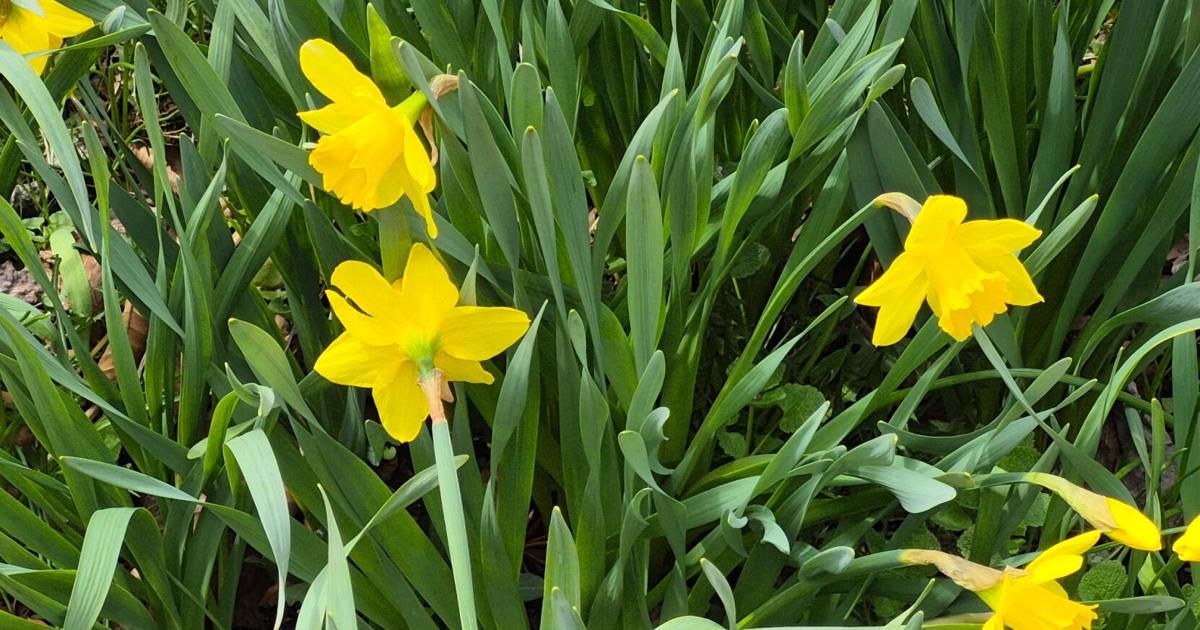
Looking out my kitchen window, my backyard is awash in daffodils. I am not sure how many patches were here when I bought my old house, but I know I have planted hundreds. Wouldn’t it be marvelous to have an entire yard of dancing daffodils? They are bright and cheery and stand up to the cold and the snow as we patiently wait for the other spring flowers to follow. There is a pattern to blooming. I watch it unfold yearly in my sweet little yard. There is so much more to come, but the daffodil is really the crowning jewel that heralds the true coming of warm weather and spring.
I love making bouquets, tying them with ribbons, attaching a poem and sending them off to friends and all who stop by. Let’s chat about daffodils today. I hope that you see them dancing outside of your own windows or even in the yard of your neighbors. Go ahead, take a quick peak and then come back and settle in with a cup of tea of your morning coffee.
I have always loved daffodils. One of my very favorite memories was strolling in the Lake District in England on a spring morning. I was on my way to visit Beatrice Potter’s home. Potter married late after years of spinsterhood, or so they called it then. She was able to buy 14 farms with her earnings from … you guessed it … Peter Cottontail and his siblings!
While strolling through her house and gardens, English daffodils dotted all the countrysides. I would be amiss not to mention the beauty of her house on Hill Top. Upon her death in 1943, Potter gave all of her 1,000 acres and her farms to the National Trust in England. She was very concerned about land management and the preservation of the English countryside. Her house is still home to the little rabbits that ate up Mr. McGregor’s garden as it is dotted with little doorways and pathways for her favorite friends.
As I wandered through the Lake District, I was very curious as to why so many daffodils dotted the hillsides. Even Shakespeare referenced the daffodil, as he wrote, “The flower that comes before the swallows dare.“ During Shakespeare’s time, young girls sold these bouquets on the streets of London. I imagine them singing, “Come buy my flowers … you need my flowers.”
However, looking at the commercial growth of the daffodils, history and a wee bit of research here, tells us that it was William Trevellick in 1875, who thought about raising them commercially. The train passed by his farm and if he could get the early crops to London by train, he could keep his bills all paid. That was exactly what he did. He raised acres of daffodils and sent them to London.
During the second World War, some of these same fields full of daffodil bulbs were dug up in the “Dig for Victory” campaign.
It was decided nationwide that fields of daffodils would not feed the English, so the fields were dug up for the planting of vegetables. So what happened to all of the daffodil bulbs? They were dumped onto the hillsides where they took root and grew. Today when you visit England, as I did, you will be mesmerized by all of these hillside flowers. Today the UK is the largest distributor of commercial daffodils producing over 900 million stems per year.
I guess I will never reach that amount! It is enough for me, though, to fill my sweet little garden space with daffodils of all varieties and pass them out to friends. I also give out bulbs in the autumn. Aaron and Rachel receive a box of daffodils every year on their wedding anniversary. One day their farm will be full of these beautiful flowers.
I not only grow these wonderful flowers but share my love of poetry through one of the loveliest poems written by William Wordsworth. In April 1802, as he was walking with his sister, he was overcome by the beauty of the daffodils on the hillsides in the Lake District. He wrote his most famous poem two years later in the iambic tetrameter. It was then published in 1807. It has become his most cherished poem.
I wandered lonely as a cloud
That floats on high o’er vales and hills,
When all at once I saw a crowd,
A host, of golden daffodils;
Beside the lake, beneath the trees,
Fluttering and dancing in the breeze.
Lou Ann Homan-Saylor lives in Angola at the White Picket Gardens where you can find her gardening or writing late into the night under the light of her frayed scarlet lamp. She is a storyteller, teacher, writer, actress and a collector of front porch stories. She can be contacted at locketof time@aol.com.