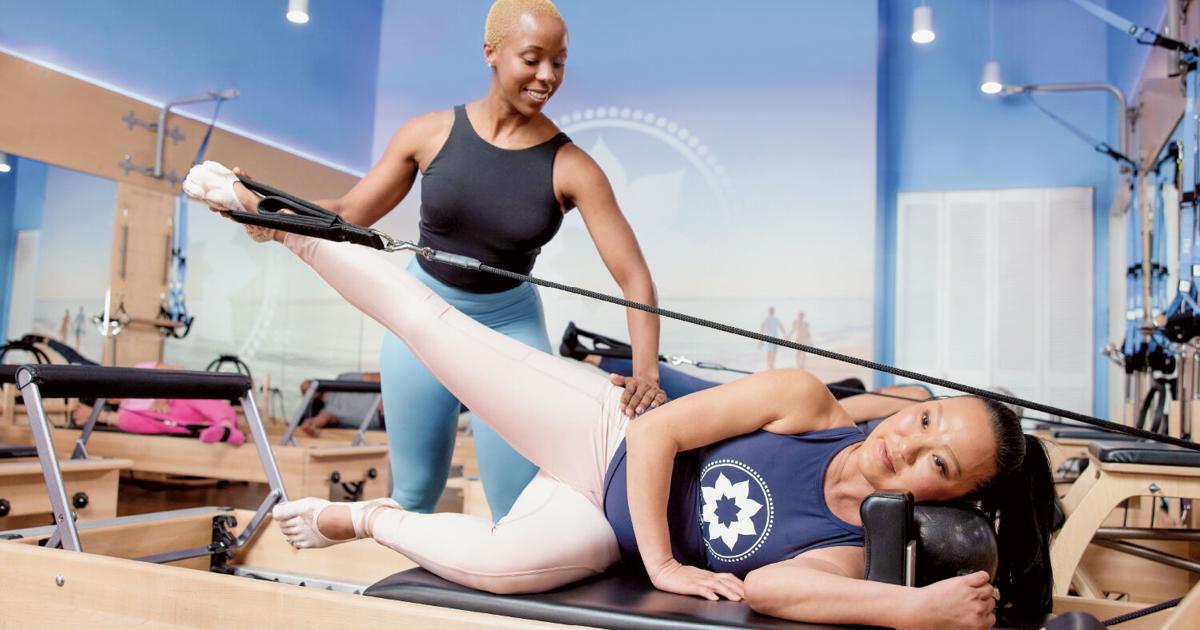

Club Pilates and its more than 1,400 studios generate 65 percent of the revenue for Xponential Fitness.
Xponential Fitness, which owns five boutique fitness and wellness concepts including Club Pilates and Pure Barre and in recent years grappled with federal investigations and franchisee disputes, is prioritizing investments it says will support top-line growth for franchisees.
Mike Nuzzo has his hands full at Xponential Fitness. Hired as CEO in August, he’s the third person to hold the role in less than two years as the multi-brand fitness platform company confronts franchisee profitability pressure, delinquent development, an increasingly competitive landscape and the strenuous task of centralizing franchisee support for its five brands.
Founded by Anthony Geisler in 2017 and at one point the owner of 11 boutique gym and wellness concepts, Xponential “took the approach that we were going to grow at almost all costs,” Nuzzo said. As the company’s portfolio swelled and the franchise sales pipeline along with it, “we got over our skis, and the result was … being in some brands and some arrangements that really weren’t healthy for the long-term growth of the business.”
Xponential CEO Mike Nuzzo.
“Even though this company has been around for a while and has grown very quickly, it still is in a less mature stage of really building a good franchisor business,” Nuzzo said in late January during an interview at Xponential’s Irvine, California, headquarters.
A month later, during its fourth quarter earnings call, Xponential announced it would pay nearly $40 million in settlements to the Federal Trade Commission and to more than 500 current and former franchisees. Under the proposed FTC consent agreement and without admitting liability, Xponential agreed to pay $17 million over 12 months to resolve an investigation first disclosed in July 2024. In its most recent 10-K federal securities filing, the company said the investigation was related to its compliance with the “unfair or deceptive acts or practices” section of the FTC Act and with the Franchise Rule.
“We believe resolution of this matter will resolve a meaningful amount of uncertainty for all our stakeholders,” Chief Financial Officer John Meloun said during the earnings call. (Meloun left Xponential in March as this issue went to press; the company appointed former RealReal financial chief Robert Julian as interim CFO.)
Xponential also finalized a settlement that will pay $22.75 million over 35 months to 509 existing and former franchisees who “allege they were aggrieved by purported misstatements and omissions by the company or an affiliate thereof.” Those disputes date back to 2023.
Xponential is rethinking its go-to-market strategy for StretchLab, its assisted stretching concept.
The consent agreement is subject to approval by FTC commissioners and a court, and it comes as Xponential remains under investigation by the United States Attorney’s Office for the Central District of California. A separate investigation opened by the Securities and Exchange Commission in 2023 closed in July 2025 without action.
Xponential reported systemwide same-store sales fell 4.3 percent in the fourth quarter. Club Pilates, its largest brand with more than 1,400 studios, posted a 3 percent drop in same-store sales for North American locations, while StretchLab reported the steepest decline at 15 percent. Sales at Body Fit Training were up 6 percent; Pure Barre and YogaSix were essentially flat.
“We acknowledge that over the past few years, legal and regulatory hurdles, underperforming brand acquisitions and divestitures, and organizational challenges limited our ability to consistently execute best-in-class support capabilities,” Nuzzo said on the earnings call. “So inevitably and not surprisingly, sales growth started to moderate, beginning in late 2024 and into 2025.”
Nuzzo also pointed to “marketing and lead management missteps” that affected membership growth and put pressure on same-store sales.
Marketing, profitability and studio growth
Geisler was Xponential’s CEO until being forced out in May 2024 amid the federal probe. Former Taco Bell chief Mark King replaced Geisler but left last summer for health reasons.
Nuzzo came to Xponential from Eyemart Express, where as CEO he was tasked with turning around a business that was then sold to VSP Vision in January 2025. The situation at the optical retailer was similar to what Nuzzo found at Xponential, with a need for “more sophistication, more capabilities, more technology.”
“Culturally, the company was kind of in the midst of this struggle around having resources and capabilities in the brands and the desire to centralize more resources into what we would call centers of excellence,” Nuzzo said in January.
Following a round of corporate layoffs last year, the company restructured several support functions and reallocated brand-specific resources to more broadly serve all five concepts. The shift is “still a work in progress,” Nuzzo noted.
With a streamlined platform—Xponential’s sold five concepts, including Stride, CycleBar and Rumble Boxing, and it wound down AKT, since 2024—the company is balancing the need for distinct brand identities with opportunities to put its scale to work in areas such as supply chain and advertising.
A major effort this year involves investments in member acquisition as Xponential puts more muscle behind top-of-funnel marketing. Each brand’s digital presence will get an overhaul and the company is deploying a franchise match program to put more dollars to work at the local level. Refinement of trial offers that drive conversion, along with promotion of class packages versus a typical monthly membership, are aimed at attracting consumers who want more flexibility in their fitness choices.
At Club Pilates, which Nuzzo described as a “powerhouse and anchor to the business” as it generates 65 percent of Xponential’s systemwide sales, the emphasis is on unlocking growth beyond the $1 million mark (the average unit volume was $966,000 in 2025). That could mean raising prices, he said.
A pricing study last year revealed Club Pilates has “a group of customers that are relatively price insensitive,” Nuzzo said. These customers are its highest users. “Any time you have that dynamic, there’s opportunities to monetize,” he continued. “And we’re still working on what those look like.”(An unlimited membership costs between $200 and $350, depending on location.)
Addressing capacity constraints is also key for Club Pilates as many studios struggle to provide a full slate classes at peak times because of instructor shortages. The brand is working to promote and further tap into its internal instructor training program.
“We literally take people off the street and teach them how to be Pilates instructors,” Nuzzo said. “It’s the most thorough, differentiated, significant program in the industry.”
For Pure Barre, Xponential’s second-largest brand at 624 units, and YogaSix, with 194 locations, Nuzzo said enhancements to the studios and consistency in class formats are priorities. The company is also preparing a new go-tomarket approach for those concepts and for Body Fit Training, which he called “as close to a startup as it gets.”
Pure Barre is the second-largest brand in Xponential’s portfolio at 624 locations.
Xponential acquired Australia-based franchisor BFT in 2021 for $44 million. It has about 50 domestic locations and another 250-plus in international markets. The brand doesn’t have much awareness or market concentration in the U.S., “so we’re revisiting that piece of it,” Nuzzo said, as it seeks to compete with other high intensity interval training franchises.
Then there’s 531-unit StretchLab, which Nuzzo said is one “we’re really trying to figure out” as margins are pressured. Xponential began “aggressively” expanding the assisted stretching concept in 2022 without “understanding our target market very well.” It’s since learned the sweet spot for StretchLab is customers age 50 or older with a lot of disposable income.
“If we knew all that back in 2022, we probably would have focused that on how we think about go-to-market,” said Nuzzo as he also called out changes to Medicare Advantage plans that affected insurance coverage of stretch sessions “and really hurt us.”
At its peak, StretchLab’s AUV was $650,000; that fell to $483,000 in 2025. Xponential this year will work on repositioning the brand as a preventative health necessity, not a luxury.
“I think Stretch Lab is probably a pause so that we can get it right to think again about unit growth, but all the other brands, there’s net unit growth potential,” Nuzzo said.
Xponential’s global studio count stands at 3,097. Closures accelerated in the fourth quarter with the shuttering of 47 locations, including 31 within StretchLab, BFT and YogaSix. The company closed 140 total units last year against 341 gross new openings. Approximately 30 percent of the company’s contractually obligated studio licenses are more than 12 months behind their development schedules and are classified as inactive.
Tim Weiderhoft joined Xponential Fitness as COO in January 2025.
Nuzzo doesn’t anticipate closures on a larger scale but said individual studio performance and circumstances will dictate those decisions. Tim Weiderhoft, Xponential’s chief operating officer, noted market shifts in some areas affected the viability of locations as consumer behaviors changed through the pandemic.
“There have been situations where we’ll look in a brand and go, 10 years ago, this was the right place; today, it is not,” Weiderhoft said. “We have a choice to either relocate this location, take a look at where it needs to move, and maybe there is a conversation of shuttering. I think the difference is, we want to look at things at a case-by-case basis on markets, and utilize data to really determine that.”
Many studios closures over the last couple of years were the result of franchisees getting upside down on rent, he said.
Xponential, he continued, “completely revolutionized” its real estate strategy in 2025, moving from a primarily in-house team to an outsourced one. Commercial real estate firm Morrow Hill now leads real estate efforts for the five brands, a move Weiderhoft said resulted in more expertise and improved speed-to-market capabilities.
Morrow Hill’s proprietary Vision Map and Vision Track platforms have “been exceptionally important to the change that we’ve had there with better rates, more accountability for franchisees to us around what they’re seeing and how it’s being provided, and a heightened level of communication and strategy,” Weiderhoft said.
Xponential sold 179 franchise licenses last year, 112 of which were in international markets. Meloun, Xponential’s now ex-CFO, said during the earnings call that franchise sales in North America were lower because of a pause as the company completed a review and update of each brand’s franchise disclosure document.
Mixed franchisee results
Of the 341 gross new openings last year, 220 were in the Club Pilates brand. Riser Fitness is one of the faster growing Club Pilates franchisees, with 110 studios in eight states plus Mexico. It opened 22 locations last year, and co-CEO Jeff Nash said it expects to add 24 this year.
Fortress Investment Group made a $72 million growth capital commitment in Riser Fitness in 2024, and last year the operator secured an expanded credit facility with the firm to fund more development and acquisitions. Along with Riser, Spartan Fitness, Aligned Fitness and Empowered Pilates are some of the biggest franchisees in the brand and combined operate more than 300 units.
“Pilates is kind of finally having its moment in the sun, right? It’s just got a lot more awareness nationally and globally in the last few years. We came out of COVID with seven studios, and then we basically doubled every year,” said Nash.
Audrey Ryder owns several YogaSix locations with Toni King.
Nash called the return on investment for building new studios “extremely positive,” and said the AUV for mature locations in Riser’s portfolio is above $1 million. Its studios are cash-flow positive from day one thanks to a strong presale process that helps it get to 300 members by the soft opening, with a ramp to 500 on average.
Like Nuzzo, Nash pointed to the low supply of instructors as a barrier to growth and said his company is constantly recruiting from within its own employee and membership base. Riser Fitness also developed career tracks and scholarships to help fill its instructor pipeline.
Nash credited Xponential with “shoring up systems” and improving its use of data across the company. Next up is doing more to differentiate Club Pilates in what’s become an intensely competitive segment within fitness.
Club Pilates “was allowed to grow and create a brand presence almost of its own momentum, because it was the 800-pound gorilla with no viable competitors for a very long time,” Nash said. “That’s changed, and now competition has arrived, and so I think Xpo is doing a good job of recognizing that and realizing we’re gonna have to work a little bit harder to position the brand, to differentiate the brand relative to the newcomers.”
Operators in YogaSix, meanwhile, offered a sobering assessment of that system. Toni King and Audrey Ryder, who with seven locations are the largest franchisees, described themselves as advocates of the brand who want it to succeed, but Ryder noted the network is struggling “with any actual positive change that makes a difference to the bottom line.”
YogaSix studios posted average sales of $525,000 in 2025. The shift from individual brand support to centralized teams has proven rocky, they said. Positions they relied on were eliminated, and new functions “aren’t functioning yet.”
“We’ve done our time. We’ve been patient. We’ve been waiting,” said King as she noted communication from the franchisor needs to improve. “I don’t want to hear an excuse that you ‘need time, there’s been a lot of changes.’ Give me timelines and then update me along the way. And if you don’t meet it, give me a very good reason why, and what’s the next timeline.”
Within their studios, which are in California and Nevada, Ryder said they closely follow the model and are working to diversify revenue streams beyond the standard membership.
“People are wanting more variety in their workout routines, and so we have focused more on packs and insurance memberships and Class Pass and private trainings and corporate wellness and yoga teacher trainings and all the other kind of revenue streams that you need these days, other than memberships, to make it,” Ryder said.
Franchisees’ assessment of the parent company would “probably be mixed,” acknowledged Nuzzo as he said the next couple of years will “be a journey to get this right.”
“This is not something where you throw a switch and it all changes, and all of a sudden they love you,” he said. “But I think over time, it’ll start to really make a difference.”