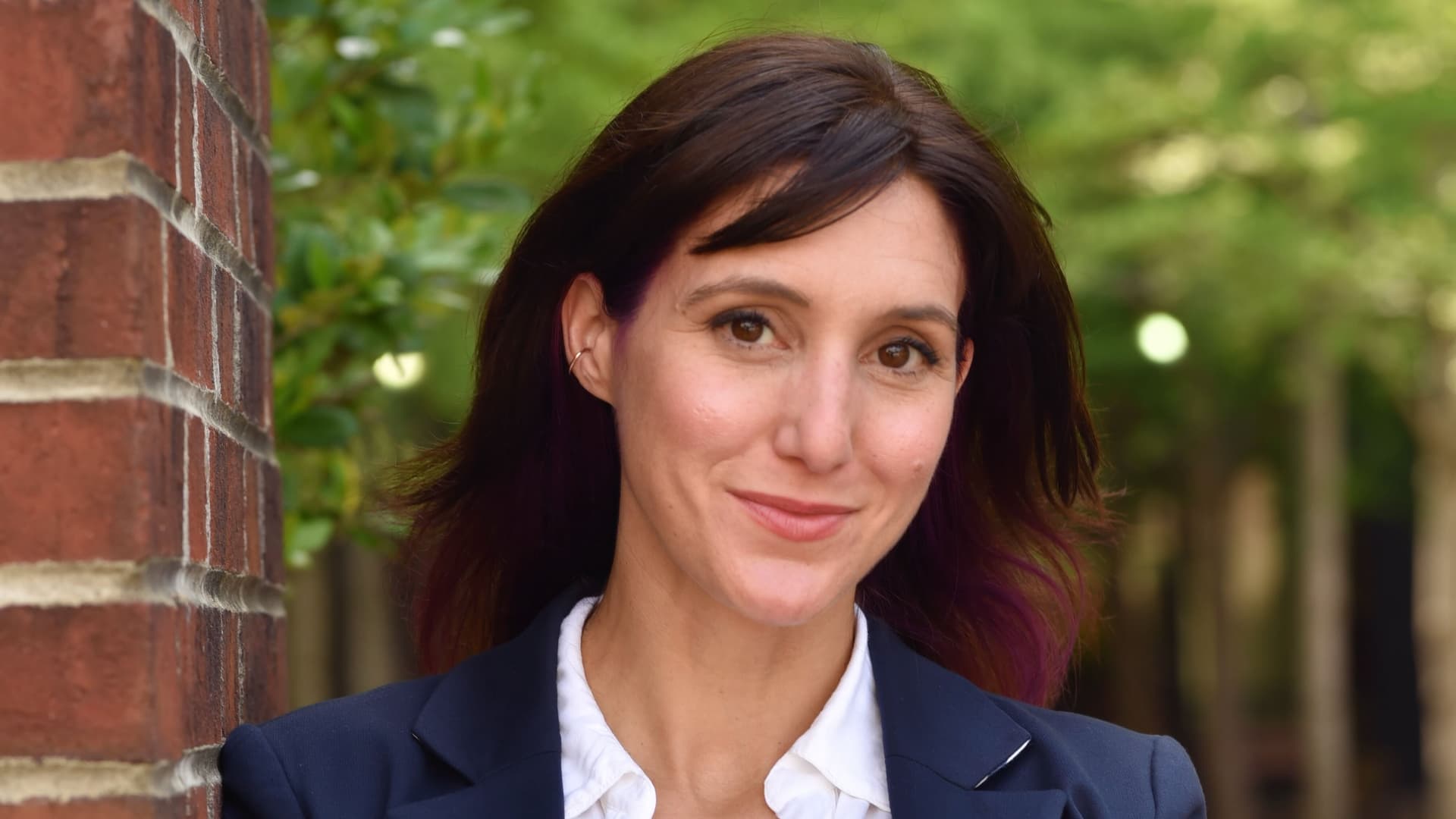
Throughout Jamie Justice’s career as a scientific researcher, her life’s work has focused on how to “prevent or delay the onset of functional declines, disability or chronic diseases” as people age, she says.
Justice has studied longevity since 2009, starting with research on athletes’ performance — examining how long people could maintain certain physical tasks before feeling fatigued — including in adults over age 50. She did that work at the University of Colorado Boulder, where she eventually received a master’s degree in integrative physiology and a doctorate in neurophysiology of movement and integrative physiology of aging.
Working with those older adults was formative for Justice: They wanted to learn how to exercise effectively as they aged, extend their ability to spend time with family and remain active in their communities, she says. Conducting research in “geroscience” — a term that refers to the study of biological mechanisms that influence aging and increase risks of developing age-related diseases — took Justice to labs, hospitals and research centers, she says.
“I began [my] work at the time when the field was really just growing. The term ‘geroscience’ had been coined, but there was really a rally around it within the scientific community,” says Justice, now 45. Today, she’s the executive vice president of the health domain at XPrize Foundation, a nonprofit organization that hosts prize competitions for technological breakthroughs in fields ranging from health care to space exploration and climate change.
DON’T MISS: The leadership skills that can help you stand out at work
In recent years, multiple tech billionaires have reportedly contributed billions of dollars in funding to a related field: longevity biotechnology, which aims to combine geroscience’s study of biological mechanisms with technologically driven anti-aging treatments. Longevity biotechnology is sometimes considered controversial, with some anti-aging clinics offering expensive procedures for healthy aging that aren’t necessarily backed by extensive scientific research.
“With attention and lack of regulatory frameworks, there is risk of charlatans riding the wave of hype, and selling products or launching clinics with insufficient evidence that the benefit of taking the geroscience-inspired therapy outweighs the risk,” says Justice. XPrize follows a “clinical trial evidence structure that de-risks the field for investors, regulators and consumers [and] patients,” she adds.
Beyond her XPrize work, Justice is an adjunct assistant professor of gerontology and geriatric medicine at Wake Forest University. Here, she discusses her own health and longevity practices, including her personal approach to diet, exercise and social interactions. Always consult with your primary doctor before making any changes that could impact your health.
‘I tend to be less on the biohacker side of things’
CNBC Make It: What are some things that you do to keep your body healthy?
Jamie Justice: I tend to be less on the biohacker side of things than some of my peers in the field. I’m very health conscious, but [my practices] happen to be more aligned with the things that your grandmother probably told you to do.
I exercise daily. I’ve been a long-distance runner since the early 2000s [and] an outdoor mountain athlete. A couple times a week, before taking calls and doing work, I get up early and do my weights routine. I do meditation every morning, mostly. I have a community group for mental health support and connection that I visit at 7 a.m., around five to six days a week.
My routine is: get up early, exercise, a little time for meditation, re-centering and getting ready for the day, community group and then I start work. I work remotely but travel often. My work life primarily happens online, and via airplanes and conference meeting rooms. Prior to my 2023 transition to XPrize, my work life was in the lab and a clinical research center at a hospital academic medical center.
CNBC Make It: Brain health is a huge one that people talk about in terms of longevity. What are you doing specifically for your brain?
Justice: Meditation is great. Exercise is also great, so running, weight lifting. The body-brain connection cannot be understated. Some other things for cognitive ability are truly interacting with other people and listening to them, and asking to be of service in some way.
I’m very fortunate to have a life where I read, react, develop and create every day. That [strengthens] that cognitive muscle. Even outside of work, I enjoy learning new things. I listen to podcasts that challenge me mentally. Some topics are related to things I study, but often they’re completely out of the loop for me. Yesterday’s [podcast] was on interspecific brood parasites.
I wish I spent more time painting and drawing, or other similar creative arts activities I love. Those have been deprioritized because of my current schedule. All in time, they will come back.
CNBC Make It: You talked a bit about the importance of reaching out to people, and we hear the term social fitness a lot. What’s your social fitness like?
Justice: I don’t like small talk, and I need to cocoon for a moment [after some social interactions] to regroup. Trying to find balance has been important. Most of my job is in building networks and collaborations. When I go to meetings and I give talks, it’s like, “OK, I’m going to need to go cocoon for an hour, reset and then I can go back.”
Part of social fitness for me is being very intentional about my relationships. I’ve been married for over 20 years and I have a son who’s really important to me, so when I’m home, I make sure that I give them some undivided attention. My meditation coach, Penny, has become one of my dearest friends. That’s one of my most cherished relationships that I have.
My community group is really focused on giving back, especially through offering support for individuals in recovery from alcohol use and addiction. My stepson passed away from a drug overdose in 2019. Since then, it has become really important to us to make sure that in our local communities, we find a place to give back to others who struggle.
CNBC Make It: Another major aspect of longevity is diet. What’s your daily diet for longevity? What are some foods you eat on a daily basis?
Justice: I’m a vegetarian. I [often] consider, “Where can I get whole-food sources?” And I know I need to supplement with some processed foods for protein.
Knowing my athletic endeavors and medical history, I make sure that I get enough calcium and vitamin D. One of the most fundamental changes I made was in 2001, maybe 2000, when I was running ultra-marathons. I thought I was doing everything right for sports nutrition — eating a plain bagel [for breakfast], having a pasta dinner the night before.
Then, I started passing out after my runs. I couldn’t figure out what was going on with me until I passed out in my car while driving, totaled it against a pole and ended up in the emergency room. The doctor tested me for hypoglycemia, and sure enough, my sugar levels were in the tank.
Now, I keep snacks with me, and I make sure that they’re good snacks — like fresh fruit, nuts, nut butter, Greek yogurt, protein drinks, cut vegetables and hummus. I love chocolate, sweets and salty things, [and] when I’m running a lot of miles or training for an event, they’re “good” in moderation. But I need to be mindful of how much of them I eat, and when.
CNBC Make It: I always ask this question to round things out. What are you currently reading? It doesn’t have to be specific to your field, it’s just interesting to hear what longevity experts are reading these days.
Justice: I have my playlist on Audible, which I listen to when I do my long runs, my podcasts that I listen to as I’m bopping around the house, and then my physical books. I’m a big science-fiction fan, and I’m in a field where I get to interact with people who often write really good science fiction.
One series I’m reading right now is by a former colleague of mine, Philip Kramer. It’s called “Motus,” it’s a hardcore science-fiction book on this other planet, it’s in the future and it’s cool.
I also read a lot of non-fiction. Steven N. Austad, who’s an advisor and friend, wrote this fabulous book about the comparative biology of longevity [called “Methuselah’s Zoo: What Nature Can Teach Us About Living Longer, Healthier Lives”]. One of the best things I read last year is called “Stronger,” by Michael Joseph Gross. It’s a story about strength training. He’s one of the best scientific story writers. I just couldn’t put it down.
The daily practices of a longevity expert
To sum up Justice’s routine for longevity, here’s a breakdown of how she structures her daily activities:
For physical health: Sticking to tried-and-true practices like exercise and meditation.For mental health: Meditating daily, exercising, participating in a service-oriented community group and learning new things as often as possible.For social fitness: Finding a healthy balance between engaging with others and setting aside moments for rest and solitude.For her daily diet: Following a vegetarian diet with an adequate amount of protein, calcium and vitamin D.For her media diet: Listening to podcasts, reading science fiction and staying up-to-date with health literature in her field.
This interview has been edited and condensed for clarity.
Want to lead with confidence and bring out the best in your team? Take CNBC’s new online course, How To Be A Standout Leader. Expert instructors share practical strategies to help you build trust, communicate clearly and motivate other people to do their best work. Sign up today!
Take control of your money with CNBC Select
CNBC Select is editorially independent and may earn a commission from affiliate partners on links.