I already thought I was doing protein “right.” I hit at least 100 grams a day, ate balanced meals, and rarely felt like I had low energy. But when I learned that research suggests it’s not just about how much protein you eat, but when you eat it throughout the day, I started to wonder if I was leaving real benefits on the table (literally).
“Once you get over 35, we need to start focusing on the meals,” says Donald K. Layman, PhD, FASN, an internationally recognized protein researcher whose work helped inform the 2025–2030 Dietary Guidelines for Americans. While these updated guidelines emphasize a higher overall recommended protein intake, Dr. Layman told me that as we enter midlife and beyond, timing matters as much as your daily total. “What we know is for adults to benefit, they need at least 25 to 40 grams of high-quality protein in a single sitting,” he says.
As someone approaching her late 30s, that got my attention. I already prioritize protein, but I tend to eat intuitively, focusing on my daily total rather than how it’s distributed. So I was curious about what would happen if I aimed for 40 grams of protein, at every meal, for a full month.
Before diving in, I reached out to Lina Begdache, PhD, RDN, CDN, CNS-S, FAND, a registered dietitian and associate professor at New York’s Binghamton University, to better understand why larger “doses” of protein at once may be especially beneficial for adults—and what I could realistically expect. Always remember to talk to your own healthcare team before making any substantial changes to your diet.
Why protein needs change with age
By our late 20s, muscle mass starts breaking down faster than it rebuilds—a process called sarcopenia, also known as age-related muscle decline. This occurs because our bodies become less responsive to the muscle-building signals triggered by protein intake, a phenomenon known as anabolic resistance, Dr. Begdache explains.
“The result is that the same protein intake that is used to maintain muscle in your 20s produces a weaker response in your 40s,” she says. “Beyond muscle, protein is the structural backbone of enzymes, hormones, neurotransmitters, and connective tissue that could follow the same pattern of [age-related] resistance.”
In other words, as we age, it’s not just about eating more protein—it’s about eating it in a way your body can actually use.
Why 40 grams of protein per meal matters
Research from Dr. Layman, including a foundational 2015 paper published in The American Journal of Clinical Nutrition, suggests that protein works like a “switch” in the body—it only fully turns on muscle-building processes when you consume enough at once. That switch is largely driven by an amino acid called leucine.
“The minimal leucine threshold changes with age,” Dr. Begdache says. “Younger adults can initiate this anabolic response from as little as 20 grams [of protein].” But as anabolic resistance develops with age, that threshold rises. “Research consistently shows that 40 grams per meal produces measurably greater protein synthesis in older adults compared to 20 grams.”
And triggering this protein response goes beyond supporting your muscles. According to Dr. Begdache, eating concentrated amounts of protein in a sitting—around 40 grams—supports multiple systems that can decline with age, including:
Musculoskeletal system: Adequate protein at each meal helps stimulate muscle repair and slow muscle loss, supports healthy tendons, ligaments, and cartilage, and is linked to better bone density.
Hormonal health: Higher-protein meals can help blunt cortisol (the body’s primary stress hormone) and support certain hormones that decline with age, Dr. Begdache says. This pattern may also help stabilize blood sugar, which plays a role in overall stress regulation.
Cognitive health: Protein provides the amino acids your brain uses to produce key neurotransmitters, including serotonin, dopamine, and melatonin—chemicals that influence mood, focus, sleep, and more.
Heart health: Getting enough protein supports the repair and maintenance of blood vessels and helps regulate blood pressure. Says Dr. Begdache: “Higher protein intake from varied sources is also associated with better lipid profiles and lower inflammatory markers over time.”
What I ate to hit 40 grams per meal
 Sergio Amiti/Getty Images
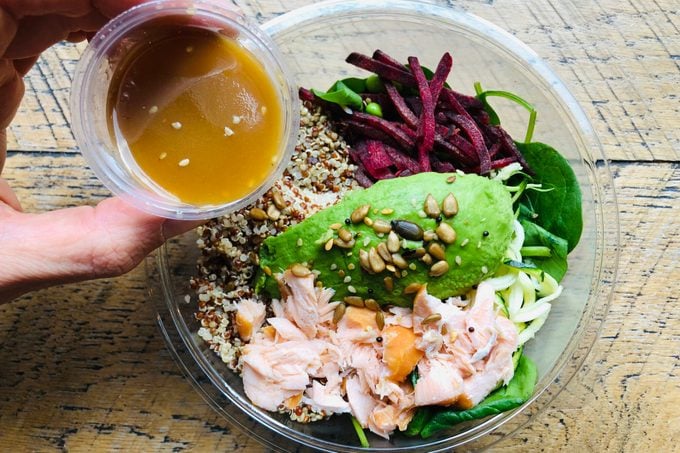
To make this experiment realistic—and increase my chances of sticking with it—I kept up with my usual meals, just with a few strategic protein upgrades.
For breakfast, my go-to is overnight oats with a drizzle of peanut butter and frozen blueberries. To amp up the protein, I mixed in a scoop of vanilla protein powder, bringing the total to about 40 grams. On weekends, I’d get a little fancier and make shakshuka—dialing up the protein with extra egg whites, chickpeas, a bit of feta, and a dollop of Greek yogurt.
I tend to gravitate toward salad or grain bowls for lunch, since they make for a great opportunity to use up whatever’s lying around in my fridge. My appetite is usually lighter in the afternoon, so I leaned on combos of plant-based proteins to hit my target—think: tempeh, tofu, seitan, edamame, quinoa, beans, seeds, or hemp hearts.
Dinner was the easiest step. Like most people, I’m usually running out of steam at the end of the day, so I keep things simple, building meals around a protein source like chicken breast or salmon, paired with a carb like potatoes and a serving of vegetables.
How I felt throughout the month
By being more deliberate about my protein intake, I ended up eating more than usual—about 140 grams per day on average—and the effects of consistent, high-dose meals were noticeable. Within days, my energy felt steadier and my mood more even.
While I don’t have much of a sweet tooth, my partner does—which means desserts are often around. Normally, I’ll indulge here and there, but by mid-month, my sugar cravings had almost entirely disappeared.
Dr. Bedgache wasn’t surprised. “The first two weeks bring the most immediate changes: reduced hunger between meals, fewer carbohydrate cravings, and more stable energy, particularly the elimination of the mid-afternoon crash,” she explains. “Protein decreases the hunger hormone ghrelin more effectively than carbohydrates or fat, and blood sugar stability improves relatively quickly.”
By the halfway point, I was also sleeping more deeply and consistently. According to Dr. Begdache, that’s a sign my body is getting enough protein to function optimally. With a steady supply of amino acids like tryptophan (which helps produce melatonin) and more stable overnight blood sugar, sleep tends to improve. Many people also notice a more consistent mood within a few weeks, she adds.
“By weeks three to four, those who exercise will experience reduced exercise soreness, faster recovery, and modest strength improvements,” Dr. Bedgache says—though she notes that people coming from a lower-protein baseline tend to feel these changes most. I was already eating a relatively high-protein diet, so I didn’t notice major changes in soreness or strength, but my recovery did seem faster. On nights when I expected to feel wrecked the next day, I’d wake feeling up surprisingly… spry.
I also tracked my food to make sure prioritizing protein didn’t lead to overeating or unbalanced nutrition. Interestingly, while my protein intake increased by about 40%, I ended up eating fewer total calories without trying to restrict. I simply felt fuller, longer—and with protein as the anchor of each meal, I naturally ate smaller portions overall.
While I likely won’t track every gram moving forward, I am sold on this simple new rule: making sure each meal includes a meaningful dose of protein—right around that research-backed sweet spot of 25 to 40 grams.
About the experts
Donald K. Layman, PhD, FASN, is a professor emeritus in the Department of Food Science and Human Nutrition at the University of Illinois at Urbana-Champaign. Dr. Layman is internationally recognized for his research on dietary protein and amino acids and contributed to the protein recommendations for the 2025-2030 Dietary Guidelines for Americans.
Lina Begdache, PhD, RDN, CDN, CNS-S, FAND, is a registered dietitian nutritionist and an associate professor at Binghamton University, State University of New York. She’s a certified nutrition specialist-scholar and a fellow of the Academy of Nutrition and Dietetics.
For daily wellness updates, subscribe to The Healthy newsletter and follow The Healthy on Facebook and Instagram. Keep reading: