
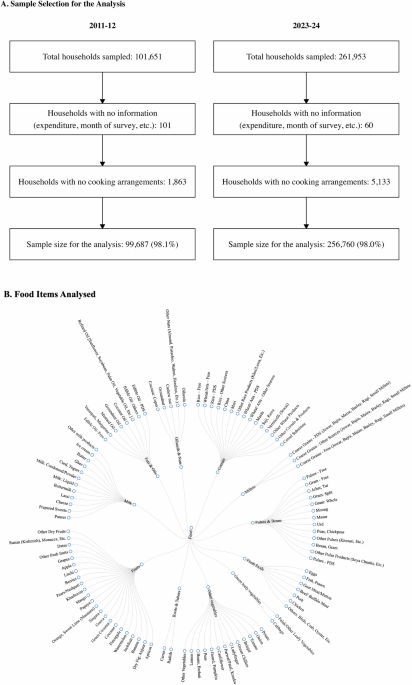
India’s dietary landscape is undergoing a profound transformation, driven by rising incomes, shifting consumption patterns, and targeted welfare initiatives. The present analysis provides updated estimates of food group and micronutrient intakes in India, with a focus on disparities by place of residence, socioeconomic status, and season. The patterns, summarised in Tables 1 and 2, reveal both the magnitude and distributional shifts in consumption over the past decade. For example, the richest-to-poorest fruit intake ratio narrowed from 4.05 to 2.64, and seasonal gaps in several food groups also diminished, suggesting modest progress toward dietary equity.
The decline in food expenditure as a proportion of total household spending—falling below 50% in rural areas for the first time in post-independence India—signals improved living standards and economic maturation. This trend parallels patterns observed in other emerging economies undergoing nutrition transition, where staple-centric diets give way to more diverse and nutrient-rich consumption [22].
The sharp reduction in cereal expenditure, particularly among the bottom quintiles, reflects both demand-side shifts and the impact of large-scale food security programs such as the Pradhan Mantri Garib Kalyan Anna Yojana (PMGKAY) [23] and the National Food Security Act (NFSA) [24]. These schemes have effectively decoupled staple access from household budgets, enabling reallocation toward fruits, dairy, and animal-source foods. This reallocation is evident in the increased consumption of fresh fruits, milk, and meat across all socioeconomic strata, with the most pronounced gains among the poorest households. These shifts indicate the early success of targeted social protection measures and improved market integration in promoting more inclusive dietary improvements. Such patterns also align with the concept of “saved expenditure” acting as a fiscal stimulus for dietary diversification [25].
Existing studies have made substantial progress in documenting dietary patterns and nutrition outcomes in low– and middle–income countries [26, 27]. A systematic review by Mayén et al. (2014) [28], which included 33 studies from 17 LMIC countries, primarily from Brazil, China, and Iran, found that households with higher socioeconomic status consumed higher quantities of fruits and vegetables and had a more diversified diet. We found similar patterns in the context of India; however, the inequality in consumption of food items such as fresh fruits, dairy, and flesh products (eggs, fish & meat), between the top 20% and the bottom 20% has decreased significantly between 2011–12 and 2023–24. At the same time, food consumption in 2023–24 revealed pronounced regional disparities—fruit intake was highest in the south, dairy in the north and west, flesh foods in the northeast and Kerala, vegetables in the east, cereals in the north and east, and pulses in central and southern states. This heterogeneity reflects cultural preferences, agroecological conditions, and market access, highlighting the importance of regionally tailored nutrition strategies [29].
While the shift toward greater dietary diversity is encouraging, it remains insufficient to meet recommended intake levels for many essential nutrients. Significant micronutrient gaps persist across income groups and regions, particularly for Iron, Zinc, B–Vitamins (Vitamins B1, B2, B3, and B6), and Calcium. These findings highlight that diversification alone does not ensure nutritional adequacy; complementary strategies—such as targeted subsidies, focused interventions, and strengthened supply chains—are essential to translate evolving consumption patterns into meaningful health gains.
Encouragingly, the most considerable relative improvements in dietary diversity have occurred among the poorest quintiles, contributing to a narrowing of both rural–urban and socioeconomic gaps. National-level analyses (survey on Household Consumption Expenditure Survey 2023–24) indicate that overall rural–urban consumption disparities decreased from 84% to 70% over the past decade. Our study corroborates this convergence through food group–specific trends: the steepest proportional gains in fruit, dairy, and animal-source food intake were observed among the bottom quintiles.
Seasonal fluctuations in perishable food intake—particularly fruits and vegetables—have diminished significantly since 2011–12, suggesting improvements in cold chain infrastructure, storage, and transport logistics. These supply-side enhancements have enabled year-round access to nutrient-dense foods, even in remote regions. Notably, India’s horticultural output has surged in recent years, with the gross value added from fruits, vegetables, and floriculture surpassing that of cereals for the first time—reflecting both production growth and shifting consumption patterns [30]. The narrowing of seasonal troughs and peaks is a critical marker of food system resilience and has implications for dietary stability and micronutrient adequacy [31].
However, despite these gains, significant challenges remain in ensuring that perishable foods are consistently accessible and affordable across geographies and income groups. Gaps in last-mile connectivity, uneven market integration, and affordability constraints continue to limit the nutritional impact of these supply-side improvements.
Despite the persistence of cereals as dominant contributors to Iron, Zinc, and B Vitamins intake, their limitations in providing key micronutrients—especially vitamin C and Calcium—are evident. Micronutrient mapping based on HCES data and compositional analysis reveals that fruits and vegetables contribute over 60% of vitamin C. In comparison, dairy accounts for 70–75% of Calcium. Pulses and legumes, while modest in quantity, also play a critical role in Zinc and Folate intake, especially among vegetarian households.
However, the quantitative estimates of micronutrient intake highlight that the nutritional gaps persist despite modest improvements in dietary diversity. For example, our analysis shows that the mean iron intake among non-lactating adult women falls short of the EAR by nearly 4 mg/day, with almost 70% of this population group at risk of inadequate intake (Supplementary Fig. 1). Such high probabilities of inadequacy underscore the limitations of current dietary patterns and the need for targeted interventions that address both quantity and quality of nutrient intake. These findings also reinforce the importance of integrating nutrient requirement distributions into population-level dietary assessments, enabling more precise identification of at-risk groups and more effective policy responses.
Furthermore, we also observed that in many large states, the Iron intake of households primarily comes from cereals. For example, in Rajasthan, cereals contribute approximately 79% of the Iron intake, while in Uttar Pradesh, Haryana, Punjab, Bihar, Gujarat, Maharashtra, Madhya Pradesh, it is in excess of 60%. This raises the question of absorption of non–heme iron which is substantially lower (3-5%) compared to heme iron sources. The Comprehensive National Nutrition Survey (CNNS, 2016–18) further highlights that over 25–30% of adolescents are iron deficient, reinforcing that reliance on cereal-based iron intake alone is insufficient to meet physiological needs [32].
These findings underscore the significance of dietary diversity in mitigating micronutrient deficiencies and alleviating the double burden of malnutrition [8, 26, 33]. They also highlight the need for programmatic strategies that promote access to nutrient-dense foods beyond cereals, including fruits, vegetables, dairy, pulses, and animal-source foods—each of which contributes uniquely to the micronutrient landscape.
Interpretation of these findings must reflect the population-level nature of HCES-based analysis. Household acquisition data do not capture intra-household allocation or foods consumed outside the home, nor do they allow consideration of cooking losses — characteristics also highlighted in national dietary guidance. In addition, ultra-processed foods and out-of-home foods are not included in nutrient estimation due to lack of composition coding in HCES, even though their contribution to diets is rising. Dietary identity, including vegetarianism, which shapes animal-source food choices for cultural reasons rather than affordability alone, is not observed in HCES. Hence, trends in animal-source food intake should be interpreted as changes among households that consume them, not necessarily all households.
Taken together, these considerations highlight the role of HCES as a complementary surveillance platform. While 24-h recalls and biomarker assessments remain essential for measuring individual adequacy and deficiency, HCES uniquely enables regular, nationally representative monitoring of dietary sourcing and inequities at a scale not feasible through individual-level nutrition surveys. Policies designed to strengthen nutrition security should therefore be informed by combined evidence from food system surveillance (HCES) and individual nutrition assessment tools.
Policy implications and future directions
The dietary intake findings underscore the need for a multi-pronged policy response that reflects both evolving consumption patterns and persistent nutritional gaps. First, policies should be implemented to actively support the production, distribution, and affordability of nutrient-rich foods, including fruits, vegetables, pulses, dairy products, and animal-source products [34]. Second, nutrition guidelines should be regionally adapted to account for cultural preferences, agroecological diversity, and observed consumption heterogeneity—particularly in states with lagging intake of key food groups. Third, targeted subsidies and market incentives for perishable, micronutrient-dense foods could enhance access among vulnerable populations, building on the existing equity gains. Fourth, continued investment in cold chain infrastructure and transport logistics is essential to sustain year-round availability and reduce seasonal volatility in intake [35].
At the same time, nutritional surveillance and reformulation standards of processed and packaged foods—whose consumption is rising rapidly across all quintiles—must ensure nutritional quality and mitigate risks associated with ultra-processed diets [36]. Nutrition coding updates would enable surveillance systems to better capture their impact on micronutrient adequacy and unhealthy dietary risks. Future research should investigate the health implications of shifting food environments, the role of diverse food systems in preventing non-communicable diseases, and the effectiveness of integrated, regionally tailored interventions in sustaining equitable nutrition gains. Periodic 24-h recalls, and biomarker surveys are essential for assessing adequacy and deficiency. Complementing these with HCES would provide a stronger evidence base for nutrition. Equally critical is the regular generation of more granular dietary data—disaggregated by state, region, physiological group, and gender—to inform context-sensitive strategies and program targeting that address persistent gaps in nutrient adequacy. Together, these policy directions offer a roadmap for advancing nutrition equity and resilience in India’s evolving food system.
Limitations
The use of HCES for dietary surveillance and program design offers several advantages. The large sample size and regular implementation allow for monitoring trends over time and across subnational units. It also enables the linking of dietary patterns with socioeconomic and demographic variables for more nuanced targeting of interventions. Integrating HCES-derived nutrient intake estimates can help prioritise investments in fortification, supplementation, and food system interventions that address both undernutrition and emerging diet-related non-communicable diseases.
Despite these benefits, several limitations warrant consideration. First, the estimates of the quantity of food consumed are based on household surveys, where the unit of observation is the household and not individual members; therefore, intra-household distributions are not captured. This is particularly relevant for nutrients like Iron, where standardising intake to AFE may overestimate the prevalence of inadequacy [2, 37]. Second, the survey is based on 7-day and 30-day recall, and hence, is subject to bias if items are not recalled accurately. The analysis assumes that foods obtained during the recall period are consumed within that same interval. However, the data do not allow us to observe household storage, wastage, or sharing. Third, micronutrient estimates are derived from the nutrient composition of raw foods from the IFCT 2017. There is a possibility that nutrient consumption based on raw food consumption may be inaccurate since many Indian cooking practices may lead to significant losses in nutrient content of food. Furthermore, our analysis does not include the nutritional content of food consumed outside the house, beverages, served processed food, or packaged processed food because standardised food composition for these products are not available in HCES. Fourth, the HCES does not capture dietary identity, including vegetarianism, which strongly shapes consumption of animal-source foods in India. In addition, the surveys under-represent households at the very top of the income distribution, likely leading to an underestimation of inequality among the richest groups. Finally, these findings should be interpreted as population-level indicators of dietary patterns and potential micronutrient adequacy. It is also important to mention that for robust estimation of micronutrient intake, one has to account for the day-to-day variability. Typically, to capture this, one has to collect the nutrition intake information over several days. Moreover, such diet and nutrition surveys depend on 24-h dietary recall at the level of the individual; if this is not possible, then perhaps use the food diary record [7]. Therefore, our results suggest broad patterns in dietary sourcing and its associated micronutrient intake, but not precise measures of nutritional status. For a more precise and rigorous estimation, a detailed nutrition survey representative of the states and the regions within large states would be required.


![[National Cancer Center]](https://www.vitaminrush.com/wp-content/uploads/2026/04/1775630735_news-p.v1.20260408.3a934993e5d245aaa6944c90f88b1a24_P1.png "The National Cancer Center announced on the 8th that it will expand its nutrition support program “C..")