

Food is a bit like the weather – a topic we talk about all the time without realising we’re doing it. We ask each other what we’re having for lunch and describe dinner plans; we say we’ve “earned” a brownie after a hard day at work or announce “the diet starts tomorrow!” when we take a piece of cake.
In the midst of all this, children and young people are absorbing all kinds of messaging about food before they’re even conscious of the fact, and parents are often unwittingly passing down their own hang-ups and toxic attitudes to the next generation. Some foods are labelled “good” and some are “bad”. Food can be entertainment, a treat, a reward, a pick-me-up, a source of guilt, a weakness, or a stick to beat yourself with.
“It’s complicated,” says Alicia Eaton, a psychotherapist and author of Mind How Your Kids Eat, of this dynamic. “Let’s face it – we use food for much more than just nourishment.” She cites the current conflict in the Middle East: “We can’t shield our kids from news events. It heightens the sense of anxiety and tension in the home for our children, and there’s a desire to help them feel better.” Cue parents reaching for the ice cream or popcorn as a knee-jerk balm to dampen that anxiety.
All of this means that “food noise” – a term used to describe the intrusive, uncontrollable mental chatter about food that leads some adults to have cravings even when not physically hungry – is trickling down to children. “Kids have it too,” says Eaton. “And I think parents today have a much tougher job raising kids, given the change in the food landscape.”
Shocking recent stats reveal that the UK has one of the worst obesity rates in Europe, with about 3.8 million children between the ages of five and 19 in the UK recording a high BMI – around twice as high as rates in France and Italy. The World Obesity Federation’s ATLAS 2026 report estimates that there will be about 228 million children worldwide living with obesity by 2040.
“We don’t realise the sheer quantity of food that we’re consuming that has nothing to do with nourishment, nothing to do with satisfying your appetite, and is not actually at a meal time,” says Eaton.
Processed foods aren’t a new invention; most people were chowing down on Angel Delight and Monster Munch at some point in the Seventies, Eighties or Nineties. But food manufacturers “have got cleverer in getting us hooked and addicted, because they understand the exact combination of fat and sugar, the ratios that are needed”, says Eaton. “And then there’s the attractive packaging, the bright colours… Are we creating a generation of dopamine-addicted children? Yes, most definitely we are.”
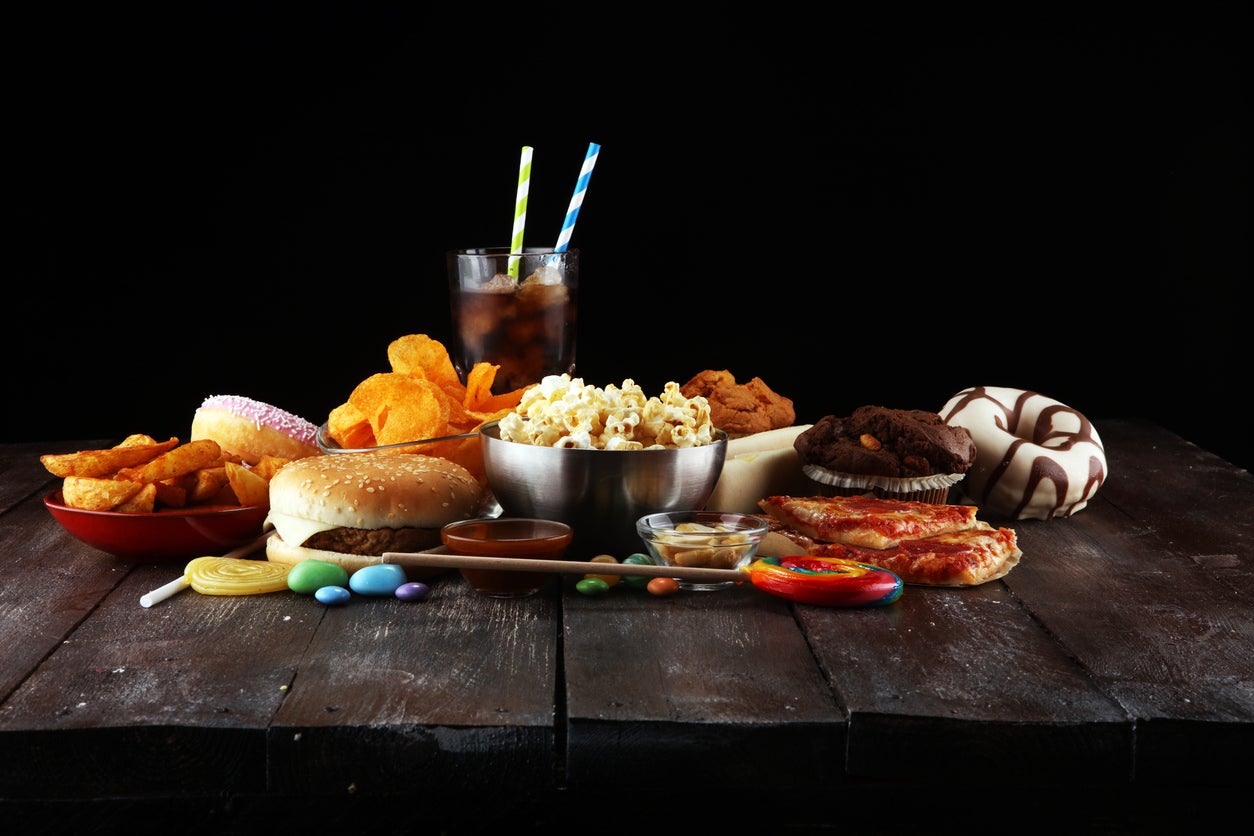 The proliferation of ultra processed foods has seen obesity rates rocket (Getty/iStock)
She stresses that none of this is about blaming or shaming parents. Chronic overeating is a societal problem – a collective fault, rather than an individual failure. The proliferation of cheap ultra-processed food (UPF), products that contain refined sugar and expansion of portion sizes are all huge contributing factors.
“You cannot populate the high streets with UPFs and takeaway shops that we know damage our health, and then go, ‘Well, it’s your own fault because you went and shopped there’,” Eaton adds.
It’s why she’s also scathing of the sugar tax: “We allow the manufacturers to make sugary foods, we allow the retailers to stock those foods. But guess what? If you walk down the high street and make a purchase, I’m going to slap your wrist and tax you. This is madness.”
Are we creating a generation of dopamine-addicted children? Yes, most definitely we are
Alicia Eaton, psychotherapist
On the other side of the food noise coin is the rise of weight loss injections, which act as appetite suppressants; an estimated 1.6 million adults in Britain used such drugs between early 2024 and early 2025, according to a UCL study. While there are myriad health benefits, including dampening food noise, there are concerns that this treatment is already being touted as a solution for children, instead of proactively and preventively tackling the overeating problem at its source.
Liraglutide (Saxenda) and semaglutide (Wegovy) are currently approved in the UK for obese adolescents aged 12 and over to use for weight management. Meanwhile, drugmaker Novo Nordisk has asked US regulators to expand the use of its liraglutide medication for kids as young as six after successful trials.
“I don’t want to see children on medication,” emphasises Eaton. She sees weight loss drugs instead as an opportunity to initiate a reset, change our flawed relationship with food as adults and break the cycle, to “avoid passing on the same problems to the next generation”. It would be a shame, she says, to waste that opportunity; to “continue to stuff our faces with UPFs, and allow our children to grow into obese teenagers and adults – because, ‘well, it doesn’t matter, there’s a weight loss drug that you can use afterwards’. That is not the legacy that we want to be giving our kids.”
So what can parents do to instil better attitudes, behaviours and habits when it comes to eating? And how can they quiet the food noise for their children?
Recognising signals
Differentiating between real and imagined hunger is a key life skill, says Eaton. Interoception is the method by which we perceive internal bodily sensations. “It’s about helping children to understand this internal messaging system so that they can recognise feelings of not only hunger, but also thirst and temperature and whether or not they need to go to the toilet,” says Eaton. “All of that messaging takes time to develop.” So when a child says, ‘I’m hungry’, they may well actually be bored, thirsty, tired or lonely.
Eaton recommends creating a “feelings menu” and sticking it on the fridge to help children to identify internal signals and interpret them correctly.
 Take a seat to eat: Sitting down to dinner as a family encourages conscious eating (Getty/iStock)
Hunger is nothing to fear
Even when hunger has been correctly identified, it’s worth dismantling the idea that we need to eat immediately, argues Eaton. She gives the example of France, which is an outlier – they have managed to stabilise child obesity rates, unlike much of Europe. As well as doing more home cooking and eating more mindfully, “they take the view that you welcome hunger pangs, because if you’re feeling hungry, that’s a message telling you that you’re going to enjoy lunch later,” says Eaton. “It’s not something to be feared.”
In the UK, a usual response to hunger is to immediately grab a snack. “Why not wait?” asks Eaton. “Quite often, the hunger pangs go away if you just wait 10 minutes.”
Mind your language
Children are like sponges; they mop up every word that’s being said about food. Even if kids are sitting in the room next door and you’re whispering, “they have amazing hearing,” says Eaton. “And if they hear us rewarding ourselves with food – ‘I’ve had a really stressful day, I deserve to have a cupcake’ – they’re learning that food compensates for bad feelings.”
On the flip side, describing a child as being a fussy eater can become a self-fulfilling prophecy. “A lot of parents bring anxiety to the meal, and will say things like ‘my kid never eats vegetables’. If your child is listening to that, they live out their labels.”
Make mealtimes an event
One of Eaton’s biggest recommendations is to eat consciously and mindfully. That means not gobbling dinner on the go in the back of the car or in front of the telly.
Children are like sponges; they mop up every word that’s being said about food
“Sit around the table and eat together,” she instructs. “I really recommend trying to make it an event: you could have a candle on the table; you could have some music playing. It means you’ve satisfied all of your senses: as well as tasting, you’re seeing something, you’re hearing it, you’re smelling it. This is an all-round sensory hit, and that’s going to help limit your craving for more hits with food.”
From packet to plate
“Why are we teaching our children to eat out of packets?” Eaton asks. “We’ve got to introduce conscious eating, which includes opening up a packet of crisps and putting them on a plate.”
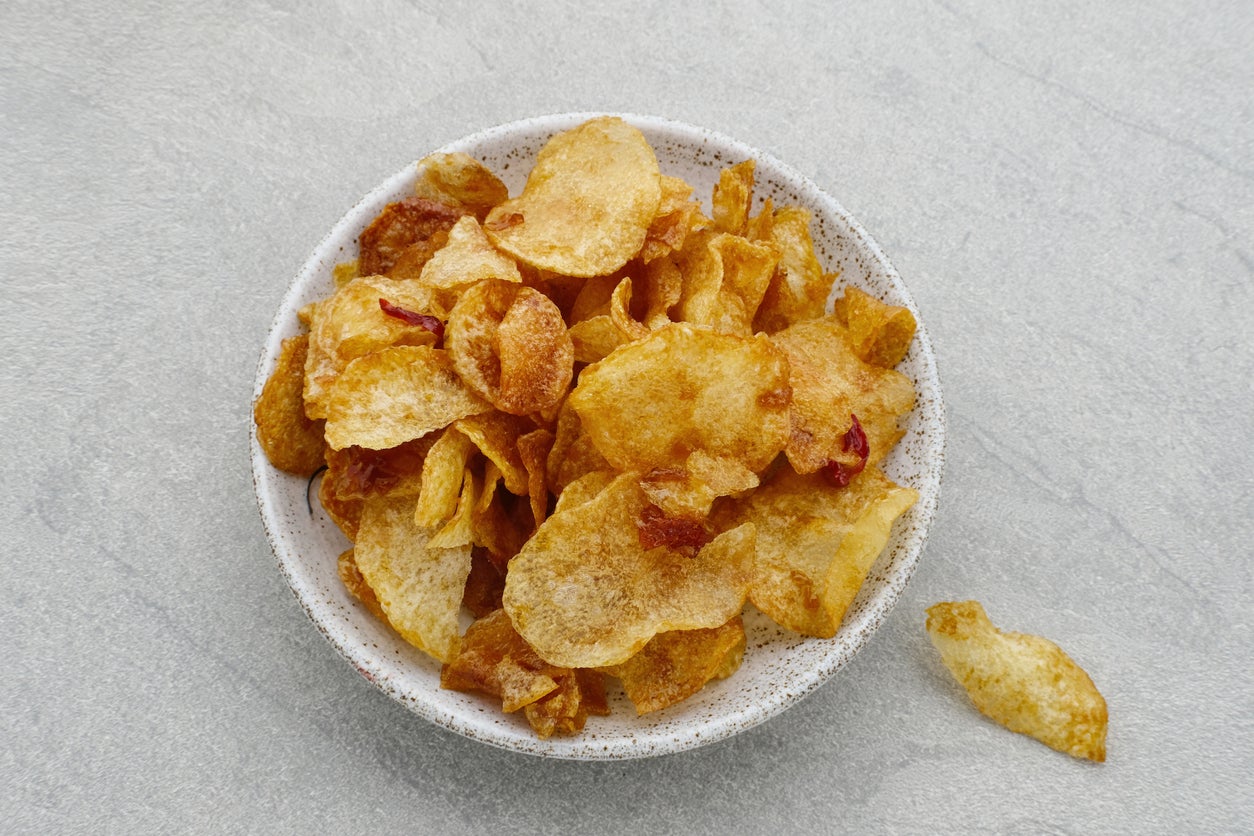 Packet in: Even transferring crisps from a bag to a bowl can help shift the experience of eating (Getty/iStock)
The packet itself is designed to be appealing – research has even been done on the most attractive colours. This can confuse our senses, explains Eaton: “Are we eating because we’re hungry or because we like the sound of the packet, the shiny foil, the cartoon character on the side?”
Relax about the menu
As a behaviour change expert, Eaton believes fostering good habits, such as mindfully eating smaller portions, is paramount – and much more important than forcing children to eat certain foods.
“The habits that become imprinted on your subconscious mind as a child become much harder to erase and change later on,” she explains. “We can always change the menu later, but habits and behaviours will help a lot more than trying to talk about food.”
As Eaton puts it: “Rather than correcting things as an adult, let’s teach our children the good habits in the first place – because, if you’re not careful, someone else is going to come along and hijack your child’s appetite and ruin it for life.”



![[National Cancer Center]](https://www.vitaminrush.com/wp-content/uploads/2026/04/1775630735_news-p.v1.20260408.3a934993e5d245aaa6944c90f88b1a24_P1.png "The National Cancer Center announced on the 8th that it will expand its nutrition support program “C..")