As Los Angeles braces for a hotter summer and tree canopy gaps widen across the city, Origins is rethinking its sustainability approach.
On Wednesday, the brand announced a new partnership with the Arbor Day Foundation focused on urban tree planting, student programs and local climate projects. Since 2009, Origins has helped plant more than 2.5 million trees globally, but the new initiative expands beyond reforestation to include local infrastructure and education.
Sustainability has become harder for beauty brands to talk about in the U.S. In 2025, Reuters reported that political backlash against ESG policies, including legal challenges and restrictions on how companies communicate sustainability efforts, pushed companies to scale back public commitments while continuing to invest more cautiously. This week, Reuters reported that cosmetics companies are facing higher costs and softer demand, with sustainability now competing more directly with price and product performance in consumer decision-making.
This is changing how brands approach sustainability, with some moving away from broad, global messaging toward more targeted, visible initiatives.
For Origins, that change is taking shape at the community level. “We’ve always been about caring for people and the planet,” said Francesca Damato, vp of global marketing at Origins. “Now, we’re trying to bring those two things closer together in a way that people can actually experience in their own communities.” The company declined to disclose the financial investment behind the initiative.
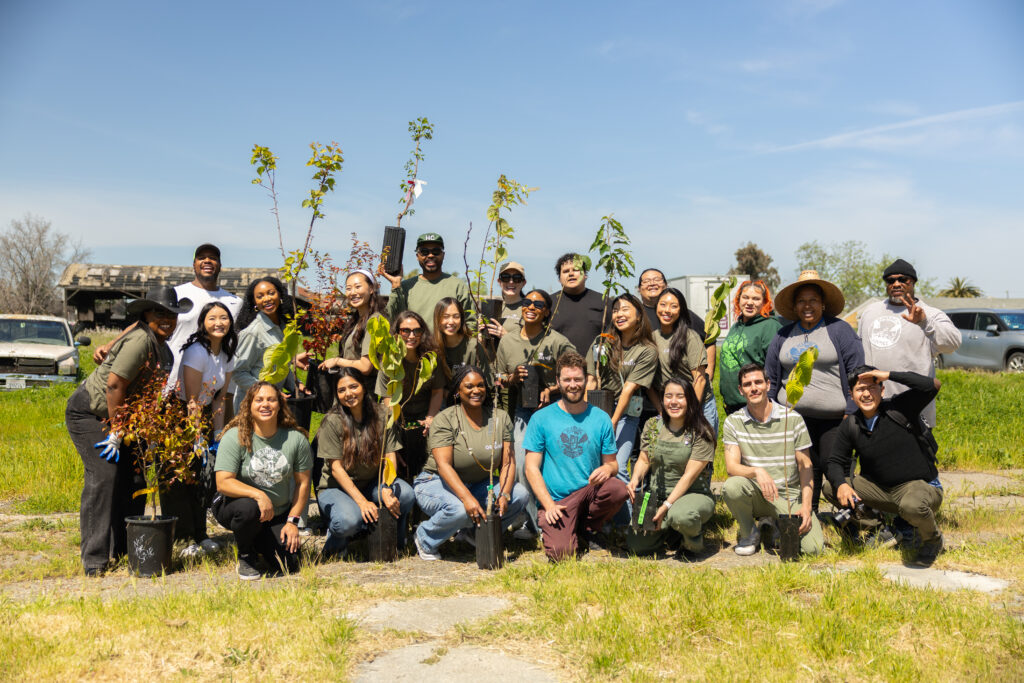
The partnership will launch later this month in Los Angeles. Origins will plant around 20 trees at the project site and distribute 200 fruit-bearing trees to local residents in a neighborhood identified for low tree canopy coverage and high climate vulnerability. Low tree canopy coverage is a public health issue, with hotter neighborhoods facing a higher risk of heat-related illness. And urban tree coverage is estimated to prevent hundreds of heat-related deaths each year in the U.S., according to the U.S. Forest Service. While relatively small in scale, Origin’s project targets neighborhoods with some of the lowest canopy coverage and highest heat exposure. Nearly 90% of residents in urban Los Angeles County live in neighborhoods with less than 10% tree canopy coverage.
About 59% of residents in these areas experience at least eight degrees of additional heat, with temperatures exceeding 100 degrees Fahrenheit during 2025 heat waves, according to the National Weather Service. “There are communities that simply don’t have access to greenery,” Damato said.
“In a changing world, we need business leaders who are bold enough to meet the moment,” said Dan Morrow, vp of partnerships at the Arbor Day Foundation.
The partnership also includes a pipeline component, with five students receiving mentorship, stipends and access to sustainability-focused conferences, alongside funding for Tree Campus initiatives at select universities. “We’re investing in the people who are going to define what sustainability looks like going forward,” Damato said.
“There isn’t one perfect solution [for the beauty industry to make an impact around sustainability],” she added, pointing to the complexity of navigating sustainability across U.S. markets with different packaging, recycling and claims regulations. “You look at materials, recyclability and regulations, and it’s incredibly complex.”
Using tools like the Tree Equity Index, the Arbor Day Foundation will identify where investment is most needed and track outcomes over time, from temperature reduction to air quality improvements.
“The intention is not just to plant and walk away,” Damato said. “It’s about making sure there’s accountability and that the impact is actually sustained over time.”
The initiative comes as Origin’s parent company, The Estée Lauder Companies, continues to navigate slower demand across the prestige beauty sector.
While Origins is focusing on local climate infrastructure, other brands are targeting different parts of the sustainability equation.
For Earth Month, Saie partnered with Sephora and 11 additional brands on Planet Beautiful, a month-long initiative funding the recovery of more than 1 million pounds of plastic waste across India, Indonesia, Colombia and Kenya, with a plastic recovery hub in Kenya and product-linked funding tied to waste removal.
The approach reflects a broader shift in how brands are allocating sustainability efforts and prioritizing initiatives that are easier to measure, communicate and localize.
The scale of the issue remains significant, since the beauty sector produces an estimated 120 billion units of packaging annually. And yet only 9% is recycled, according to data shared by Saie and its partners.
Regulatory pressure is also building around packaging in the U.S., where states including California, Oregon and Colorado are rolling out extended producer responsibility laws requiring brands to fund the collection and recycling of their packaging, with implementation accelerating through 2026. California’s SB 54 sets targets for reducing plastic and increasing recyclability, pushing beauty companies to rethink materials and volume, while regulators are also tightening scrutiny around environmental claims.
Origins has also addressed packaging. In 2024, the brand introduced packaging that uses 35% less plastic, equivalent to more than 2 million plastic water bottles, while incorporating post-consumer recycled materials.